49 works in this view — arrow keys or swipe to move between them.
Dance in Art
La danse des chiens
Unknown artist
- Collection:
- Prints depicting dance
- Source:
- New York Public Library
- Rights:
- Public domain — free to use, share and adapt.
- Recorded as:
- Public Domain
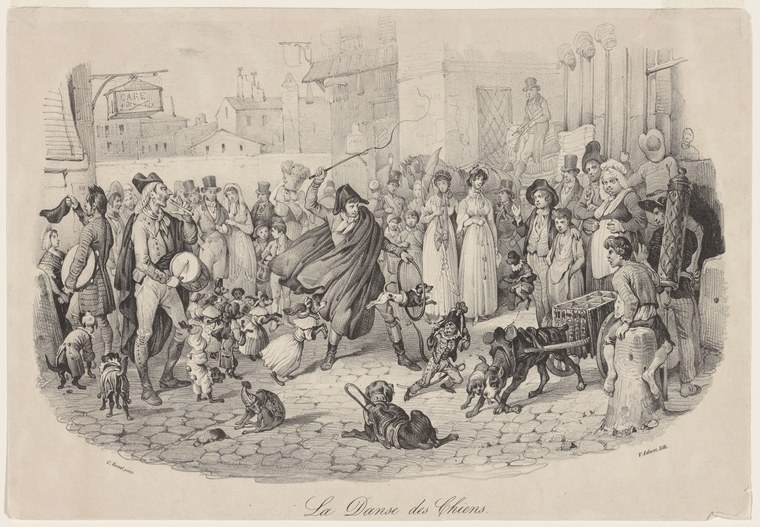
This print documents the 19th-century culture of animal spectacle and public entertainment in ways that expand how we think about dance beyond human bodies. It shows how the category of "dance" itself was understood by contemporary artists as potentially inclusive of animal movement, and it reveals attitudes toward performance, control of bodies, and public pleasure that illuminate the social world in which formal dance was practiced.
What you are looking at
A crowded street or plaza scene rendered in pen and ink, densely populated with figures in what appears to be 19th-century dress. In the foreground, dogs dominate the composition—several are prominently featured in playful, energetic poses, some appearing to leap or dance. Human figures surround them in various attitudes of observation and participation, their clothing suggesting Parisian bourgeoisie or working-class crowds of the era. The architecture in the background shows buildings with period detail. The whole scene conveys movement and carnival-like energy, with the dogs as the animating force of the composition. The title *La Danse des Chiens* (The Dance of the Dogs) makes clear that the artist intends these animals' movements as the visual center, treated as a form of performance or spectacle rather than incidental detail.
The dancing
The human figures are arrayed in loose, informal groupings—standing, gesturing, leaning in to watch. None display the controlled posture of trained dancers; their bodies respond to what the dogs are doing. The dogs themselves are drawn in exaggerated, almost caricatured movement: hind legs lifted, front legs extended, bodies twisted in impossible-seeming contortions. The dogs read as the true performers here, while the crowd functions as audience. This is anthropomorphic satire rather than observation of actual animal behavior.
The dance depicted
This is not a representation of human dance, but rather a visual joke or satirical commentary using the conceit of dog movement as if it were choreographed performance. The work parodies both the pretensions of trained animal spectacles (which were popular entertainment in 19th-century European cities) and perhaps the aesthetics of theatrical dance itself. No actual dance form is depicted; instead, the image treats animal play as a social spectacle worthy of the compositional and narrative density usually reserved for human theatrical scenes. This speaks to a tradition of Romantic-era satire that found comedy and critique in bestial inversions of human culture.
How it was made
This is an engraving or possibly an etching, identifiable by the characteristic line work, cross-hatching for tone, and the formal presentation as a finished print. The technique allows dense detail across a crowded composition and was well-suited to satirical narrative imagery intended for multiple impressions and wide circulation. The style and execution suggest professional publication, likely from a French illustrated periodical or print series of the 1830s–1850s. The signature visible in the lower right corner indicates the artist's authorship but is not clearly legible in reproduction.
About this work
This engraved print depicts a carnivalesque street scene centered not on human dancers but on performing or playfully contorting dogs, surrounded by a dense crowd of 19th-century Parisian onlookers. The title frames animal movement explicitly as "dance," inviting comparison between animal play and human theatrical practice. The work belongs to a tradition of satirical printmaking that used animals as vehicles for social commentary—here, perhaps mocking both the earnestness of trained-animal shows and the elevated pretension of dance as high art. The image survives as evidence of how 19th-century visual culture understood dance not only as a human discipline but as a concept flexible enough to encompass animal movement and popular entertainment.
How to look at it
Attend first to the dogs in the foreground and middle distance: the artist has drawn them in exaggerated, almost acrobatic postures—hindquarters raised, bodies twisted, limbs splayed—designed to read as "dancerly" or theatrical despite their animal nature. Notice how the human crowd's postures echo the energy of the animals rather than containing or framing it; the audience is nearly as animated as the performers. The composition is typically Romantic in its embrace of disorder and crowded incident rather than classical balance. The print's density—the sheer number of figures—conveys the public and social nature of street entertainment rather than the controlled geometry of a ballroom or stage.
The period
The image dates stylistically to the first half of the 19th century, an era in which trained-animal acts were genuine popular attractions in European cities, often featured in street performance, traveling shows, and early circus. Simultaneously, this was the period of Romantic ballet's ascendancy—works like *La Sylphide* (1832) and *Giselle* (1841) were establishing new aesthetic standards for human dance. Satirical printmaking, particularly in France, thrived on the juxtaposition of animal and human behavior as a commentary on social pretension. The work reflects the visual culture of the *physiologies* and caricature serials that dominated Parisian popular print in the 1830s–1840s.
Where it lives
Held in the New York Public Library's collection of prints depicting dance. This is catalogued as a historical print artifact documenting popular entertainment and visual culture rather than as a commissioned artwork or museum piece. The work survives as a document of 19th-century street life and satirical art practice.
Questions about this work
What are the dogs actually doing in this image?
The dogs are drawn in exaggerated, contorted poses—jumping, twisting, and playing—that the artist has stylized to resemble dance movements. The artist is not depicting real animal behavior but rather using dog movement as a satirical stand-in for human dance and theatrical performance. The joke lies in treating animal play with the compositional seriousness and narrative density usually reserved for human dancers.
Is this a real event or a fantasy?
This is almost certainly a satirical fantasy or commentary rather than a depiction of an actual street occurrence. However, trained-animal shows and performing animals were genuine attractions in 19th-century urban Europe, so the print's humor depends on readers recognizing this reality. The exaggeration is intentional; the artist is using the conceit of animal performance to make a point about human society.
What period is this from?
The style, technique, and dress suggest the 1830s–1850s, the height of Romantic-era satirical printmaking in Paris. This was an era of prolific caricature and social commentary in illustrated periodicals, when animals in human situations were a recognized vehicle for satire. The image belongs to the same visual culture that produced Honoré Daumier's work.
Why is this in a dance gallery?
Because the title explicitly frames animal movement as dance, and the print documents how 19th-century artists understood the concept of dance broadly enough to encompass animal spectacle. It shows that dance was not confined in contemporary imagination to formal theatrical or ballroom practice, and it reveals attitudes toward bodily control, performance, and public entertainment that illuminate the social world in which human dance was practiced.
More dance artwork





