49 works in this view — arrow keys or swipe to move between them.
Dance in Art
Odéon, Theatre Royal, Paris
Unknown artist
- Collection:
- Prints depicting dance
- Source:
- New York Public Library
- Rights:
- Public domain — free to use, share and adapt.
- Recorded as:
- Public Domain
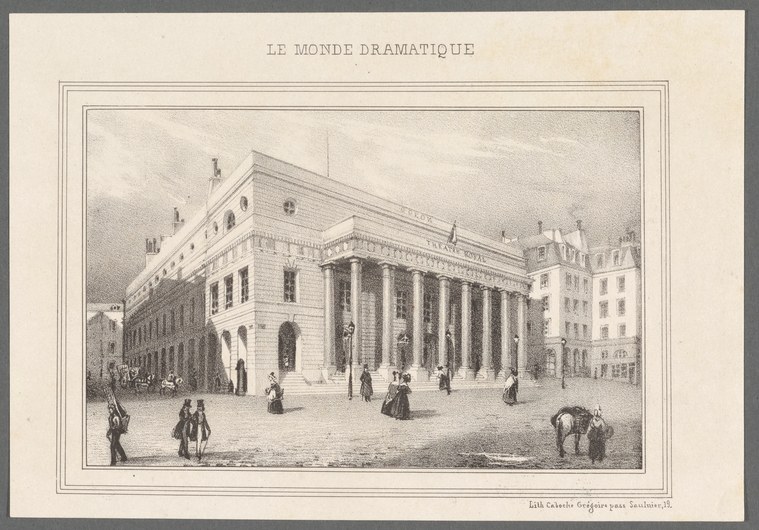
For historians of dance venue and theatrical life, this print is a primary document: it shows one of the major European stages where ballet was performed, and it demonstrates how mid-nineteenth-century visual culture represented theatrical buildings as symbols of civic culture and public gathering. The absence of any dancing figure may be the most historically significant feature: it reveals how architecture and theatre were promoted to the general public—as monuments and civic facts, not as living performance.
What you are looking at
A neoclassical theatre building occupies the centre of this engraved street scene, its columned portico and rusticated facade dominating a Paris square. The theatre's entrance features a row of tall Corinthian columns supporting a heavy entablature, with regular window openings above and a mansard roof with chimneys visible at the roofline. The surrounding buildings are Haussmann-style apartments of five to six storeys. The square itself is populated with figures in mid-nineteenth-century dress: men in top hats and coats, women in full skirts, some seated or standing in conversation, others walking. The composition suggests late afternoon or overcast weather, rendered in tonal engraving. This is the Théâtre de l'Odéon, and the image shows it as a civic monument—a space of public gathering rather than a moment of performance.
The dancing
The human figures are small in proportion to the architecture and serve as staffage—indicators of scale and civic life rather than the focus of study. They stand, walk, and converse in groups of two or three; a few appear to be seated on the pavement. Their dress is consistent with the 1850s–1870s: women in long skirts, men in tailcoats and hats. No dancing posture is evident in any figure visible here.
The dance depicted
This image does not depict dance. It is an architectural and urban record of a celebrated theatre building, not a scene of performance or choreography. The Odéon was indeed a major venue for ballet and theatrical dance in Paris during the nineteenth century, but this print documents the building's exterior and its social function as a public monument, not dance as practised within it.
How it was made
This is a steel or copper engraving, likely hand-tinted or printed in tonal ink. The technique produces fine linear hatching to indicate shadow and volume, characteristic of mid-nineteenth-century architectural and topographical engraving. The signature at lower right reads 'Gab. Cassade del[ineavit] pour [Lemercier?],' indicating the draughtsman and publisher. Engravings of this kind had wide circulation as prints for middle-class collectors and as illustrations in periodicals; this one comes from *Le Monde Dramatique*, a publication devoted to theatrical life.
About this work
This engraving documents the Théâtre de l'Odéon in Paris as an architectural and urban fact, not as a stage for performance. The building was constructed in the 1770s and rebuilt after fire in 1818; by the period of this print (likely 1850s–1870s), it stood as one of the great institutional theatres of France. The image belongs in a gallery about dance in art because the Odéon was a primary venue for ballet and pantomime during the Romantic era and beyond—but this particular work records the theatre as a civic monument rather than as a space in which dance occurred. It is a document of theatrical infrastructure, not of dancing bodies.
How to look at it
Study the relationship between building and figures. The colonnade and stone mass dominate; the human figures are scattered and small, their faces and gestures unresolved. This compositional choice—the subordination of the human to the architectural—tells us that the print is a record of a building, not a social scene. The engraver has included just enough street life to establish context and date, but without interest in movement or interaction. The formal regularity of the façade is the subject; the dancing and pantomime that occurred on its stage are absent from view.
The artist
Gabriel Cassade was a French draughtsman and lithographer active in the mid-nineteenth century. His name appears as *del.* (delineavit: he drew it from nature or a sketch); the engraving was produced and published by Lemercier or a related publisher. Cassade specialised in architectural and topographical subjects. The work is associated with *Le Monde Dramatique*, a Parisian periodical that combined theatrical news, criticism, and illustrated documentation of theatrical life and architecture.
The period
The Théâtre de l'Odéon as rebuilt in 1818 was a site of major innovation in Romantic ballet and pantomime during the 1820s–1850s. The theatre hosted premieres and revivals of works central to the history of Romantic ballet, including *La Sylphide* (1832). By the time this engraving was made, the Odéon was an established landmark of Parisian theatrical culture. The mid-nineteenth century saw a flourishing of theatrical prints, guides, and illustrated periodicals aimed at the educated public; *Le Monde Dramatique* was one vehicle for this culture. Engravings of theatres themselves served a documentary and promotional function, establishing the theatre as a permanent civic institution rather than merely a temporary spectacle.
Where it lives
This engraving is held in the New York Public Library's collection of prints depicting dance. The source attribution to *Le Monde Dramatique* and the Lemercier imprint suggest it was originally published as a periodical illustration in Paris in the mid-nineteenth century, where it would have reached a broad educated audience interested in theatrical affairs.
Questions about this work
Did the Odéon stage important ballet?
Yes. The Théâtre de l'Odéon (originally the Théâtre-Français, later the Théâtre de l'Odéon) was a major venue for Romantic ballet and pantomime in the early nineteenth century. It hosted revivals and new works during the height of Romantic ballet in the 1820s–1850s. This engraving documents the rebuilt theatre (after the fire of 1818) as a civic monument.
Why does this print show no dancers if it's in a collection of dance imagery?
The image is included because it documents a historically significant dance venue, not because it depicts dancing. It is a work about theatrical architecture and urban culture—the infrastructure in which dance occurred. Understanding where and how dance was presented is part of the history of dance itself.
What is Le Monde Dramatique?
A Parisian illustrated periodical of the mid-nineteenth century devoted to theatre, opera, ballet, and related arts. It combined critical reviews, theatrical news, and architectural and social documentation, making it a primary source for the culture of theatrical performance in this period.
More dance artwork





