49 works in this view — arrow keys or swipe to move between them.
Dance in Art
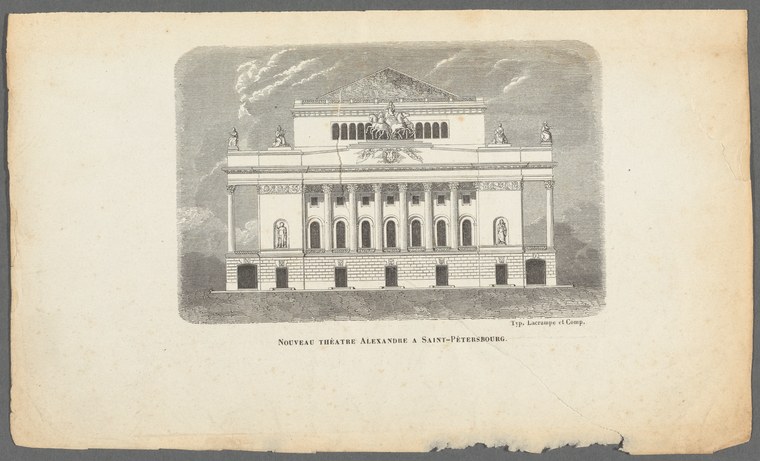
Nouveau Théatre Alexandre a Saint-Petersbourg
Unknown artist
- Collection:
- Prints depicting dance
- Source:
- New York Public Library
- Rights:
- Public domain — free to use, share and adapt.
- Recorded as:
- Public Domain
For historians of Russian ballet and theatre, this image documents a major venue of the Imperial period. For dancers and choreographers, it shows the architectural context and scale of the stages on which 19th-century Russian ballet developed. The building's neoclassical monumentality reflects the cultural status of theatrical dance in Imperial Russia.
What you are looking at
This is an architectural elevation drawing of a neoclassical theatre building, the Nouveau Théâtre Alexandre in Saint Petersburg. The structure is rendered in fine detail using engraving or lithographic technique, showing a symmetrical façade with a rusticated ground floor pierced by arched openings, and a principal storey featuring eight tall arched windows with ornamental surrounds. A prominent entablature runs across the top, with a sculptural pediment at the centre displaying what appears to be an allegorical or commemorative relief. The roof line is marked by a balustrade and further sculptural ornament. The building is shown against a tonal background suggesting a dramatic sky, with small sculptural figures or crests positioned at the corners of the roof. The rendering technique creates a sense of gravitas and monumentality appropriate to a civic institution.
The dancing
This is not a dance scene; it is an architectural representation. No human figures are depicted in motion or engaged in dance. The small sculptural elements visible on the roofline are decorative architectural features, not dancers.
The dance depicted
While this image documents a major theatre that would have hosted dance performances—particularly ballet and opera-ballet, which were central to Russian Imperial court culture—the print itself does not depict dance. It is a building elevation. Dance would have occurred inside this structure, but the artist has chosen to represent the exterior architecture rather than any performance or rehearsal.
How it was made
This is an engraving or lithograph, likely produced in the 19th century for architectural publication or documentation. The technique allows fine detail in the rendering of stonework, fenestration, and sculptural ornament, and the tonal background suggests lithographic work. Such prints circulated widely among architects, theatre patrons, and the educated public, serving both as a record of construction and as a symbol of civic cultural investment.
About this work
This is an architectural elevation of the Nouveau Théâtre Alexandre in Saint Petersburg, a neoclassical building designed to house theatrical performances including opera and ballet. It does not depict dance, but rather the monumental exterior of the institution that enabled dance. It belongs in a dance archive because the building itself is part of dance history—the physical infrastructure that defined Russian Imperial theatrical culture in the 19th century. Understanding the venue is part of understanding the dance that took place within it.
How to look at it
Study the fenestration and scale of the building to understand the depth and sightlines of the stage and auditorium it contained. Note the prominent central pediment and sculptural decoration, which signal the building's civic importance. The symmetry and monumentality of the façade reflect 19th-century ideas about culture as an instrument of state power.
The artist
The artist is not recorded. The print bears a credit line reading "Imp. Lemercier et Cie" (or similar), indicating it was produced by a commercial printing establishment, likely in Paris, which was the centre of lithographic reproduction for architectural subjects during this period.
The period
This drawing dates to the era of Russian Imperial theatre expansion in the 19th century. The neoclassical style reflects earlier 18th-century architectural principles, but the building's construction and this print's circulation belong to a period when ballet—particularly the works of Marius Petipa—was becoming the dominant art form of the Russian stage. The Théâtre Alexandre was a major venue in St. Petersburg's theatrical landscape.
Where it lives
This print is held in the New York Public Library's collection of prints depicting dance. It is catalogued as a dance-related work because the building it represents was a major venue for theatrical dance, though the print itself is an architectural document rather than a representation of dance performance or dancers.
Questions about this work
Is this a picture of people dancing?
No. This is an architectural elevation—a technical drawing showing the exterior of a theatre building. No dancers or performances are depicted. It belongs in dance history because the building housed dance, but the print itself is a record of architecture, not of dance.
What ballets were performed at this theatre?
The catalogue record does not specify which works were staged there. The Nouveau Théâtre Alexandre was one of several Imperial theatres in St. Petersburg during the late 19th century, when Petipa's ballets dominated the repertory. Research into the theatre's history and programme records would be needed to establish the specific ballets performed there.
When was this building constructed?
The print itself is not dated in the catalogue record. The theatre's construction date and the date of this print would need to be established through architectural history research.
Why is an architectural drawing in a dance archive?
Dance does not exist only in bodies and movement; it exists in institutions, venues, and infrastructure. This building shaped the conditions under which dance was made, watched, and transmitted. Understanding the theatre itself is part of understanding 19th-century Russian ballet.
More dance artwork





