49 works in this view — arrow keys or swipe to move between them.
Dance in Art
Caricature
Unknown artist
- Collection:
- Prints depicting dance
- Source:
- New York Public Library
- Rights:
- Public domain — free to use, share and adapt.
- Recorded as:
- Public Domain
The image documents the visual language of mid-19th-century fashionable dance and reveals how theatrical and social dance were blurred in contemporary consciousness. The prominent, unpartnered female dancers and the spectator frame tell us something essential about changing attitudes to women's bodily display and the performance of femininity in this period. As a popular print, it also shows how dance images circulated and were consumed by the non-dancing public.
What you are looking at
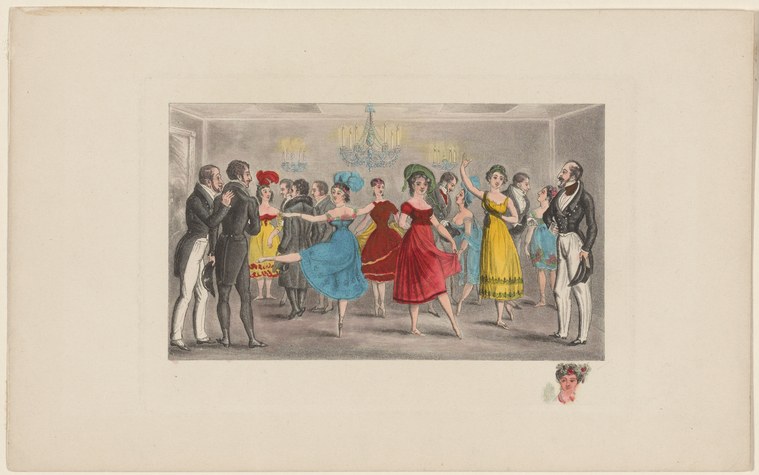
A hand-colored engraving depicts an elegant ballroom scene lit by chandeliers, showing a gathering of fashionably dressed figures arranged in formal groupings. In the center, a woman in a brilliant red dress with yellow trim stands prominently, her body angled in a dance pose; nearby, a woman in a vibrant blue dress appears mid-movement. The remaining guests—men in black tail coats and white breeches, women in yellow, blue, and pale green gowns—are distributed around the room in conversational clusters and at the margins. The composition is shallow and theatrical, with the figures arranged parallel to the picture plane. The hand-coloring is bright and fresh, with careful attention to the distinction between the gentlemen's formal black coats and the women's jewel-toned silk dresses. The scene captures a moment of social performance: some figures gesture animatedly, others observe, and the two central women occupy the visual and choreographic focus.
The dancing
The two principal dancers occupy the center in an open, upright stance with arms raised and bodies engaged in active movement—neither shows the tightly held frame of a partnered ballroom dance, nor are they in closed position with a male partner. The red-dressed woman's posture and extended limbs suggest individual or theatrical display rather than the reciprocal partnering of social dancing. The surrounding figures are static or conversational, creating a clear spectator frame around the action. This composition—prominent female dancers with onlookers arranged peripherally—is typical of theatrical presentation rather than participatory social dance.
The dance depicted
The image most likely depicts a theatrical or performance context rather than a social ballroom dance, though the setting is formally ballroom. The prominent costuming, the unpartnered central figures, and the explicit arrangement of spectators all suggest stage presentation or a demonstration of fashionable dance steps. The date and specific dance form cannot be determined from visual evidence alone, but the bright silks, the absence of male partnering, and the performance framing suggest this may represent fashionable women's exhibition dancing or a theatrical dance scene from the mid-to-late 19th century. The title 'Caricature' implies the image may be satirical commentary on fashionable ballroom culture or the pretensions of theatrical display.
How it was made
This is a hand-colored engraving, identifiable by the fine parallel line-work of the engraved plate and the careful application of transparent watercolor washes over the print. The technique allowed wide circulation and relatively affordable production, making such scenes accessible as popular prints for middle-class homes. The quality of the hand-coloring—precise but not mechanical—suggests commercial production by a print shop, probably mid-19th century. The engraving's clarity and the restraint of the coloring palette indicate a professionally produced work intended for a broad audience rather than a unique artwork.
About this work
This is a hand-colored engraving of a ballroom scene centered on two prominent female dancers surrounded by formally dressed spectators. The work captures a moment of fashionable social performance, likely from the mid-19th century, though the specific date, artist, and intended subject remain unrecorded. The composition—with its theatrical framing, bright silks, and focus on unpartnered female display—suggests either a stage performance or a satirical commentary on contemporary ballroom pretension. The work belongs in a dance history collection as evidence of how dance was represented, consumed, and satirized in popular visual culture, and what fashionable dance display looked like to a middle-class audience.
How to look at it
Attend to the positioning of the two central women: they occupy the visual and spatial apex of the composition, yet they are isolated—no male partners, no reciprocal contact, no closed hold. This is not the mutuality of a waltz or quadrille as typically danced. Note instead how the surrounding figures create a frame of spectatorship, and how the women's body language reads as display or performance rather than social participation. The title 'Caricature' invites skepticism: consider what the artist may be mocking in the exaggeration of pose, color, and theatrical arrangement.
The period
This engraving likely dates to the 1840s–1870s, a period of intense interest in ballroom dancing as both social practice and theatrical spectacle. Romantic ballet was at its height, and the idealization of the female body in motion—visible here in the elevated positioning and elaborate dress—reflected broader cultural fascination with ethereal, unattainable femininity. At the same time, mid-19th-century satirical prints often mocked fashionable society's pretensions, and the title 'Caricature' suggests this work may belong to a tradition of social commentary through exaggerated or ridiculous representation of ballroom manners.
Where it lives
The work is held in the New York Public Library's 'Prints depicting dance' collection, which documents dance as subject matter in the visual record rather than as a focused historical archive. The presence of the work in this collection confirms that librarians recognized it as dance-relevant, though without further documentation, the collecting context and earlier provenance remain unknown.
Dance in this work
Questions about this work
What dance are they doing?
The image does not show a specific identifiable ballroom dance. The composition is theatrical rather than documentary—the unpartnered women and spectator arrangement suggest staged performance or satirical commentary on fashionable dance display rather than a record of actual social or technical dancing.
Is this a ballroom scene or a theater scene?
The setting is formally a ballroom (chandeliers, mirrors, polished floor), but the composition—the isolated female figures, the spectator frame, the title 'Caricature'—suggests theatrical presentation or satirical exaggeration rather than a straightforward record of social dancing. It may depict a performance happening in a ballroom, or may be mocking ballroom pretensions.
When was this made?
The catalogue record gives the date as unknown. Visual evidence suggests mid-19th century (c. 1840–1870) based on the style of dress, the technique of hand-colored engraving, and the aesthetic conventions visible in the composition. Without further documentation, a precise date cannot be established.
Why is it called a 'Caricature'?
The title suggests the work is satirical or exaggerated commentary on fashionable ballroom culture. The prominent, theatrical posturing of the central women, the bright colors, and the conspicuous arrangement of spectators may all be meant as ridicule of contemporary ballroom pretension or of women's fashionable display.
More dance artwork





