49 works in this view — arrow keys or swipe to move between them.
Dance in Art
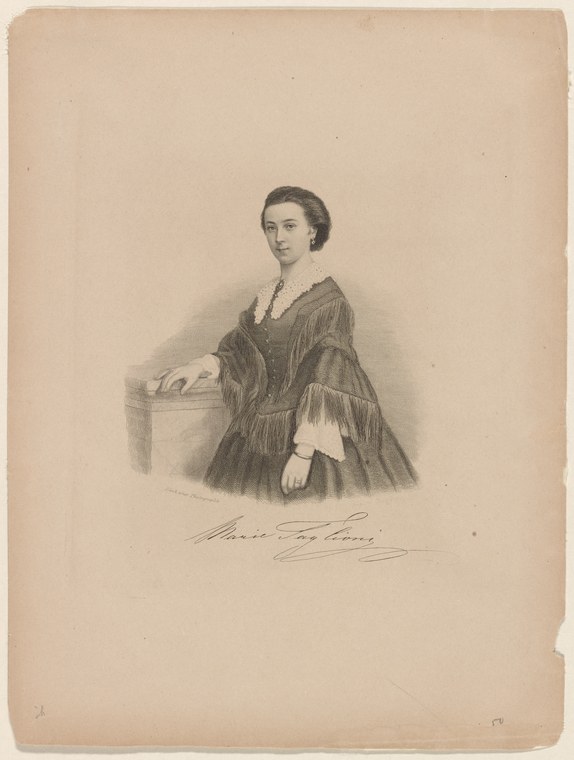
Marie Taglioni: portrait
Unknown artist
- Collection:
- Prints depicting dance
- Source:
- New York Public Library
- Rights:
- Public domain — free to use, share and adapt.
- Recorded as:
- Public Domain
Marie Taglioni transformed ballet and became one of the 19th century's first true international superstars. This portrait is evidence of how her fame transcended the theatre: she was commodified, circulated, and consumed as a visual icon, a marker of Romantic culture itself. For dance historians, such prints are primary documents of how dancers were celebrated, marketed, and fixed in the public imagination.
What you are looking at
A three-quarter-length portrait of a woman in mid-19th-century dress, shown in three-quarter view against a plain beige background. She wears a dark, heavily draped dress with voluminous skirts typical of the 1840s–1850s, with a white chemisette or collar at the neckline. Her posture is upright and dignified, her gaze directed away from the viewer. Her right arm rests naturally at her side while her left hand appears to rest on or near a small table or ledge at the left edge of the composition. Her dark hair is parted and styled close to the head in the fashion of the period. The work is rendered in fine black line with careful tonal modeling, creating a softly lit, almost ethereal quality. The signature beneath reads "Marie Taglioni" in flowing script.
The dancing
The sitter's body is held in a posture of classical repose rather than active movement—shoulders back, spine straight, weight evenly distributed. There is no dance hold, no lifted extension, no pointed foot or balletic frame visible. The figure is stationary and contemplative, presented as a portrait subject rather than as a performer in motion. The hand positions suggest rest rather than preparation for movement.
The dance depicted
This is a portrait of the dancer, not a depiction of dance itself. Marie Taglioni (1804–1884) was the most celebrated ballerina of the Romantic era and a defining figure in the history of ballet. She revolutionized the art through her weightless, ethereal technique and her iconic roles in works like La Sylphide (1832). However, this image shows her in civilian dress, removed from performance context. It documents her as a public figure and cultural celebrity rather than capturing her in the act of dancing. The work belongs to the visual culture surrounding ballet rather than to dance documentation.
How it was made
This is a lithograph or engraving—a reproductive print rather than an original drawing. The technique allows for fine linear detail and tonal gradation through careful line work and subtle shading. The even texture and precision of the line, along with the signature script, suggest a commercial reproductive print, likely made for circulation among the public as a portrait of a celebrated performer. Such prints were standard vehicles for disseminating images of famous dancers to theatregoers and collectors during the 19th century.
About this work
This is a celebrity portrait of Marie Taglioni, the legendary Romantic-era ballerina, rendered as a refined lithographic or engraved print in mid-19th-century style. Rather than depicting her dancing, it presents her as an elegantly dressed woman of society—a way of honoring her celebrity status and cultural prominence. The work belongs in a dance gallery not because it shows dance but because it documents one of ballet's most historically significant figures at the height of her fame and influence, capturing how she was seen and represented to the public.
How to look at it
This is not an action portrait; it is a study in celebrity presence and dignified repose. The viewer should note the formality of the pose and the care taken to present Taglioni as a gentlewoman rather than as a performer mid-gesture. The period dress and the refined technique of the print—its delicate line work and subtle modeling—reflect the high cultural status accorded to her. The slight turn of her gaze and the thoughtful expression invite the viewer to see her as a subject of contemplation rather than as an object on display.
The artist
The artist is not recorded. The work is a commercial reproductive print—a lithograph or engraving—likely produced by a publishing house or print studio in Paris, London, or another European cultural centre. Such portraits were typically made after drawings or paintings by known artists and distributed as part of a series of celebrity images. The unsigned reproductive print was a standard format for dance imagery in the 19th century.
The period
This portrait dates to the height of the Romantic era in ballet, roughly the 1840s–1850s, when Taglioni's influence was at its peak. She had retired from the stage in 1847, and images like this helped sustain her iconic status after her performing career ended. This was also the era when lithography and commercial engraving had made portraiture of public figures widely available and affordable. Ballet itself was undergoing a profound shift toward the ethereal and supernatural aesthetic that Taglioni embodied—away from the technical spectacle of the earlier Classical period and toward an emphasis on weightlessness, mystery, and emotional expression. Taglioni's image became synonymous with that transformation.
Where it lives
This print is held in the New York Public Library's collection of prints depicting dance. It is an example of the commercial portrait prints that were produced and circulated in large numbers during the 19th century to capitalize on public interest in famous performers.
Questions about this work
Is this a portrait of Taglioni dancing?
No. This is a civilian portrait of Taglioni as a public figure and celebrity, not a depiction of her performing. She is shown in everyday dress in a pose of repose, not in costume or in movement. Such portraits were distinct from prints that documented specific roles or performances.
Why is there no dance in a portrait of a dancer?
By the mid-19th century, famous dancers had become cultural celebrities beyond the theatre. Portraits of them were produced and collected as images of prominent public figures, similar to portraits of actors, singers, or aristocrats. This image is evidence of Taglioni's fame and cultural status.
What technique was used to make this print?
The work is a lithograph or engraving—a reproductive print made through a commercial printing process. This technique allowed the image to be reproduced multiple times and distributed widely, making Taglioni's portrait accessible to a broad audience.
When was this made?
The date is unknown, but the style of dress, the fashion of Taglioni's celebrity, and the printing technique suggest it was made in the 1840s–1850s, possibly later in her life or after her retirement from the stage in 1847.
More dance artwork





