49 works in this view — arrow keys or swipe to move between them.
Dance in Art
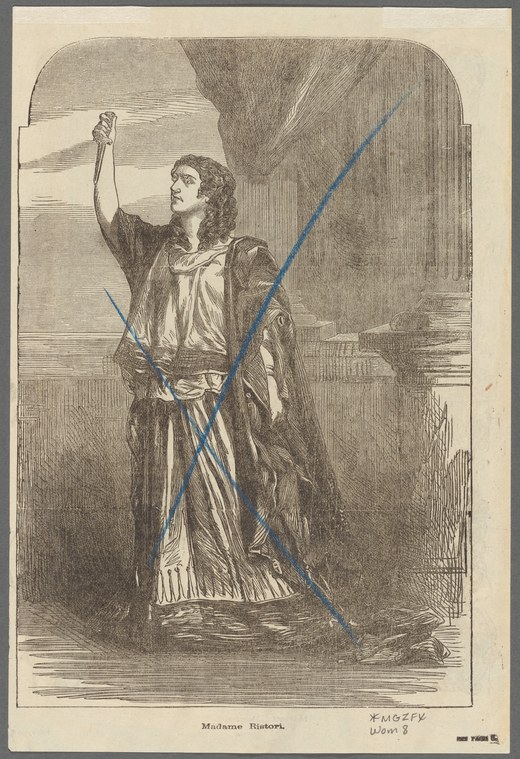
Marietta Bonfanti [on the verso: Madame Ristori]
Unknown artist
- Collection:
- Prints depicting dance
- Source:
- New York Public Library
- Rights:
- Public domain — free to use, share and adapt.
- Recorded as:
- Public Domain
This image captures the 19th-century theatrical world in which major ballet performers like Bonfanti were equally at home in dramatic spectacle and concert dance — a time before rigid genre boundaries separated 'ballet' from 'theatre.' For historians of performance, it provides visual evidence of how bodies were trained, posed, and presented in high theatrical contexts during the era of Italian opera and melodrama.
What you are looking at
A woman stands alone in an interior space, lit from the left, her body caught in a moment of theatrical gesture. She wears a long, full-skirted dress in classical drapery — a white or pale chemise with a darker overdress or shawl — and her hair is arranged in ringlets. Her right arm is raised high, holding what appears to be a torch or light source aloft; her gaze follows upward to it. The setting is sparse: vertical paneling or pilasters define the rear wall, and the floor is suggested by horizontal hatching. The composition is vertical and intimate, almost a portrait, yet the pose is one of dramatic address — not repose but declaration. The engraving employs fine parallel lines to model form and suggest volume, creating a strong sense of theatrical lighting and shadow.
The dancing
A single figure dominates the composition, standing in a contrapposto stance with the weight appearing to rest on the back leg. The raised right arm extends fully upward in a gesture of supplication or revelation; the left arm hangs at the side or is drawn across the body. The torso is frontal and open, the head tilted back slightly to track the raised hand. The posture suggests neither active locomotion nor the closed frame of social dance, but rather a moment of emotional intensity or address — a gesture native to theatrical performance and classical mime. The figure's bearing conveys weight and solidity rather than the ethereal suspension of ballet technique.
The dance depicted
This is not a dance in the ballroom or social sense, but a record of theatrical or dramatic movement — the kind of classicized gesture that would appear in mid-to-late 19th-century theatrical spectacle, particularly in Italian opera or melodrama. The raised torch, the classical drapery, and the pose suggest a moment of patriotic or romantic declaration, possibly from a historical or mythological drama. The figure's identification as either Marietta Bonfanti or Madame Ristori points to two major Italian performers of the 1860s–1870s: Bonfanti was a celebrated prima ballerina (one of the first to perform Swan Lake in Europe); Ristori was a renowned dramatic actress. The engraving likely documents a moment from a theatrical production rather than concert dance proper, though the distinction was porous in this era.
How it was made
This is a finely executed engraving, produced by the intaglio method — the artist has cut lines into a metal plate using a burin or similar tool, creating furrows that hold ink. The parallel hatching, the precise control of line weight, and the careful modeling of drapery folds are hallmarks of 19th-century reproductive engraving. Such works were created to circulate images of celebrated performers and productions to a broad audience — they appear in illustrated newspapers, theatrical journals, and collected series. The technique allows for fine gradation of tone and a legible image even at small scale, making it ideal for mass reproduction. The care taken here suggests a well-known performer and a work of some commercial value.
About this work
This engraving documents a moment from a theatrical production starring a celebrated Italian performer, likely from the 1860s or 1870s. The woman holds aloft a torch in a pose of classical drama — whether from opera, melodrama, or theatrical spectacle is not certain from the image alone, but the gesture, costume, and setting all mark this as a work of theatrical performance rather than social or concert dance. The print circulated as a commodity, allowing audiences who had not attended the production to own an image of the performance and the celebrated performer who embodied it. It belongs in a dance gallery not because it shows dance technique or social dance practice, but because it documents theatrical movement and gesture at a moment when the boundary between dramatic acting and theatrical dance was rich and contested.
How to look at it
The viewer should attend to the raised arm and the direction of the gaze — they create an axis of attention that pulls the eye upward, staging a moment of revelation or appeal. Notice how the artist has rendered the drapery: it clings to the body in some places (the torso, the upper legs) while billowing in others (the skirt), creating a sense of movement even within the static frame of the engraving. The spare, shadowed setting focuses all attention on the figure and gesture. The artist has chosen not a moment of active dance steps or turns, but a held pose — a tableau that would have been recognizable to audiences of the era as the climactic moment in a scene of emotional or dramatic intensity.
The artist
The artist is unrecorded in the catalogue. The engraving bears a signature or mark in the lower right (difficult to read in reproduction), and the work is clearly the product of a professional engraver's workshop — skilled reproductive engravers of this period typically worked from photographs, sketches, or paintings of famous performers. Such engravings were produced on commission by theatrical management, publishers, or impresarios keen to publicize their stars. The quality of execution suggests a reputable atelier, possibly Roman or Milanese.
The period
This print dates from an era when theatrical spectacle, opera, and emerging forms of theatrical dance were tightly interwoven in European culture, particularly in Italy. The 1860s and 1870s saw Italian opera at its height, with massive productions involving elaborate sets, classical themes, and performers trained in multiple movement vocabularies. Major ballet dancers of the era — including Marietta Bonfanti — regularly appeared in operas and theatrical spectacles, not only in pure ballet. The engraving as a medium was at the peak of its cultural reach: photographic technology was developing but still limited in tonal range and public acceptance, so engravers remained the primary means by which theatrical images reached mass audiences. This work sits at the intersection of theatre history, dance history, and the history of print reproduction.
Where it lives
The print is held in the New York Public Library's collection of prints depicting dance. The catalogue record gives the title as 'Madame Ristori' on the verso, though the recto may have borne a different attribution (to Marietta Bonfanti); the discrepancy is unresolved and documented here.
Questions about this work
Is this a ballet dancer?
Possibly, and possibly not. If the print shows Marietta Bonfanti, she was a ballet dancer; if it shows Madame Ristori, she was a dramatic actress. The gesture and costume suggest theatrical drama rather than ballet technique. It may represent either performer in a theatrical spectacle that combined dramatic acting and movement — a common boundary in 19th-century European theatre.
What is she holding?
A torch or light source — a prop that signals a moment of revelation, triumph, or proclamation within a theatrical narrative. The torch was a common attribute in classical and historical dramatic scenes.
How was this made?
By engraving — cutting fine lines into a metal plate so that they hold ink and transfer an image to paper. This was the dominant method for reproducing images of theatre and performance in the mid-19th century, before photographic reproduction became standard.
More dance artwork





