49 works in this view — arrow keys or swipe to move between them.
Dance in Art
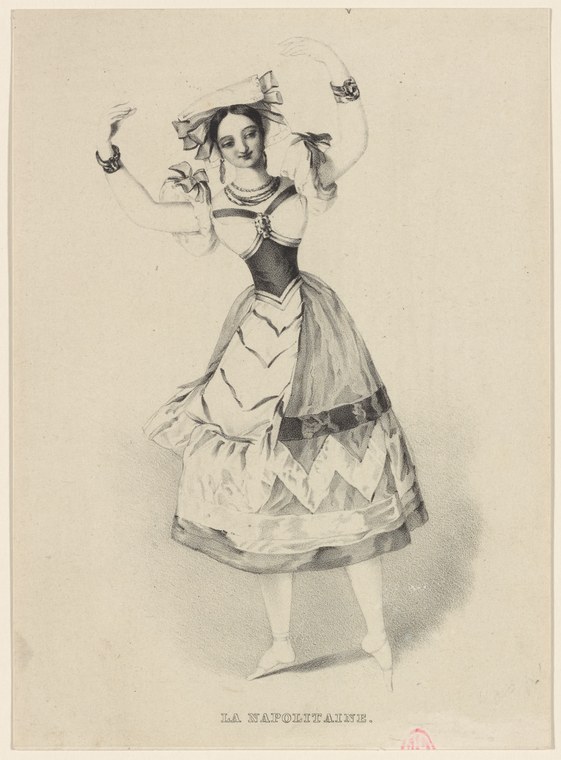
La napolitaine
Unknown artist
- Collection:
- Prints depicting dance
- Source:
- New York Public Library
- Rights:
- Public domain — free to use, share and adapt.
- Recorded as:
- Public Domain
This work documents the aesthetics and execution of character dance in the romantic-era theater, showing how European theaters staged national and folk identities through costume and gesture. For dance historians, it reveals the visual conventions by which 19th-century audiences understood and consumed "national" dance—a category that often bore little resemblance to the dances actually performed in the source culture, but shaped European and American stage practice for generations.
What you are looking at
A single female figure stands against a plain background in a three-quarter pose, gazing toward the viewer with a slight smile. She wears a dark corset or bodice with white lacing and a full skirt composed of white and dark striped or paneled sections, gathered at the waist and falling to mid-calf. The skirt has pronounced volume and a distinctive geometric construction. She wears white stockings and dark shoes. Her arms are raised and bent, with both hands holding what appear to be white handkerchiefs or scarves that float upward around her head and shoulders, creating an airy, playful frame. A decorative bow adorns her dark hair. The rendering is a fine pen or pencil drawing with subtle shading that gives the figure dimensionality and grace, executed in a style consistent with 19th-century theatrical costume documentation.
The dancing
The dancer stands with weight evenly distributed, her body angled gently to show the skirt's construction and volume. Her arms frame the head in a lifted, playful attitude—not the rigid line of classical ballet but an open, welcoming gesture. The raised arms and floating handkerchiefs suggest lightness and movement, though the figure itself is frozen mid-performance. The overall frame is expansive and celebratory rather than formal or contained.
The dance depicted
The title "La napolitaine" (The Neapolitan Woman) and the costume suggest a theatrical dance from the 19th-century stage. The striped skirt construction, the handkerchief-work, and the character-dance framing point toward a European theatrical piece drawing on Neapolitan or Italian folk idiom—likely a solo or principal role from the romantic-era ballet or from vaudeville-style entertainment of the mid-to-late 1800s. The raised arms and arm gesture with handkerchiefs are consistent with character dances that incorporated folk or national elements into the theatrical vocabulary of the period. This does not appear to be a depiction of vernacular Neapolitan dance but rather a stylized theatrical interpretation of Neapolitan character for European stage audiences.
How it was made
This is a lithographic print, recognizable from the subtle tonal gradations, the fine line work, and the characteristic surface quality of a lithographic stone. The medium allowed for relatively economical reproduction of costume designs and theatrical scenes for distribution among performers, theater companies, and the public during the 19th century. Lithography made such images far more accessible and widespread than hand-drawn costume sketches would have been, suggesting this was documentation of a known and performed role, likely from a Parisian or European stage.
About this work
This lithograph documents a woman's theatrical costume and character role from the 19th-century European stage, identified by title as a Neapolitan character dance. The figure is rendered with the grace and attention to costume detail typical of 19th-century theatrical portraiture. The piece belongs to the tradition of character dance—a genre that incorporated folk and national costume elements into balletic or theatrical performance for European audiences seeking exotic or picturesque entertainment. The image captures not the dance itself but the performer and costume that embodied a particular theatrical type.
How to look at it
Observe the construction of the skirt: the geometric paneling and the way it creates volume and movement even in stillness suggests the dancer's actions in performance. The handkerchiefs held aloft are not incidental—they are the tool of the dance, a common prop in character dances that allowed performers to create shape, flow, and visual interest. The lightness of the arms and the upward gesture convey energy and playfulness, the emotional register the choreographer and audience associated with the character type. The artist has frozen a moment of performance that suggests motion, joy, and virtuosity.
The period
The 19th century saw the rise of character dance as a distinct theatrical genre within ballet and popular entertainment. Drawing on folk, national, and exotic themes, character dances offered a contrast to the ethereal formality of romantic ballet. Parisian theaters in particular commissioned and performed such dances, and the rise of lithographic reproduction meant that costume designs, role-types, and famous performers could be mass-produced and circulated, creating a shared visual vocabulary of theatrical character. The Neapolitan type—cheerful, spirited, folksy—became a familiar stock character in European theatrical entertainment.
Where it lives
This lithographic print is held in the New York Public Library's collection of prints depicting dance, suggesting it was circulated as theatrical documentation or souvenir rather than fine-art print. Such images were commonly sold at theaters, kept by performers, and collected by theater enthusiasts during the 19th century.
Dance in this work
Questions about this work
Was this dance actually performed in Naples?
Almost certainly not as depicted here. 'La napolitaine' was a European theatrical interpretation of Neapolitan character—a stylized, romanticized version of southern Italian culture created for Parisian or European stage audiences. The costume, though it draws on Italian elements, is a theatrical fantasy rather than a historical or ethnographic document.
What are the handkerchiefs for?
Handkerchiefs were a common prop in 19th-century character dances, used to create visual patterns, simulate folk gestures, and add movement and airiness to the performance. They allowed the dancer to extend the line of the body and to move the audience's eye around the stage.
Is this a solo or part of a larger work?
The costume documentation and single-figure format suggest this was likely a star role or a solo number within a larger ballet or theatrical entertainment, rather than a corps part. The care with which the costume and figure are rendered implies this was a known, recognizable, and probably popular role.
More dance artwork





