49 works in this view — arrow keys or swipe to move between them.
Dance in Art
The costume of Turkey
Unknown artist
- Collection:
- Prints depicting dance
- Source:
- New York Public Library
- Rights:
- Public domain — free to use, share and adapt.
- Recorded as:
- Public Domain
The presence of this image in a dance collection raises an important question about how dance imagery has been archived and classified historically. It demonstrates how costume documentation—crucial to understanding the material culture of Ottoman performance—can be filed alongside dance images without itself depicting movement, and how European collecting practices grouped visual material by geographic origin rather than by subject matter.
What you are looking at
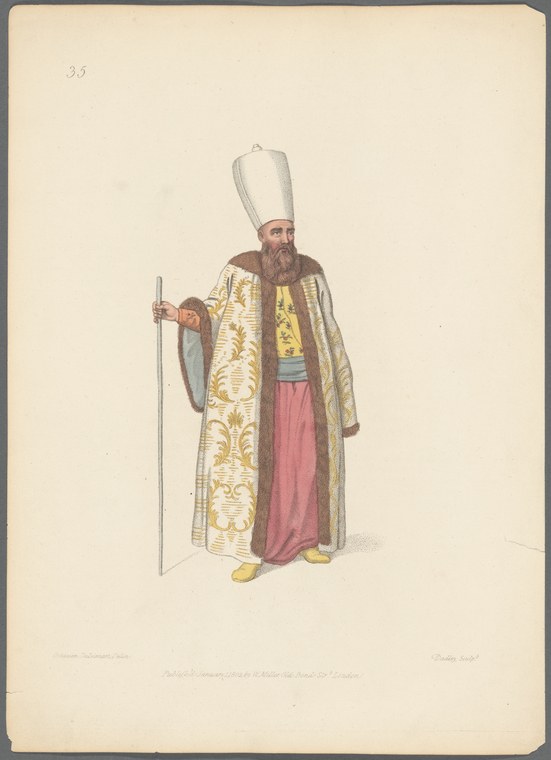
A standing figure in formal Ottoman court dress, depicted in three-quarter view against a plain cream background. The man wears a tall cylindrical headdress (kallpak) in cream or off-white, a long ornately embroidered robe (kaftan) in cream and gold with elaborate floral patterns covering the chest and front, and pink-red trousers extending to yellow pointed slippers. He holds a long staff or ceremonial rod in his left hand, angled across his body. The figure stands in a composed, frontal pose with weight evenly distributed, neither moving nor dancing but presented as a formal portrait of official costume. The coloring is hand-applied, suggesting this is a hand-tinted print.
The dancing
A single male figure stands motionless in formal presentation pose. His posture is upright and static, with no indication of active movement or dance vocabulary—the weight is balanced, the arms hang naturally, and the overall composition reads as a ceremonial or official standing position rather than a frozen moment of dance. This is a figure presented for identification rather than action.
The dance depicted
This image does not depict dance. The figure is posed in formal Ottoman court dress for identification and documentation purposes. The title claims this as Turkish costume, and the dress—kaftan, kallpak, staff—indicates high official or court rank in the Ottoman Empire, likely 18th or 19th century. The static, frontal presentation and ceremonial nature of the pose belong to the tradition of costume documentation rather than dance representation.
How it was made
Hand-colored engraving or aquatint on laid paper. The fine lines and tonal work suggest engraving; the color has been applied by hand in discrete areas—gold for embroidery, pink for trousers, yellow for slippers—in the manner typical of 18th and early 19th-century costume prints. This technique was standard for European circulation of ethnographic and official costume imagery, allowing detailed documentation of dress across cultures while remaining economical to produce in quantity.
About this work
This is a costume documentation print, not a dance image, though it appears in a collection labelled as depicting dance. It presents a figure in formal Ottoman court dress, likely intended as an ethnographic or official reference rather than as a representation of movement or performance. The work belongs to the tradition of European costume books and ethnographic prints that circulated widely in the 18th and 19th centuries, documenting the dress of courts and officials across the Ottoman Empire and Middle East. Such prints served educational, diplomatic, and commercial purposes, establishing visual reference for European audiences unfamiliar with Ottoman formal wear.
How to look at it
Note the precision of the embroidery rendering—the gold thread pattern on the kaftan is rendered with fine parallel lines suggesting actual metalwork or gold-wrapped thread. Observe the formal frontality of the pose, entirely different from the compositional strategies used in contemporary dance prints, where bodies are turned, limbs are active, and drapery catches movement. The staff held by this figure is an emblem of office or rank, not a dance prop. This is documentary dress display, not performance documentation.
The artist
The artist is not recorded. The style and hand-coloring technique are consistent with European costume prints of the late 18th or early 19th century, possibly from a series on Ottoman or Turkish official dress. Such works were often produced by engravers working from drawings or descriptions provided by diplomats, travelers, or collectors returning from the Ottoman Empire.
The period
This print belongs to the era of European fascination with Ottoman court culture, particularly in the late 18th century following increased diplomatic contact. European artists and engravers produced costume books and ethnographic prints documenting Ottoman officials, dancers, and street life, intended for a wealthy European audience. These prints often conflated entertainment, official dress, and daily wear, grouping them under generalized headings like 'Turkish' or 'Eastern' costume. The kallpak and kaftan shown here were marks of Ottoman officialdom, not performance wear, though they appear in both contexts in contemporary visual sources.
Where it lives
The work is held in the New York Public Library's Prints collection under the label 'Prints depicting dance', though it does not depict dance. It is identified in the record only as 'The costume of Turkey', with no attributed artist, date, or medium recorded. The handwritten shelf mark '3.6' visible in the upper left suggests cataloging within a larger series or collection.
Questions about this work
Why is a costume portrait in a dance collection?
This reflects historical cataloging practice in which visual material was often grouped by geographic origin or general cultural association rather than by specific subject. Ottoman costume documentation was filed alongside Ottoman dance prints because both related to Turkey or the Levant, even though this image does not depict movement. Archival reclassification efforts now distinguish between costume documentation and dance representation.
Could this figure be a dancer in court dress?
Possibly, but nothing in the image indicates dance. The pose is entirely static and frontal, the staff is held as an emblem of rank rather than as a prop, and the composition follows the convention of official costume documentation rather than performance or narrative art. Without additional context, the image should be read as what it presents: a figure in formal dress for identification.
What was the kallpak and who wore it?
The kallpak (or similar tall cylindrical hat) was worn by Ottoman officials, janissaries, and courtiers as a mark of rank. It varied in shape and decoration by office and period. The elaborate kaftan and the formal presentation suggest a figure of some authority, though the exact rank cannot be determined from the costume alone.
More dance artwork





