49 works in this view — arrow keys or swipe to move between them.
Dance in Art
The costume of Turkey
Unknown artist
- Collection:
- Prints depicting dance
- Source:
- New York Public Library
- Rights:
- Public domain — free to use, share and adapt.
- Recorded as:
- Public Domain
The work provides visual evidence of how Ottoman dress was perceived and represented for European audiences during a period of intense cultural exchange and colonial imagination. For historians of dress, textiles, and the material culture of the Ottoman Empire, the image is valuable documentation; for dancers and choreographers, it serves as a reference for the silhouettes and adornments of the period, though not for dance technique or practice itself.
What you are looking at
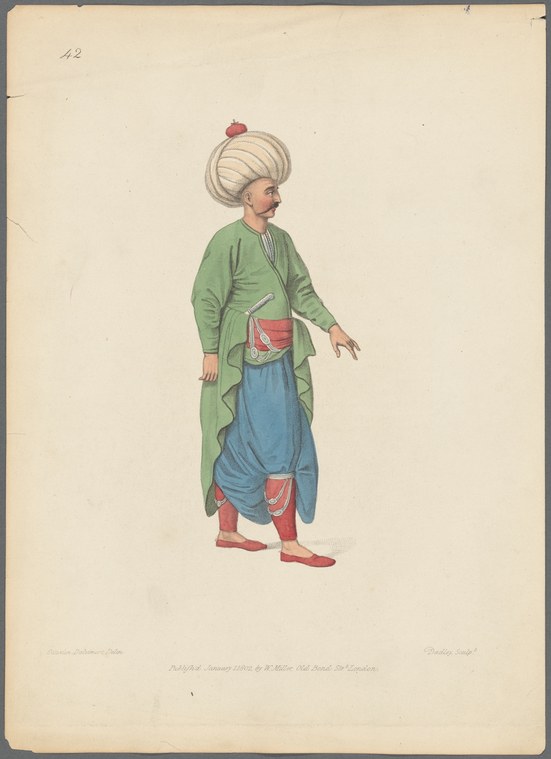
A standing figure in Ottoman dress, shown in three-quarter profile facing left. The figure wears a voluminous pale cream turban with a red jeweled ornament at its crown, a moss-green long-sleeved coat or robe (likely a kaftan) worn open over the torso, and blue full-length trousers gathered at the ankles. A red cloth or sash is wrapped around the waist. Red slippers or soft shoes are visible on the feet. The figure's right arm is extended gently downward and away from the body in a gesture of ease or presentation. The pose is frontal and static rather than captured mid-movement. The background is plain cream, allowing the saturated colors of the costume to dominate. The figure stands upright with weight evenly distributed, suggesting a formal display or presentation of dress rather than the documentation of active motion.
The dancing
A single standing male figure in a relaxed, frontal posture with minimal dynamic engagement. The right arm hangs extended but loosely away from the body; the left arm is not visible, likely at rest against the figure's side. There is no suggestion of weight transfer, turn, or footwork. The head is held upright in profile view. The body shows no evidence of the flexion, extension, or directional impulse that characterizes dance movement. The stance is that of a fashion plate or ethnographic specimen display rather than a performer captured mid-step.
The dance depicted
This appears to be a costume study or fashion illustration rather than a representation of dance. While Turkish and Ottoman cultural dress traditions encompassed rich ceremonial and social dance practices (including court dances and folk forms), this figure is presented in a stationary pose of formal dress display. There is no evidence of movement, spatial intention, or the bodily engagement that would suggest a specific dance is being performed or referenced. The work documents the visual apparatus of Ottoman dress — the silhouette, layering, and adornment — without depicting dance itself.
How it was made
This is a hand-colored engraving or print, likely from the 18th or early 19th century. The linear work defining the figure and drapery suggests engraving; the delicate hand-coloring in discrete blocks of color (cream, green, blue, red) is consistent with period practice for costume albums or ethnographic series. The technique allowed for reproducibility and wide circulation of images documenting foreign dress — a genre that flourished in Europe as Ottoman cultural contact intensified. The precision of the line and the restrained, documentary approach to color suggest this was part of a portfolio or book of costume studies.
About this work
This work is a costume study depicting an Ottoman male figure in formal dress, presented as a standing display rather than as an active dancer. It belongs to the 18th–19th-century European tradition of ethnographic and orientalist costume illustration, in which foreign dress was systematized and circulated through engraved prints. While Ottoman dance traditions are rich and varied, this particular image does not document dance movement or practice; it is an artifact of the visual economy through which European audiences encountered and cataloged "the Orient" as a realm of exotic costume and distant customs.
How to look at it
Attend to the complete stasis of the pose: this is a standing display, not a moment of motion. The extended arm is a gesture of presentation, common in fashion illustration, not an element of choreography. Notice the sophisticated layering of the costume—the open robe over gathered trousers, the wrapped sash, the precise turban—which would have required time and skill to assemble and was unlikely to survive vigorous movement. The hand-coloring is restrained and systematic, prioritizing clarity of the silhouette over naturalistic shading, a choice that reinforces the didactic rather than narrative purpose of the image.
The period
The 18th and 19th centuries saw an explosion of European interest in Ottoman and Eastern dress, driven by travel, trade, and colonial expansion. Costume albums—serially published engraved plates of foreign dress—became fashionable collectibles and ethnographic tools. These were often produced without first-hand observation and relied on earlier prints, travel accounts, and imaginative reconstruction. Turkish dress held particular appeal, associated with luxury, sensuality, and political power. The precise dating of this work is uncertain, but the style of the figure, the engraving technique, and the color palette are consistent with late 18th-century practice. Dance historians should note that while Ottoman court dances (such as certain forms performed in the Topkapi Palace) and folk traditions (including regional circle and couple dances) were active during this period, European costume studies typically documented static dress rather than dynamic bodily practice.
Where it lives
The work is held in the New York Public Library's collection of prints depicting dance, where it was cataloged as a dance image. The bare catalogue record provides no artist attribution, date, or medium specification, suggesting it arrived as part of a larger acquisition or collection without full documentation.
Questions about this work
Is this person actually dancing?
No. The figure is posed in a static, frontal stance typical of fashion plates and costume studies. There is no indication of weight transfer, directional movement, or the dynamic engagement of the body that would characterize dance. The work documents dress, not movement.
What can this tell me about Ottoman dance?
Very little directly. The Ottoman Empire had rich dance traditions—court entertainments, folk circle dances, and ceremonial forms—but this image does not depict any of them. It is useful as a reference for the silhouettes and adornments of the period, but not for understanding how people actually danced.
Why is it in a dance collection?
The image was likely acquired or cataloged as part of a broader collection of prints on dance and cultural subjects, reflecting 19th-century curatorial practices that sometimes conflated costume, ethnography, and dance documentation. It belongs in a costume or fashion history collection more precisely than in one focused on dance practice.
More dance artwork





