49 works in this view — arrow keys or swipe to move between them.
Dance in Art
The costume of Turkey
Unknown artist
- Collection:
- Prints depicting dance
- Source:
- New York Public Library
- Rights:
- Public domain — free to use, share and adapt.
- Recorded as:
- Public Domain
For dance historians, this image documents the actual garments worn in Ottoman dance and performance contexts during the period it was created. The silhouette, the gathered trousers, the soft footwear, and the freedom of the upper body tell us something about how movement was possible and constrained in this tradition. For theater historians, it is evidence of how European productions represented 'Turkey' to their audiences—what visual codes signaled Otherness and exoticism on the stage.
What you are looking at
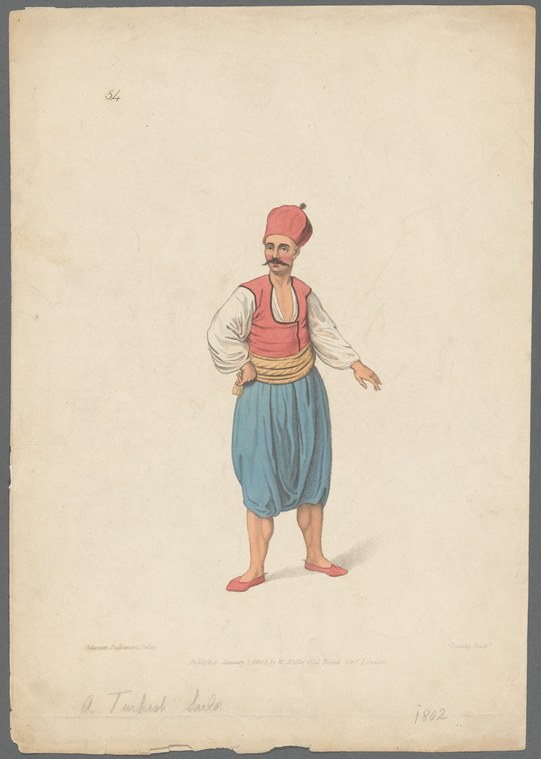
A single male figure stands in a relaxed contrapposto pose against a plain pale background, gazing slightly to the side. He wears the costume of Ottoman Turkey: a tall red cylindrical hat (fez or similar), a white linen shirt with full sleeves, a coral-pink vest or jacket worn open over the shirt, a yellow sash at the waist, and blue gathered trousers that fall to knee-length, paired with red slippers or soft shoes. His right arm is extended at shoulder height in a gesture of openness or balance; his left hangs loosely at his side. The figure is rendered in watercolor or gouache with careful attention to fabric texture and color gradation, particularly in the drapery of the trousers and the delicate rendering of the linen sleeves. This is a costume study rather than an active dance scene—a portrait of dress and bearing rather than movement.
The dancing
The single standing figure employs a classical contrapposto stance with weight distributed evenly, one leg slightly relaxed. The extended right arm is held at approximately shoulder height with the palm open—a gesture of ease or display rather than an active dance position. There is no closed hold, no partner, no footwork visible; the body is calm and presentational. The posture is upright and dignified, the gaze directed outward in the manner of a formal portrait.
The dance depicted
This is not a depiction of active dance but rather a costume study, likely prepared as reference material for theater, opera, or illustrated ethnographic documentation. The Ottoman Turkish dress suggests a figure from a European production—operatic, theatrical, or orientalist in context. The relaxed, presentational pose indicates this was meant to document costume and bearing rather than to capture a specific dance movement. No particular dance style can be identified from the static pose; this is dress rather than choreography.
How it was made
This appears to be a watercolor or gouache on paper, executed with careful attention to color, texture, and proportion. The technique allows for the precise rendering of fabric detail and the subtle gradation of hue visible in the trousers and hat. The pale background and the formal, isolated presentation suggest this is a costume plate or figure study, likely one of a series, prepared for circulation among theater practitioners, set designers, or as part of an ethnographic or theatrical reference collection. The refinement of technique and the archival presentation imply a professional or institutional context.
About this work
This is a costume study of Ottoman Turkish dress, executed as a watercolor figure study without narrative or active movement. It appears to be part of a larger collection documenting dress or theatrical costume types, likely created for reference in European theater or as ethnographic illustration during a period when European artists were systematically recording non-European dress and custom. The work belongs in a dance-in-art collection not because it depicts dance itself, but because it documents the material culture—specifically the dress conventions—within which a particular regional dance tradition would have been performed. Costume is inseparable from dance history; what bodies wore shaped what they could move.
How to look at it
Attend to the precision of the drapery and the implied movement it would allow: the gathered trousers permit freedom of hip and leg movement; the open vest and full sleeves allow arm gestures like the one shown. The color palette—the brightness of the pink vest and yellow sash against the muted blues—suggests how visible such a figure would be on stage in candlelight. The figure's calm, frontal presentation and open gaze are conventions of theatrical costume portraiture, designed to display the garment to the viewer as if for approval or study. This is not a naturalistic moment but a formal display.
The artist
The artist is not recorded. The technical proficiency, the archival context, and the formal presentation suggest either a professional theater designer, a trained illustrator working for a publishing house, or an artist employed in ethnographic documentation. The style and medium are consistent with early-to-mid 19th-century European practice in costume and ethnographic illustration.
The period
This work dates from the era of European orientalism and the theatrical fascination with Ottoman and Turkish subjects that peaked in the 18th and 19th centuries. Operatic and theatrical productions drew heavily on orientalist imagery; artists produced costume studies and reference plates to guide production designers and performers. The careful documentation of non-European dress was also part of a broader 19th-century project of ethnographic illustration and collection. Dance in this period was increasingly documented and codified; what had been living tradition became subject matter for theater, illustration, and study.
Where it lives
Held by the New York Public Library as part of a collection of prints depicting dance. The work is catalogued as a costume study of Turkish dress, date and artist unknown, suggesting it is one of many similar works collected as reference material for historical or theatrical research.
Questions about this work
Is this actually a dance picture?
It is a costume study rather than a depiction of active dance. However, costume and dance are inseparable; what dancers wore determined what they could move. This image documents the material conditions of Ottoman dance and performance practice. It also shows us how European theaters visualized and staged 'Turkey' for their audiences.
What period was this costume worn?
The catalogue record does not provide a date for this work. The style of illustration, the technique, and the European approach to ethnographic documentation suggest the 18th or 19th century. The Ottoman dress itself has a longer history, but this particular rendering and collection context point to the European orientalist period.
Who wore these clothes and when?
This is Ottoman Turkish dress, worn across Ottoman territories by people of various ranks and professions depending on specific garments and materials. The components shown—the fez, the vest, the gathered trousers, the sash—are recognizable markers of Ottoman identity in European theatrical and visual representation. However, this image is a European artistic interpretation, not a documentary record; it shows what a European artist understood Turkish dress to be.
Why is this in a dance collection?
Dance history includes the study of costume, body adornment, and the material conditions that shaped movement. What dancers wore limited and enabled specific kinds of motion. This image is archived as dance material because it documents the dress conventions of a dance tradition, even though it does not show active dancing.
More dance artwork





