49 works in this view — arrow keys or swipe to move between them.
Dance in Art
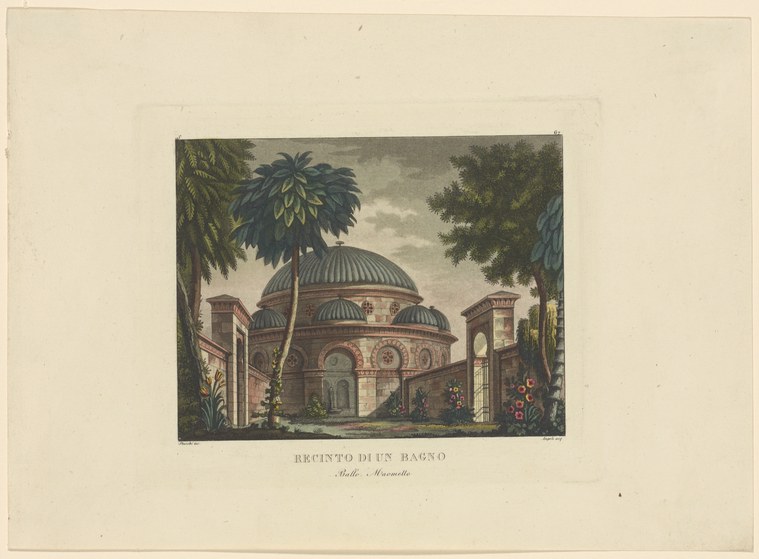
Recinto di un bagno, ballo Maometto
Unknown artist
- Collection:
- Prints depicting dance
- Source:
- New York Public Library
- Rights:
- Public domain — free to use, share and adapt.
- Recorded as:
- Public Domain
This work illuminates the history of orientalism in European visual culture and how dance was enlisted to signal exotic otherness. It shows a moment when Middle Eastern social spaces were being romanticized and theatricalized for Western consumption, with dance positioned as a marker of luxury and difference.
What you are looking at
This hand-colored engraving depicts the interior of a Turkish bathhouse (hammam), presented as an exotic architectural fantasy. The composition centers on a domed structure with three hemispherical domes—a prominent central dome flanked by two smaller ones—rendered in precise linear perspective. The building is constructed of reddish-brown masonry with arched colonnades and Classical architectural details. Luxuriant tropical vegetation frames both sides: tall palm fronds arch overhead, and flowering plants bloom at the base. The sky beyond shows luminous clouds. Within and before the structure, small human figures move through the space; at least two appear to be engaged in dance or rhythmic movement in the foreground and middle distance. The overall effect is of a Picturesque orientalist stage set—an imagined, romanticized version of Islamic architectural and social space designed to intrigue European viewers.
The dancing
The figures are rendered at a small scale relative to the architecture, emphasizing the grandeur of the setting over the specificity of human action. Two or three figures in the foreground appear to be in motion: their postures suggest raised arms and upper-body movement consistent with social or celebratory dance rather than the rigid discipline of European court forms. The figures wear loose, flowing garments that read as Turkish or Arabic in style. Their positioning is informal and scattered rather than arranged in the geometric formations of ballroom or court dance.
The dance depicted
The title identifies this as a ball (dance) in a hammam under the name of Muhammad (Maometto). This appears to be an imaginative European interpretation of Ottoman or North African social practice, likely theatrical or operatic in origin. The dance depicted is not identifiable as any specific Islamic or Middle Eastern dance form—the image reflects European fantasy rather than documented ethnographic observation. The scene conflates bathing culture with entertainment in a way that serves orientalist pictorial convention rather than historical accuracy. Such scenes were popular in 18th-century theatrical design and satirical or fantastical narratives.
How it was made
This is a hand-colored engraving, a mass-produced print medium that allowed wide circulation of images. The fine linear work of the architectural elements is characteristic of copper-plate engraving; the hand coloring—applied in translucent washes of watercolor or similar medium—gives it the quality of a finished artwork while preserving the crisp definition of the engraved line. This combination was typical of high-quality commercial prints intended for collectors and theatre patrons. The technique allowed for architectural precision while the color adds atmosphere and the exotic palette signals the 'foreign' subject to viewers.
About this work
This is a theatrical engraving documenting the visual culture of orientalist stage design in the late 18th or early 19th century. It presents an imagined interior of a Turkish bathhouse with figures engaged in dance, framed by exotic architecture and vegetation. The work belongs in a dance archive because it records how dance—here undefined as a specific form but generically 'Eastern'—was visualized and circulated in European commercial print culture. It shows not actual Ottoman dance practice but the European fantasy of the Orient as a space of sensuality, leisure, and spectacle. The image was likely produced for theatrical patrons, collectors of curiosities, or travelers seeking pre-visit visual preparation.
How to look at it
Note how the architecture dominates the composition: the human figures are tiny, almost incidental to the grandeur of the domes and colonnades. This hierarchy tells you that the appeal of the image is the exotic *place* rather than the specificity of the dance itself. Look at the postures of the two or three dancing figures—their arms raised, their bodies moving—and consider how vague and generic their gestures are compared to the obsessive architectural detail. This gap between precise setting and undefined figures is characteristic of orientalist design: the location is fantastically specific while the people remain stereotypes. The tropical framing suggests this is a fantasy rather than a record.
The period
This engraving belongs to the late 18th- or early 19th-century boom in orientalist imagery in European printmaking and theatre design. Works depicting Turkish, Arabic, and Persian interiors and customs flooded the market following increased travel narratives and theatrical productions set in the Levant and Ottoman territories. Dance, when depicted in such scenes, served as shorthand for sensuality and abandon—a counter-image to European propriety. Stage designers created elaborate architectural fantasies like this one to visualize the plots of operas and comedies set in harems and palaces. The hand-colored engraving was the dominant medium for disseminating such images to a broad educated public.
Where it lives
This print is held in the New York Public Library's collection of prints depicting dance. It is catalogued by title and subject rather than artist attribution, suggesting the maker is unknown or the work circulated anonymously—common for commercial theatrical prints of the period.
Questions about this work
Is this depicting a real Ottoman bathhouse dance?
Almost certainly not. This is a European theatrical or literary fantasy. The image was designed to appeal to Western audiences seeking visual access to the imagined 'Orient.' Real Ottoman hammam culture involved bathing, socializing, and sometimes music and movement, but this engraving presents an architecturally exaggerated, aestheticized, and likely eroticized version shaped by European taste and stage design conventions.
Who would have owned or seen a print like this?
Educated collectors, theatre patrons, and travelers. Hand-colored engravings were expensive enough to be luxury objects, but widely printed enough to reach a substantial audience. Such prints were collected in albums, framed for display, and used as sources of inspiration by stage designers, painters, and writers. They were also dispersed through theatrical circles.
What does this tell us about how dance was understood in this period?
This image shows that European audiences in the 18th–19th centuries understood 'foreign' dance primarily as a visual marker of cultural otherness, luxury, and sensuality rather than as a technical or aesthetic system. The dance is not named, taught, or described in movement terms—it is simply present as an attribute of the exotic location, much like the palm trees and domes.
More dance artwork





