49 works in this view — arrow keys or swipe to move between them.
Dance in Art
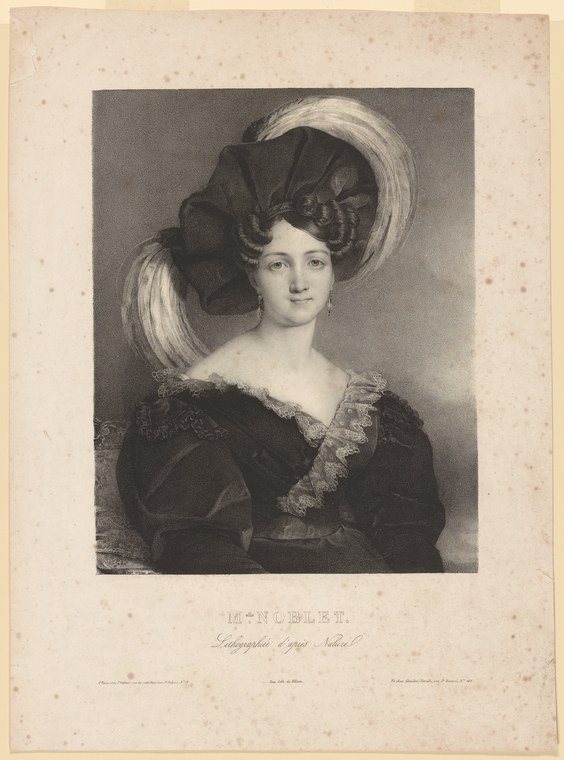
Melle Noblet: lithographie d'après nature
Unknown artist
- Collection:
- Prints depicting dance
- Source:
- New York Public Library
- Rights:
- Public domain — free to use, share and adapt.
- Recorded as:
- Public Domain
The image is historically valuable as evidence of how professional dancers were marketed and perceived in early 19th-century Paris, and of the fashionable silhouette and accessories associated with women of cultural prominence. For dance history, it serves as a record of a named performer from the Romantic ballet era and the kinds of celebrity portraiture through which dancers were known to the public.
What you are looking at
A three-quarter-length portrait of a young woman in early 19th-century dress, shown against a neutral dark background. She wears a high-waisted Empire-silhouette gown of dark velvet with a low neckline and short puffed sleeves edged in white lace or silk trim. Over her shoulders sits a white cashmere shawl or stole. Her most striking feature is an enormous bonnet or headdress of black silk with a dramatic white plume or ostrich feather sweeping upward and back. Her dark hair is arranged in the fashionable ringlets of the period and frames her face. The young woman faces slightly to her left, her expression composed and her gaze directed outward. She appears poised and elegant, the image capturing the height of Restoration or July Monarchy fashion.
The dancing
The figure stands in a relaxed three-quarter pose with one shoulder slightly advanced, creating an informal yet dignified deportment. Her arms are at rest, one draped across her body in the manner typical of portraiture of the period. The pose itself contains no dance-specific movement or hold; she is presented as a fashionable figure for admiration rather than in the act of dancing. Her weight appears evenly distributed, and her posture is upright and correct without the dynamic tension of a dancer in motion.
The dance depicted
This is not a dance scene but rather a fashionable portrait of a stage performer. The title "Melle Noblet" indicates this depicts a professional dancer—likely either Lise Noblet or her sister Anne Noblet of the Paris Opéra—but the image shows her in street or reception dress rather than in costume or performing. The absence of any indication of movement, dance-specific costume, or theatrical setting means the work documents the social standing and fashionable appearance of a named dancer rather than the dance itself. It is a celebrity portrait of the kind that circulated in the early 19th century to promote stage performers.
How it was made
This is a lithograph, a print technology that became the dominant medium for fashionable portraiture in the 1820s and 1830s. Lithography allowed for rapid, relatively inexpensive production and wide circulation compared to hand-painted portraits or engravings. The technique is evident in the soft tonal gradations of the background, the subtle modeling of the face, and the delicate rendering of the lace and feathers. The inscription 'lithographie d'après nature' (lithographed from nature) indicates this was copied from a drawing or perhaps a painting, a common practice that allowed single images to be widely distributed among the theatergoing public.
About this work
This is a fashionable portrait lithograph of a named stage performer from the Paris Opéra of the Restoration period (c. 1820s–1830s). It documents not a choreographic or performance moment but rather the celebrity status and sartorial elegance of a professional dancer in her street dress. The work belongs to a genre of theater promotion and celebrity culture that flourished in the early 19th century, when lithography made possible the mass production of images of famous performers. Such portraits were collected, displayed, and traded as mementos of admired dancers and helped establish their public identities beyond the stage.
How to look at it
Notice the contradiction between the dancer's professional status (signaled by her name and the genre of the work) and the image's complete absence of any theatrical or choreographic content. Observe the extreme scale and ornamentation of the bonnet—a fashion accessory of such exaggerated size that it would be impossible to move dynamically in. The portrait documents not how Melle Noblet moved but how she was seen and desired as a fashionable figure. The soft lithographic technique allows the artist to render the delicate textures of lace, silk, and the feather with great subtlety, emphasizing the luxury and refinement that stage success had made available to her.
The artist
The artist is unknown. The work is a lithograph of the type produced in commercial quantity during the 1820s–1830s in Paris. Such theatrical and celebrity portraits were often executed by print workshops or minor artists and were issued both individually and in series; attribution in many cases was not recorded.
The period
This portrait dates to the Restoration or July Monarchy period (c. 1815–1848), when lithography had recently become the dominant medium for fashionable portraiture and theatrical publicity. Professional dancers, particularly women from the Paris Opéra, had become celebrities of the first rank, especially as Romantic ballet emerged and the repertory shifted toward narratives that showcased the ethereal, supernatural qualities associated with the female dancer. The Noblet sisters were prominent figures in this transition, and their images were widely circulated. Fashion itself was in rapid flux: the high-waisted Empire silhouette was giving way to the corseted, bell-skirted silhouettes of the 1830s, and the enormous bonnets and feathers shown here were the height of fashionable excess.
Where it lives
The work is held in the New York Public Library's print collection devoted to dance imagery. It is catalogued as a lithograph but without recorded date or artist. Such theatrical portraits were typically sold individually or in sets through print shops, making them accessible to a broad theatergoing public.
Questions about this work
Who was Melle Noblet?
The Noblet sisters—Lise and Anne—were prominent Paris Opéra dancers of the 1820s–1830s, the era when Romantic ballet was emerging. They were celebrated performers in classical and theatrical works of the period. Professional dancers of their rank were major celebrities, and their likenesses were widely circulated as lithographs.
Why doesn't she appear to be dancing?
This is a celebrity portrait, not a performance or choreographic study. It documents how Melle Noblet presented herself to the public in fashionable dress. Such images celebrated a dancer's status and elegance rather than capturing the dancer in motion on stage.
What is that enormous headdress?
It is a fashionable bonnet of the 1820s–1830s, decorated with an ostrich plume or feather. Such accessories, often called 'poke bonnets,' were extremely large and were status symbols of fashionable dress among women of the upper classes and successful performers. They were impractical for movement but were essential to fashionable dress of the period.
How was this image distributed?
As a lithograph, this work could be printed in quantity and sold individually or in series through print sellers and at theaters. Theatergoers could purchase portraits of their favorite performers, making such images a form of early celebrity memorabilia and an important revenue stream for both theaters and dancers.
More dance artwork





