49 works in this view — arrow keys or swipe to move between them.
Dance in Art
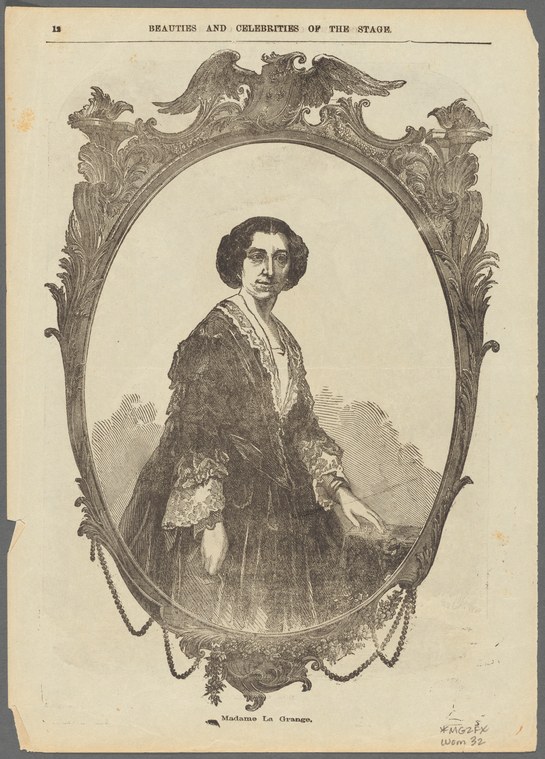
Rita Sangalli; Beauties and celebrities of the stage [on the verso: Madame La Grange]
Unknown artist
- Collection:
- Prints depicting dance
- Source:
- New York Public Library
- Rights:
- Public domain — free to use, share and adapt.
- Recorded as:
- Public Domain
This print belongs to a genre that shaped how dancers were publicly known and celebrated. It reveals the conventions by which female theatrical performers presented themselves—the costume choices, the composed stillness, the direct gaze—and the woodcut or engraving technique guaranteed wide circulation among theatre-goers and collectors. For historians of dance iconography, it documents the visual culture surrounding professional dance performance in the period when ballet and theatrical dance were central to urban entertainment.
What you are looking at
A three-quarter-length portrait of a woman in elegant 19th-century dress, shown against a plain background and framed by an ornate oval cartouche with scrolling acanthus leaves and a central eagle finial. The woman wears a dark velvet or silk jacket with lace cuffs, and a light chemise or underdress visible at the neckline and wrists. Her dark hair is parted and pulled back in the fashion of the 1860s–1880s. She gazes directly toward the viewer with a composed, professional expression. Her left arm hangs naturally at her side while her right arm is positioned across her body, hand resting near her waist—a pose that suggests both ease and controlled elegance. The engraving technique creates fine parallel lines that model the fabric textures and the planes of her face, with denser cross-hatching in the shadows of the jacket.
The dancing
A single standing figure in a relaxed but dignified posture. The woman's weight appears evenly distributed; her shoulders are level and her carriage upright. The positioning of her arms—one at rest, one subtly placed across the body—conveys poise without tension. There is no suggestion of active movement or a dance pose; this is a formal presentational stance typical of theatrical portraiture of the era. The refined hand placement and the quality of stillness suggest a performer at ease with public scrutiny.
The dance depicted
This is not a dance scene but a theatrical portrait of a performer. The catalogue identifies her as associated with 'Beauties and Celebrities of the Stage'—a common 19th-century print series celebrating opera singers, ballerinas, and other theatre stars. The woman's costume, grooming, and the style of presentation are consistent with a prima ballerina or opera singer of the 1860s–1880s. Without inscription or confirmed identity, we cannot establish which dance forms she performed, but the elegance and precision of the portrait suggest a solo performer of high status in the canonical theatrical repertory of the period.
How it was made
This is a wood engraving or steel engraving, executed in the fine-line manner characteristic of mid-to-late 19th-century theatrical portraiture. The technique allows for precise reproduction of facial features and fabric texture, and the ornate cartouche frame indicates a work designed for mass circulation—likely a page from a printed collection or periodical. The consistent line weight and the crisp definition of the frame suggest professional workshop execution, probably by an anonymous engraver working from a photograph or oil sketch.
About this work
This is a formal theatrical portrait of a female performer from the mid-to-late 19th century, presented as one image in a series celebrating stage celebrities. The engraving technique and the standardized oval frame place it in the commercial print tradition of theatrical portraiture, a major form of celebrity culture in the Victorian era. For dance historians, it documents the visual presentation and professional standing of a woman performer, though it does not depict dance in action; rather, it shows the off-stage, formally composed image by which theatrical stars were circulated to the public. The work belongs in this collection as evidence of how dancers and performers were marketed, seen, and remembered.
How to look at it
Notice the calculated informality of the pose—this is not a stiff or allegorical presentation, but rather a woman at ease, someone accustomed to being watched and comfortable in the gaze of others. The ornate frame elevates her to the status of a famous person worthy of collection and display. The fine detail of the engraving—the lace at her wrists, the texture of the velvet, the modelling of her face—invites close looking and speaks to the engraver's investment in capturing the subject's distinction. The direct, calm gaze is the key gesture: it is a performer's gaze, acknowledging the viewer's attention without apology.
The period
In the 1860s–1880s, theatrical portraiture was a major commercial enterprise. Photography had made portraiture faster and cheaper, but engraved and lithographed prints remained the primary way performers' images reached the public; they were collected, posted in dressing rooms, and sold in theatre lobbies. During this period, the Romantic ballet tradition was in decline in Europe, but the Paris Opéra and other major houses still maintained a star system built on celebrated female dancers. The engraved portrait series—often titled 'Beauties and Celebrities of the Stage'—functioned as a gallery of contemporary fame, mixing opera singers, actresses, and dancers. The medium and the presentation reflect the economics and visual culture of Victorian theatre.
Where it lives
This work comes from the New York Public Library's collection of prints depicting dance. The verso identifies it as 'Madame La Grange,' but the recto labels it as part of a series titled 'Beauties and Celebrities of the Stage,' with reference to 'Rita Sangalli.' This discrepancy (addressed in record flags) suggests either that the print was used for multiple subjects or that cataloguing confusion has occurred.
Questions about this work
Is this a photograph?
No. This is an engraving—a print made by hand-cutting lines into a metal plate (usually wood or steel) and then inking and printing. The fine parallel lines visible throughout are the characteristic mark of the engraving technique. Engravings were the primary way to reproduce images before photomechanical printing became common, and they allowed mass circulation of theatrical portraits.
Does this show someone dancing?
No. This is a formal portrait of a performer in off-stage dress, posed for the camera or for the engraver. It is a promotional or biographical image, not a record of a dance. It belongs in a dance collection as evidence of how dancers were publicly presented and celebrated, not as a depiction of choreography or movement.
Who is this person?
The catalogue record does not confirm her identity conclusively. The recto mentions Rita Sangalli; the verso names Madame La Grange. Sangalli was an Italian prima ballerina who performed at the Paris Opéra in the 1860s–1870s. Without additional documentation, we cannot determine whether this portrait is of Sangalli, La Grange, or another performer.
When was this made?
The style of dress, hair, and the technique of the engraving suggest the 1860s–1880s. The catalogue record does not provide a precise date. The image itself does not bear a date or engraver's signature that would narrow it further.
More dance artwork





