49 works in this view — arrow keys or swipe to move between them.
Dance in Art
Vue brillante de l'aniversaire du 14 juillet 1801
Unknown artist
- Collection:
- Prints depicting dance
- Source:
- New York Public Library
- Rights:
- Public domain — free to use, share and adapt.
- Recorded as:
- Public Domain
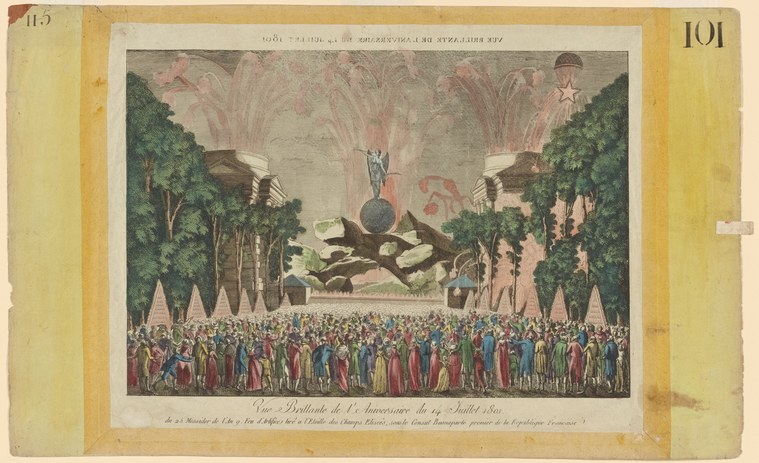
This print documents how revolutionary and Napoleonic France staged political legitimacy through public spectacle and massed civilian participation, making visible the relationship between dance, ceremony, and state power. For dance historians, it shows how formal processional and celebratory movement operated at civic scale during a transformative moment in European history.
What you are looking at
A vast public celebration fills an orderly urban plaza lined with tall trees on both sides, creating a formal processional space. Hundreds of figures in colorful dress—reds, blues, yellows, greens—populate the ground, arranged in loose formation facing a monumental spectacle at the center. Above them, a colossal allegorical or military figure rides an enormous winged creature (possibly a dragon or fantastical beast), wreathed in billowing smoke or clouds rendered in pale pinks and grays. A star glows above the scene. The composition is symmetrical and ceremonial, with the crowd spread across the full width of the plaza in a manner suggesting coordinated movement or processional formation rather than chaotic celebration. The engraving's delicate hatching and fine detail work convey both the grandeur of the monument and the texture of masses of people.
The dancing
Individual figures are rendered small and schematic, their bodies upright and facing generally toward the center spectacle. No clear couple-work, holds, or intricate choreographic frames are visible at this scale; the crowd appears to stand, walk, or gesture rather than execute formal dance steps. The density of figures and their distribution suggests processional or parade formation rather than partner dancing or courtly figures. Arms are generally at sides or raised in gestures of attention or celebration.
The dance depicted
This is almost certainly a depiction of a civic or state celebration rather than a theatrical dance performance. The date 14 juillet 1801 in the title places it in the Napoleonic era, likely commemorating the French Revolution's founding date (Bastille Day, moved to July 14 after the Revolution). The 'vue brillante' (brilliant view) describes a pageant or public ceremony with theatrical machinery—the winged beast and ascending smoke suggest pyrotechnics or stage effects. This is celebratory public spectacle rather than dance in the ballroom or theatrical sense, though the massed crowd may well have engaged in informal dancing as part of festivities.
How it was made
This is a hand-colored engraving or etching, identifiable by the fine parallel hatching lines used to create tonal depth in the sky, smoke, and crowd, and by the delicate linear rendering of architectural and landscape elements. The coloring is applied selectively—greens for foliage, flesh tones and bright hues for the crowd, pale pink and gray for the clouds—suggesting either contemporary hand-coloring or a later colored impression. The technique allowed wide distribution of topical images commemorating public events to an educated urban audience, and the careful composition and scale imply this was a published commemorative print.
About this work
This is a hand-colored engraving commemorating a Napoleonic-era public celebration on 14 July 1801, almost certainly Bastille Day festivities in Paris. The composition centers on a colossal allegorical or military monument with fantastic machinery, watched by hundreds of formally arranged citizens in a tree-lined plaza. While the image captures a festive civic occasion with possible dancing in the crowd, it is primarily a record of state spectacle and public order rather than a dance performance. It belongs in a dance gallery because such civic pageants were choreographed events that shaped how large populations moved together, and because they represent an important category of movement practice distinct from theatrical or ballroom dance.
How to look at it
Attend to the composition's symmetry and the deliberate arrangement of the crowd: this is not a spontaneous gathering but a formally orchestrated event. The monumental machinery at center—the winged beast and the figure astride it—is the choreographic focus, with the crowd arranged as witness and participant. Note how the engraver has used the tree-lined vista to create a processional perspective, drawing the eye to the spectacle and implying movement along a central axis. The scale and distribution of the crowd suggests the artist is interested in conveying mass participation and civic order as much as the spectacle itself.
The period
The date 1801 places this in the consolidation phase of the Napoleonic regime, after the instability of the 1790s. Civic celebrations of the Revolution's founding were repurposed by Napoleon to affirm national unity and his authority. Public pageantry during this era combined Enlightenment ideals of rational order with baroque spectacle—the carefully arranged crowds and monumental machinery reflect both democratic aspiration and autocratic control. Contemporary French engravers documented such events as newsprint for a literate public, creating a visual record of how the state choreographed collective participation.
Where it lives
The work is held in the New York Public Library's collection of prints depicting dance. It is a published commemorative engraving, likely produced for sale to a broad audience in France or internationally, and serves as both historical document and contemporary visual commentary on Napoleonic civic ceremony.
Dance in this work
Questions about this work
Is this actually a dance performance?
Not in the theatrical or ballroom sense. This is a civic pageant—a choreographed public celebration combining processional formation, spectacle machinery, and crowd participation. For dance historians, such events are important because they show how large populations were organized to move, celebrate, and affirm political authority through their collective body. Dancing may have occurred within the celebration, but the print documents the overall spectacle rather than specific dance steps.
What is the creature in the sky?
It appears to be an allegorical or military figure astride a winged dragon or fantastical beast, surrounded by smoke or clouds. The imagery likely carries political or military symbolism appropriate to Napoleonic celebration, though the specific allegory is not explicit. The machinery suggests either an elevated stage structure or a representation of fantastical flight and power.
Why July 14, 1801?
14 July is Bastille Day, marking the storming of the Bastille in 1789 and the outbreak of the French Revolution. In 1801, over a decade later, Napoleon's regime commemorated the event as part of consolidating his authority and claiming continuity with revolutionary ideals. Civic celebrations on this date were major annual events combining pageantry, ceremony, and public participation.
More dance artwork





