49 works in this view — arrow keys or swipe to move between them.
Dance in Art
Pastoral dance scenes of the eighteenth century
Unknown artist
- Collection:
- Prints depicting dance
- Source:
- New York Public Library
- Rights:
- Public domain — free to use, share and adapt.
- Recorded as:
- Public Domain
This image documents an early form of body-centered entertainment performance in the eighteenth century that sits at the intersection of acrobatics, dance, and courtship display—forms that were rarely recorded in written sources. It demonstrates that physical virtuosity and aerial work were enjoyed by the fashionable classes in recreational settings, not merely by professional performers, and that such displays were valued enough to be memorialized in prints.
What you are looking at
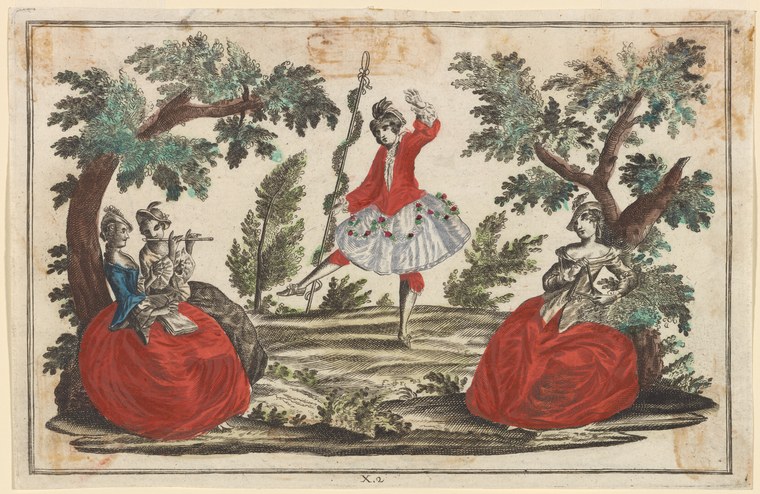
This hand-colored engraving depicts three fashionable figures in a woodland setting, engaged in an outdoor entertainment scene typical of eighteenth-century pastoral imagery. Two women in voluminous red skirts sit beneath spreading trees on either side of the composition; the woman on the left holds a small child and gestures toward a central male figure. The man, dressed in a red coat and light breeches, performs an acrobatic pose on a rope or pole suspended between the trees, his body arched backward in a dramatic leap or swing. The setting is a sylvan glade with carefully rendered foliage, a cleared ground, and soft naturalistic lighting. The figures' dress—the women's elaborate gowns with panniers, the man's fashionable coat and hat—places this firmly in the mid-to-late eighteenth century.
The dancing
The central male figure is captured mid-action in an extended, arched backbend or aerial inversion on a rope or suspended apparatus, demonstrating considerable physical control and elevation. The two seated women are stationary and observational, their poses graceful but grounded, their attention directed toward the performing male. The contrast between the dynamic, extended body of the central figure and the composed, seated postures of the women establishes a clear performer-and-audience dynamic.
The dance depicted
This is not a dance scene in the formal ballroom sense, but rather depicts acrobatic performance or physical display that was part of outdoor entertainment and courtship rituals of the period. The rope or pole work suggests historical acrobatics or early rope-walking acts that entertained eighteenth-century audiences. The pastoral setting and fashionable dress indicate this is likely an imagined scene of genteel amusement rather than a depiction of professional street acrobatics, reflecting the period's fascination with elegant leisure and playful physicality.
How it was made
This is a hand-colored engraving, identified by the precise linear work defining forms and the carefully applied watercolor or ink washes creating depth and modeling. The technique allowed for wide circulation in prints; multiple hand-colored impressions could be produced from the same copper plate, making such scenes affordable to middle-class households. The relatively simple composition and pastoral subject matter suggest this was intended for a broad domestic market rather than as a fine art commission.
About this work
This engraving belongs to the tradition of eighteenth-century pastoral and recreational imagery that documented the leisure activities and entertainments of fashionable society. It captures a moment of acrobatic display within an idealized natural setting, where physical performance serves as an amusement for an appreciative audience. The work testifies to the period's interest in the body in motion, the blending of dance, acrobatics, and courtship narratives, and the consumption of such scenes through affordable prints distributed to middle-class homes across Europe.
How to look at it
Observe the moment of suspension: the artist has frozen the male figure in an extended arching pose that emphasizes control, strength, and grace—qualities valued in eighteenth-century courtship and performance. Note how the composition frames acrobatic skill as an entertainment for an elegant female audience, reflecting the period's convention of male display and female appreciation. The pastoral setting elevates this act from street performance to genteel amusement, positioning acrobatics within the world of refined leisure.
The period
The eighteenth century saw a flourishing of pastoral imagery in the decorative arts, partly influenced by Rococo taste and the idealization of rural life and leisure among urban elites. Dance and physical entertainment were central to sociability in this period; while formal ballroom dances like the minuet and country dances dominated polite society, acrobatic feats and displays of physical prowess were also fashionable entertainments. Prints depicting such scenes were popular décor items and circulated widely, shaping ideas about genteel recreation and the acceptable display of the body.
Where it lives
This work is held in the New York Public Library's collection of prints depicting dance, a collection that captures the visual record of movement practices and entertainments from the sixteenth century onward. It is catalogued within that collection as a pastoral dance scene of the eighteenth century.
Dance in this work
Questions about this work
Is this an actual dance or acrobatics?
This depicts acrobatic performance—specifically rope or pole work—rather than a ballroom or social dance. However, in the eighteenth century, acrobatics and dance were not strictly separated; both were valued as displays of physical skill and gracefulness. This scene likely documents an entertainment that blended athletic prowess with the aesthetic values of dance.
Why are the women sitting and the man performing?
This reflects an eighteenth-century convention in which male performers displayed their physical abilities for female admiration. The composition stages this as a courtship entertainment: the man's virtuosity is offered for the women's appreciation, a dynamic that appears repeatedly in period imagery of leisure and amusement.
What does the rope or pole tell us?
The apparatus suggests early forms of aerial or rope-based performance that entertained eighteenth-century audiences. These skills were part of a broader culture of physical display among both professional and amateur performers, and the fashionable dress of the figures here suggests this is an amateur or social performance rather than a street act.
Is this a well-known scene or type?
Pastoral entertainment scenes with acrobatic or physical displays were a recognizable subject in eighteenth-century decorative prints. While this specific composition may not be widely documented, the type—elegant figures engaged in playful physical display in a woodland setting—was popular in domestic prints of the period.
More dance artwork





