49 works in this view — arrow keys or swipe to move between them.
Dance in Art
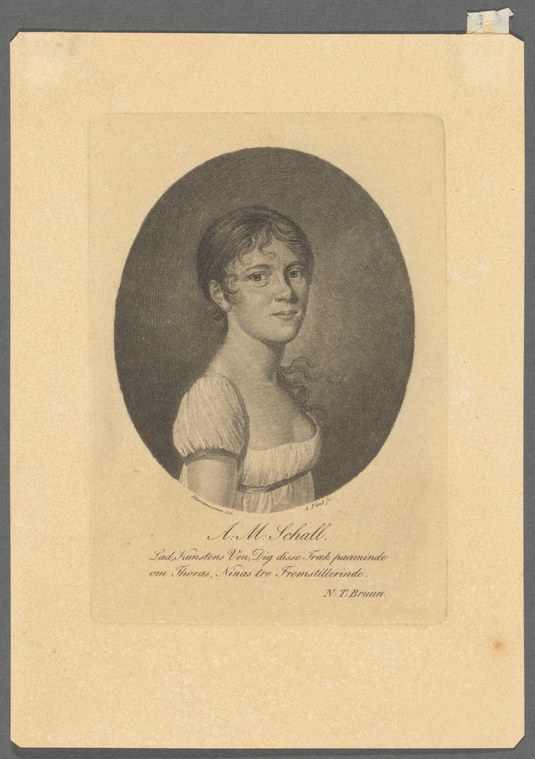
A.M. Schall [with verse signed N.T. Bruun]
Unknown artist
- Collection:
- Prints depicting dance
- Source:
- New York Public Library
- Rights:
- Public domain — free to use, share and adapt.
- Recorded as:
- Public Domain
This portrait records the professional identity of a named female performer at a moment when women's theatrical work was increasingly documented and celebrated. It exemplifies how reproductive prints served as a primary medium for circulating images of dancers and performers to the public, and it demonstrates the cultural status of the theater at the turn of the 19th century.
What you are looking at
A young woman with dark hair is depicted in bust-length portrait format within an oval frame, set against a dark background that emphasizes her pale complexion and simple white empire-waist dress. The setting is austere and frontal—this is not a narrative scene but a formal portrait study. The woman's gaze is directed slightly away from the viewer, and her head turns gently to the right; her shoulders are relaxed and her expression serene. The engraving technique creates fine hatching in the background and delicate modeling of her features, the work executed with the restraint and precision typical of early 19th-century portraiture.
The dancing
A single figure, shown from the shoulders up. Her posture is upright but natural, without the rigid formality of earlier court portraiture. The dress—a high-waisted Empire silhouette with short puffed sleeves—allows the neck and shoulders to be seen clearly. Her hair is parted and swept back simply, in the fashion of the Regency period. There is no active dance gesture; the pose is contemplative and still.
The dance depicted
This is not a depiction of dance in action, but a portrait of a named individual. The inscription indicates this is a study of "A.M. Schall," a dancer or performer of the period. Without additional documentation, the specific dance genres practiced by Schall cannot be determined from the image alone. The style and date of the engraving and the fashion of the dress suggest the early 19th century, when European theatrical dance was dominated by Romantic ballet and pantomime, but no visual evidence of active dancing is present.
How it was made
This is a line engraving (or stipple-engraved portrait), a reproductive print technique that allowed multiple copies to be distributed. The fine parallel lines in the background and the controlled gradations of tone indicate the precision of the engraver's hand. Such prints were common for publicizing dancers and theatrical performers of the period, serving as portraits for the stage-going public. The technique implies this was a published image, circulated beyond a single patron.
About this work
This is a formal portrait engraving of A.M. Schall, a dancer or theatrical performer of the early 19th century, rendered in the restrained and elegant style typical of Regency-era portraiture. The work belongs to a tradition of reproductive prints documenting the performers of European theater. Though it contains no depiction of dance itself, it documents an individual associated with the dance world during the Romantic period and offers evidence of how dancers were publicly represented—as refined, educated subjects worthy of fine-art portraiture, rather than as exotic or carnivalesque figures.
How to look at it
Observe the balance between formality and intimacy: this is a carefully composed portrait, yet the slight turn of the head and the soft gaze create a sense of personal presence. The Empire-waist dress and simple hairstyle are historically precise markers of the Regency era and tell us exactly when the image was made. Notice how the engraver has used the oval frame and dark background to isolate and elevate the subject—a compositional choice that confers dignity on a performer at a time when theatrical women occupied ambiguous social status.
The artist
The engraver is not named in the catalogue record. The inscription credits "N.T. Bruun" for accompanying verse rather than for the engraving itself. The style is consistent with the work of early 19th-century portrait engravers active in Northern Europe, though without a signature or confirmed attribution, the engraver's identity remains uncertain.
The period
This portrait dates to the early decades of the 19th century, a transformative moment for European dance. The Romantic ballet was emerging in France and beginning to reshape theatrical dance, emphasizing ethereal, poetic movement and female performers. Outside the ballet world, theatrical dancing also encompassed pantomime, dramatic dances, and various entertainments. Portraiture of performers—in prints and lithographs—became a standard medium for promoting theater and building a performer's public image. The refined, contemplative quality of this portrait aligns with the aesthetics of the period, presenting the subject as an educated woman of taste rather than as a spectacle.
Where it lives
The work is held in the NYPL's collection of prints depicting dance. It was catalogued as a work of unknown artist and date, though the style, inscription, and fashion evidence all point confidently to the early 19th century.
Questions about this work
Who was A.M. Schall?
The catalogue record provides no biographical information beyond the name. Schall was active in European theater in the early 19th century, but her specific roles, training, and career trajectory cannot be determined from this portrait alone. The presence of accompanying verse by N.T. Bruun suggests she was a subject of literary or public interest.
Why don't we see her dancing?
This is a formal portrait, not a narrative or theatrical scene. Early 19th-century portraiture of performers often presented them in refined, composed settings rather than in action—a choice that elevated their cultural status. Dance scenes were common in other artistic contexts (prints, paintings, theatrical programs), but this engraver chose the idiom of dignified portraiture.
What does the Empire waist tell us?
The high-waisted dress is the dominant silhouette of the Regency era (roughly 1811–1820) and dates the portrait precisely to the early 19th century. It also reflects contemporary fashion and theatrical costume of the period. Dancers of the era wore similar dresses for certain roles, particularly in early Romantic ballet and pantomime.
What was the verse by N.T. Bruun?
The inscription notes that verse accompanies the portrait, but the text is not fully legible in the image. Such verses were common in printed portraits of the period, offering biographical or laudatory remarks. Without the full text, we cannot determine what Bruun wrote about Schall.
More dance artwork





