49 works in this view — arrow keys or swipe to move between them.
Dance in Art
Die Willy
Unknown artist
- Collection:
- Prints depicting dance
- Source:
- New York Public Library
- Rights:
- Public domain — free to use, share and adapt.
- Recorded as:
- Public Domain
For dance historians, this engraving documents the Romantic era's investment in supernatural movement as a vehicle for exploring themes of possession, control, and the body's capacity to transgress social order—preoccupations that would influence theatrical dance throughout the 19th century, from ghost ballets to the expressionist dances of the early 20th century. The image reveals how the grammar of classical ballet and formal gesture could be inverted to suggest supernatural forces and the breakdown of rationality, making it a crucial visual document of the period's anxieties about embodied movement.
What you are looking at
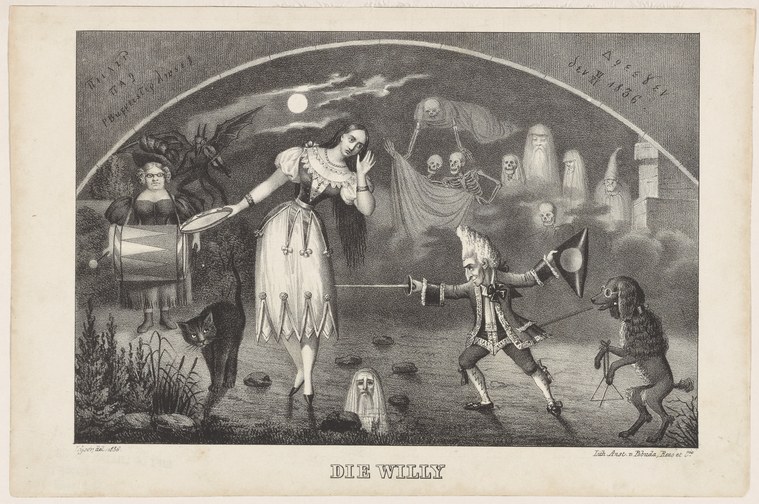
A supernatural gathering unfolds in this engraving, rendered in the flickering luminescence of moonlight and ghostly illumination. At center stands a woman in classical drapery, one arm extended in commanding gesture toward a swirling crowd of spectral figures—skeletal forms, hooded phantoms, and demonic creatures—that fill the background in a churning mass. To the left, a witch or sorceress sits astride a large creature or beast; to the right, diminutive demonic figures caper and cavort in wild abandon. The foreground contains darker vegetation and a sense of threshold or boundary between the mortal and supernatural realms. The entire scene throbs with theatrical energy: the central woman appears to be conducting or summoning the spectral dancers, her body taut with authority, while the ghostly figures respond in a chaos of motion that suggests fevered, uncontrolled movement—the antithesis of orderly dance.
The dancing
The central female figure maintains a formal, almost balletic posture despite the supernatural chaos surrounding her—her torso erect, one arm extended in a summoning gesture that suggests command rather than participation. The smaller demonic or sprite figures on the right display exaggerated, contorted postures: bent knees, twisted spines, and flailing limbs suggest grotesque mockery of human movement. The ghostly forms in the background are rendered as weightless, ethereal presences—insubstantial compared to the solidity of the summoning woman. There is no reciprocal connection or partnering; rather, a hierarchy of control: one figure commands, many respond in chaotic obedience.
The dance depicted
This is not a depiction of an actual historical dance form, but rather a theatrical or literary visualization of supernatural summoning, likely informed by folklore, theatrical tradition, and Romantic-era fascination with the occult and witchcraft. The scene most closely resembles the witch-summoning or ghost-dance traditions portrayed in German Romantic art and theater—particularly the theatrical convention of the Walpurgis Night gathering or similar demonic assemblies. The 'dance' here is not choreographed movement but rather wild, uncontrolled frenzy: the spectral figures do not dance with partners, measure, or structure, but instead writhe in supernatural compulsion. The image documents not a social or theatrical dance but a moment of magical coercion—the woman as enchantress compelling ghostly forces to move at her will.
How it was made
This is an engraving, a medium evident from the fine parallel hatching lines that model form, the tonal gradations achieved through line density, and the stark interplay of black and white that creates dramatic shadow and illumination. The technique allowed for precise rendering of the woman's classical drapery and facial features while using looser, more gestural linework to suggest the chaos and insubstantiality of the supernatural crowd. Engravings of this type circulated widely as prints in the 19th century, suggesting this image was intended for a educated middle-class or artistic audience familiar with Romantic themes and classical references. The formal technique—precise, controlled, classical in its anatomical accuracy—stands in deliberate contrast to the chaos of the subject, heightening the supernatural transgression depicted.
About this work
Die Willy is a Romantic-era engraving depicting a woman in classical drapery summoning or commanding a supernatural assembly of ghosts, demons, and spectral forms. The work is a theatrical visualization of occult power, not a representation of an actual historical dance, but it documents the Romantic imagination's fascination with supernatural movement, witchcraft, and the crossing of boundaries between material and immaterial worlds. The central female figure's formal, authoritative posture contrasts sharply with the writhing chaos of the summoned forces, suggesting themes of magical control, transgression, and the unleashing of forces beyond social order. As an engraving, it is a product of 19th-century print culture, designed for circulation among audiences engaged with Romantic literature, German folklore, and theatrical spectacle. The work sits at the intersection of visual art, theater, and the occult traditions that fascinated the Romantic era.
How to look at it
Attend to the compositional hierarchy: the central woman's formal, commanding posture frames and contains the writhing chaos of the supernatural assembly, suggesting the Romantic theme of will and reason struggling against unbounded force. Notice how the engraver's technique shifts between the precise hatching that renders the woman's classical drapery and the looser, more gestural marks that suggest the insubstantiality and wild motion of the ghosts and demons. The moment captured is not mid-dance but mid-summoning: the woman is not dancing but conducting, commanding through gesture rather than movement. The theatrical convention is inverted—rather than the dancer as the object of spectation, here the dancer (or summoner) exercises supernatural power over a mass audience of compelled, unwilling 'dancers.'
The period
This engraving belongs to the Romantic era's fascination with the supernatural, witchcraft, and folk traditions—a movement that encompassed literature (Goethe, the German Sturm und Drang), visual art, and theatrical practice. In the early-to-mid 19th century, European artists and writers mined German folklore and medieval legends for imagery of supernatural power and transgression. Theater embraced supernatural themes: the Walpurgis Night scene from Goethe's Faust (published 1808) became a touchstone for depictions of demonic assemblies, and the Romantic ballet (developing from the 1830s onward) would incorporate ghostly and supernatural elements as vehicles for exploring the uncanny and the body's capacity to exceed rational order. Engravings like this one circulated as illustrations, theatrical documents, and works of art in their own right, shaping visual culture around the supernatural and the transgressive body.
Where it lives
The print is held in the New York Public Library's collection of prints depicting dance. The catalogue record provides minimal information: the title alone remains, with artist, date, and medium unrecorded in the available metadata. The engraving format and style suggest a 19th-century origin, likely German or Germanic in cultural context, but without further provenance documentation, specifics cannot be established from the image alone.
Questions about this work
Is this an actual historical dance?
No. This is a theatrical or literary visualization of supernatural summoning, not a representation of a dance form practiced in society or the theater. It documents the Romantic imagination's fascination with witchcraft and occult power, rendered through visual conventions borrowed from classical art and ballet.
Why are the figures in the background so chaotic and distorted?
The chaos reflects the Romantic concept of supernatural possession and uncontrolled force—movement driven by external magical compulsion rather than the dancer's own will. The distortion marks the boundary between the rational, ordered classical body (represented by the summoning woman) and the transgressive, unbounded body of the supernatural realm.
What is the woman doing? Is she dancing?
The woman is summoning or conducting the supernatural assembly; her extended arm and formal posture suggest command rather than participation. She occupies a different register from the spectral figures—she directs movement rather than dancing, marking her as the locus of rational will and magical power.
What does the title 'Die Willy' mean?
The German title likely translates to 'The Willow' or refers to a figure named Willy. Without additional context or documentation, the precise meaning and any literary or theatrical source for the image remain unclear.
More dance artwork





