49 works in this view — arrow keys or swipe to move between them.
Dance in Art
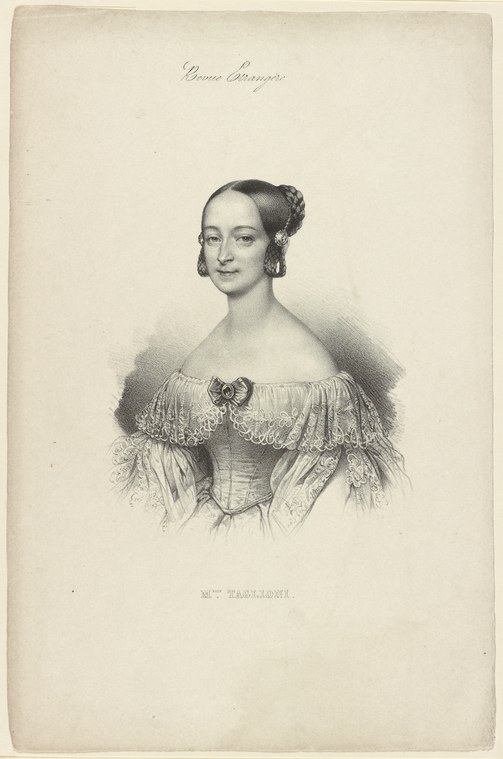
Melle. Taglioni
Unknown artist
- Collection:
- Prints depicting dance
- Source:
- New York Public Library
- Rights:
- Public domain — free to use, share and adapt.
- Recorded as:
- Public Domain
Taglioni was the defining figure of Romantic ballet and one of the most famous women of her era; this engraving documents how her image was marketed and distributed across Europe and beyond. The work shows the close relationship between ballet stardom, fashion, and printmaking in the nineteenth century, revealing how dancers' images circulated as art objects in their own right.
What you are looking at
A three-quarter-length portrait of a young woman shown against a plain background, facing slightly right. She wears a white off-shoulder dress with voluminous sleeves trimmed in lace or fine embroidery; the neckline is low and wide, exposing the shoulders and upper chest in the fashion of the 1830s–1840s. Her dark hair is arranged in an elaborate upswept style with ringlets framing her face. A brooch or small ornament is visible at the center of her bodice. The composition is intimate and refined—a studio portrait rather than a narrative scene—rendered in fine line engraving with subtle shading to model the face and suggest the texture of fabric. The woman's gaze is direct and composed, neither smiling nor grave. The title at the bottom reads "Melle. Taglioni," identifying her by name.
The dancing
The figure is posed in a conventional portrait stance—upright, relaxed, shoulders back. The arms are held loosely at the sides or partially gathered, with no active gesture or active arm carriage visible. The body shows no tension or readiness for movement; this is a dress portrait, not a dance documentation. The face is serene and composed, the line of the body vertical and still.
The dance depicted
This is Marie Taglioni, the Swedish-Italian prima ballerina and the most celebrated dancer of the Romantic era (1804–1884). She revolutionized ballet technique and aesthetics in the 1820s–1840s, introducing the pointe shoe as a standard tool, lightening the center of gravity, and embodying the ethereal, otherworldly quality central to Romantic ballet ideals. This portrait, however, is not a depiction of her dancing. It is a portrait of her in dress, as a celebrated public figure. The image tells us nothing about her technique or performance presence—it is a record of her identity and her status as an international star whose image was widely circulated through prints.
How it was made
This is a line engraving on white paper, likely a steel or copper engraving based on the fineness of the line work and the delicate modeling of the face. The technique was standard for celebrity portraiture in the 1830s–1840s and allowed for wide circulation at modest cost. The clarity and refinement of the engraving suggest this was a professional, high-quality production—the kind of image sold to the public as a collectible souvenir of a celebrated performer. Engraving was the primary medium for distributing images of dancers and performers before photography became practical.
About this work
This is a celebrity portrait engraving of Marie Taglioni, the Romantic era's greatest ballerina, in the costume and style of her era but posed as a fashionable portrait rather than as a performer in motion. The work documents Taglioni's status as an international star and cultural icon during the height of her fame. It belongs in a gallery of dance in art not as a depiction of dance itself but as evidence of how dancers were represented, circulated, and consumed as public figures in the nineteenth century. The image is part of a visual economy of celebrity that depended on prints, engravings, and lithographs to build and sustain fame across borders and over time.
How to look at it
Attend to the garment: the off-shoulder dress and refined neckline were fashionable in the 1830s–1840s but also consistent with stage costume conventions of the era, when Romantic ballerinas wore simplified, high-waisted dresses in pale fabrics. The hair arrangement—elaborate and fashionable—tells you this is a society portrait, not a costume study. The serenity of the gaze and the stillness of the pose were conventions of portraiture in this period, not a record of how Taglioni appeared in performance. This is an image designed to celebrate her identity and beauty, not her technique.
The artist
The artist is not recorded in the catalogue. The engraving is a professional production, likely commissioned by a publisher or Taglioni's management to capitalize on her celebrity. Many such celebrity portraits were produced anonymously or by minor engravers working in commercial studios. The style and technique suggest mid-nineteenth-century European practice, consistent with the widespread production of Taglioni prints during her peak fame (1820s–1840s).
The period
The 1830s–1840s were the height of the Romantic movement in ballet, when Marie Taglioni dominated European stages and became an international celebrity. The rise of lithography and commercial engraving made it possible to produce and distribute images of performers on an unprecedented scale. Taglioni's image—her ethereal appearance, her costume, her fame—became a commodity: prints and engravings of her were sold as collectibles, souvenirs, and artworks in their own right. This portrait is part of that visual economy, reflecting both her status as a star and the new culture of celebrity that the nineteenth century made possible.
Where it lives
The work is held in the New York Public Library's prints collection documenting dance. It is part of a large body of nineteenth-century portrait engravings of performers, dancers, and celebrities that served as popular prints and collectibles.
Questions about this work
Is this Marie Taglioni dancing?
No. This is a formal portrait of Taglioni in fashionable dress, posed for the studio. It is one of many celebrity portraits of her that were engraved and sold as prints during her lifetime. It documents her fame and image, not her technique or performance.
Why is she important?
Marie Taglioni (1804–1884) was the greatest ballerina of the Romantic era and a cultural icon. She pioneered the use of the pointe shoe, lightened and etherealized ballet technique, and embodied the otherworldly ideals central to Romantic ballet. She was one of the most famous women in Europe during the 1820s–1840s.
How did dancers' images circulate in the nineteenth century?
Before photography, engraved and lithographed portraits were the primary way a performer's image reached the public. Commercial prints like this one were sold as souvenirs and collectibles, allowing celebrities like Taglioni to build an international following through visual circulation as much as through performance.
What does the dress tell us?
The off-shoulder, high-waisted white dress is consistent with both fashionable dress of the 1830s–1840s and with stage costume conventions of Romantic ballet. It would not be out of place on stage, though this portrait was not made to document a specific performance.
More dance artwork





