49 works in this view — arrow keys or swipe to move between them.
Dance in Art
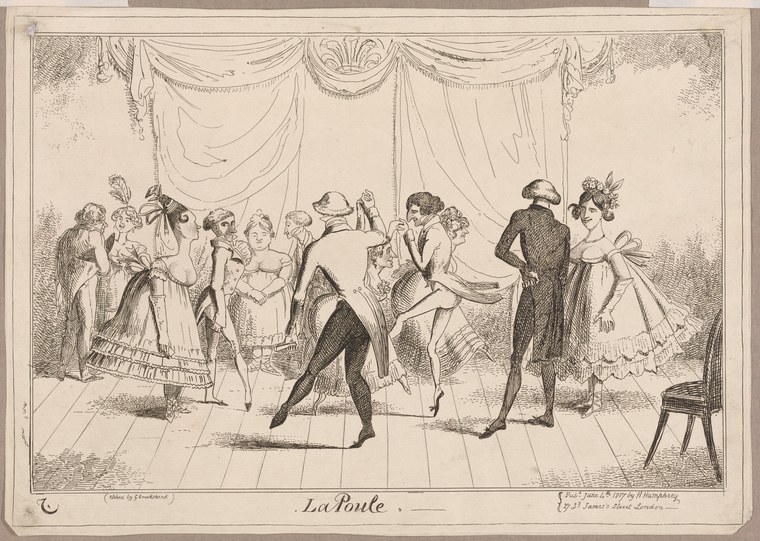
La Poule
Unknown artist
- Collection:
- Prints depicting dance
- Source:
- New York Public Library
- Rights:
- Public domain — free to use, share and adapt.
- Recorded as:
- Public Domain
For historians of social dance, this image provides rare direct visual documentation of *La Poule*, a dance that appears in period descriptions and dance manuals but left few visual records. The print demonstrates how unusual movement vocabularies circulated in ballroom culture and how those movements were perceived—with amusement and exaggeration—by contemporary observers and image-makers.
What you are looking at
A lively ballroom or assembly room scene under a draped canopy, filled with fashionably dressed figures arranged in loose groups. In the center, a male dancer in tight breeches and dark coat performs a solo movement, his body bent forward at a sharp angle with one leg extended behind him in an exaggerated posture. The surrounding figures—men in coats and breeches, women in high-waisted gowns with elaborate skirts and feathered headdresses—observe and converse, creating the atmosphere of a social dance gathering. The engraving technique produces fine hatching throughout the composition, with deeper shadows in the corners and lighter tones in the central gathering space. The title "La Poule" appears below the scene, with a publication mark suggesting this is a printed satirical or documentary image.
The dancing
The central male dancer assumes an extremely flexed, almost contorted posture—torso bent forward sharply, rear leg raised high behind, front leg planted—that exaggerates the movement far beyond natural technique. His body position suggests mimicry or caricature rather than serious instruction. The surrounding figures maintain upright postures in fashionable dress, with women's arms held naturally at their sides and men's postures formal. The arrangement is characteristic of a social gathering rather than a formal dance class or theatrical performance, with figures arranged in clusters of observation rather than in geometric formation.
The dance depicted
This appears to be a satirical or comic image of a popular social dance rather than a serious technical representation. The title *La Poule* ("The Hen") refers to a carnival dance that was fashionable in Europe, particularly in France, in the 19th century. The dance's name derives from the bird-like movements and postures that dancers adopted, which the exaggerated central figure mockingly demonstrates. The comic exaggeration of the male dancer's posture—the absurdly bent back and elevated leg—suggests the image documents or ridicules a well-known popular dance form known for its physically demanding and unusual body positions, likely performed at balls and social assemblies as novelty entertainment.
How it was made
This is an engraving, executed with fine linear hatching and cross-hatching to establish tone and volume. The technique allows for sharp detail in the costumes and setting while maintaining the capacity for satirical exaggeration through deliberate distortion of the central figure's anatomy. The print format and publication mark indicate this was produced for circulation among a broad middle-class audience interested in social satire and fashionable life. Engravings of this type were commonly bound into periodicals or sold separately as satirical commentary on contemporary manners and entertainment.
About this work
This engraved print documents or satirizes a fashionable social dance of the 19th century, likely French or European in origin. The work captures both the material culture of ballroom gathering—the dress, the setting, the social arrangement—and the physical practice of an unusual movement vocabulary. The exaggerated posture of the central dancer suggests the image operates as both documentary and mockery, recording a real dance that seemed bizarre or comical to the print's original audience. Its presence in a collection of dance-related prints indicates recognition of its value as historical evidence, even where the intent may have been satirical rather than celebratory.
How to look at it
Attend to the central figure's deliberately exaggerated posture: the extreme forward bend and raised leg create a silhouette that is anatomically awkward and visibly performed for comic effect. The surrounding figures' calm observation and formal dress establish the context as a social ballroom rather than a circus or theatrical stage, which makes the central dancer's contortion all the more striking. The engraving's crisp detail in the costumes and architectural setting provides evidence that this documents a real social world, even as the satirical distortion makes clear this is commentary rather than neutral observation. The composition uses the contrast between the normal, well-behaved figures at the margins and the wildly distorted dancer at the center to create its satirical effect.
The period
The 19th century saw the emergence of social dances with specific names and associated movements that circulated rapidly among fashionable urban society. *La Poule* belonged to a category of novelty or carnival dances that periodically became fashionable at balls and assemblies, often with comic or acrobatic elements that distinguished them from the more formal waltz and quadrille repertoire. Satirical prints of fashionable life, manners, and entertainment were extremely popular in this period, particularly in France, where artists used exaggeration and caricature to document and mock contemporary social behavior. The engraved format allowed such images to circulate widely and quickly, making them vehicles for both social commentary and informal historical record.
Where it lives
This engraving is held in the New York Public Library's collection of prints depicting dance. It belongs to the category of historical dance documentation in print form, likely produced and distributed in the 19th century as part of a series or periodical focused on fashionable society and entertainment.
Dance in this work
Questions about this work
What is 'La Poule' and why is it called that?
*La Poule* was a fashionable social dance of the 19th century, named for the bird-like or fowl-like postures and movements dancers adopted during performance. The exaggerated backward bend and raised leg visible in this print demonstrate the physical vocabulary that earned the dance its animal name. It was performed as entertainment at balls and assemblies, often treated as a novelty or comic diversion from the more formal dances of the period.
Is this a serious dance instruction image or a satire?
The extreme exaggeration of the central figure's posture indicates this functions as both documentation and satire. While *La Poule* was a real dance that people performed, this engraving exaggerates the movement's awkwardness for comic effect. The contrast between the formally dressed, composed observers and the grotesquely contorted dancer suggests the image mocks fashionable society's enthusiasm for unusual or physically demanding novelty dances.
How do we know this depicts the 19th century?
The women's high-waisted gowns with Empire silhouettes, feathered headdresses, and the men's tight breeches and high-collared coats are all consistent with fashionable dress of the early 19th century. The engraving technique and style of the publication mark also point to this period, when satirical prints of fashionable life were extremely popular, particularly in France.
More dance artwork





