49 works in this view — arrow keys or swipe to move between them.
Dance in Art
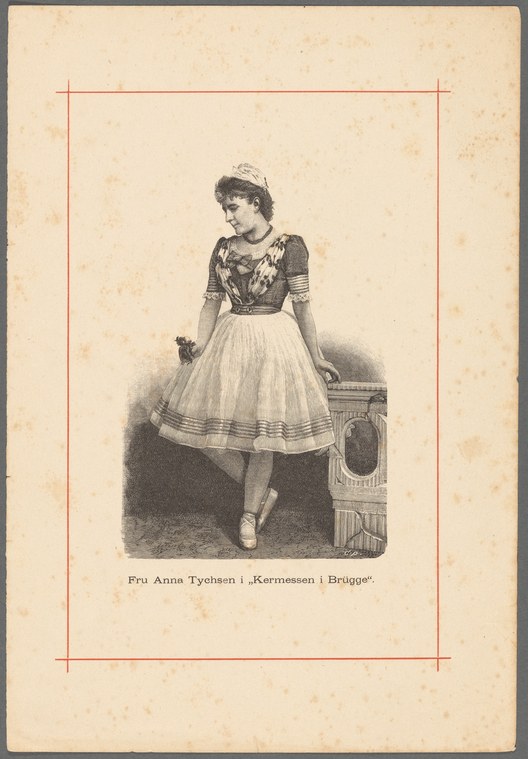
Fru Anna Tychsen i Kermessen i Brügge
Unknown artist
- Collection:
- Prints depicting dance
- Source:
- New York Public Library
- Rights:
- Public domain — free to use, share and adapt.
- Recorded as:
- Public Domain
This engraving is a named documentary record of a theatrical performer and a specific production, providing visual evidence of stage costume, styling, and professional performance practice. For historians of theater and dance, such promotional prints are crucial primary sources—they document performers, productions, and the visual conventions of performance that might otherwise disappear.
What you are looking at
A young woman stands alone against a plain background, turned slightly leftward in a pose of graceful repose. She wears a dark patterned bodice with fitted three-quarter sleeves and a full skirt of pale fabric gathered at the waist, decorated with horizontal bands or ribbons near the hem. Her hair is styled up with what appears to be a small hat or ornament. She rests one hand lightly on a draped fabric or cushioned surface to her right, suggesting an interior setting—possibly a dressing room or studio. Her posture is upright but relaxed, her gaze directed away from the viewer. The engraving is rendered in fine line work with careful attention to the fall of fabric and the modeling of the figure, typical of theatrical portraiture from the mid-to-late 19th century.
The dancing
The single figure stands in a neutral, dignified posture with weight evenly distributed, suggesting a moment of rest rather than active dancing. Her frame is tall and composed, with one arm lowered naturally and the other relaxed at her side. There is no visible tension in the shoulders or arms that would suggest an active dance position, and her stance is symmetrical and self-contained. The pose is that of a performer presenting herself rather than executing a movement.
The dance depicted
The title identifies this as a theatrical figure—Fru (Mrs.) Anna Tychsen in 'Kermessen i Brügge' (The Fair in Bruges), a theatrical production. Without additional context about the work or its choreography, the specific dance form cannot be determined from the image alone. The costume and posture suggest a stage performer, likely from a pantomime, ballet, or operatic production of the period. The relaxed stance and theatrical dress suggest this may be a portrait of the dancer in character or costume rather than a depiction of an actual dance movement.
How it was made
This is a line engraving or steel engraving, executed with fine parallel lines to build tone and form. The technique allows for precise detail in the costume and facial features, and the image has been printed from a metal plate—evidenced by the regular frame border and the even quality of the line work. Such engravings were commonly produced as theatrical prints or promotional images, circulated to advertise performers and productions. The technique suggests this was a work of some commercial importance, intended for distribution to a broader audience than a single theater.
About this work
This is a theatrical portrait engraving of a performer in costume, dating to the 19th century. The work documents a moment of theatrical production—a named performer, Anna Tychsen, in a specific stage role. The image belongs in a dance collection both as evidence of the theatrical practices of the period and because it documents a performer whose name and production are recorded. While the specific choreography or dance style is not visible in this posed studio moment, the work provides important visual evidence of costume, staging, and the professional apparatus of 19th-century theatrical dance.
How to look at it
Look at the costume as a complete document: the cut and construction of the bodice, the fullness and gathering of the skirt, the ribboned hem, and the styling of hair and hat all establish the character type and the theatrical aesthetic of the production. Notice the artist's attention to the texture and fall of fabric, achieved through fine engraving technique. The figure's relaxed posture and the plain background indicate this is a portrait of a performer in character, not a depiction of an active dance or movement—the interest lies in costume and presentation rather than choreography.
The period
This engraving dates to the era when theatrical portraiture—especially of dancers and opera singers—was a major form of printmaking and popular circulation. In the mid-to-late 19th century, stars of the stage were promoted through widely distributed engravings, lithographs, and photographs. 'The Fair in Bruges' appears to be a theatrical work, possibly a pantomime or operetta, produced during this period. The costume and styling reflect late 19th-century theatrical conventions, where character roles in romantic or historical narratives were costumed with period detail.
Where it lives
The work is held in the Prints collection at the New York Public Library, catalogued under 'Prints depicting dance.' It is likely part of a larger collection of theatrical portraiture and promotional prints.
Questions about this work
Who was Anna Tychsen?
The engraving identifies her as the performer in this role, but no other biographical information is recorded in the catalogue. She was active in theatrical production in the 19th century, appearing in at least this named work.
What was 'Kermessen i Brügge'?
The title translates as 'The Fair in Bruges.' It appears to have been a theatrical production, likely a pantomime or operetta, staged during the 19th century. The specific details of the work, its date, and its choreography are not recorded here.
Why is this in a dance collection?
While the image does not show active dancing, it documents a theatrical performer and production, making it a primary source for understanding 19th-century stage practice, costume, and the performers who were part of theatrical history.
More dance artwork





