49 works in this view — arrow keys or swipe to move between them.
Dance in Art
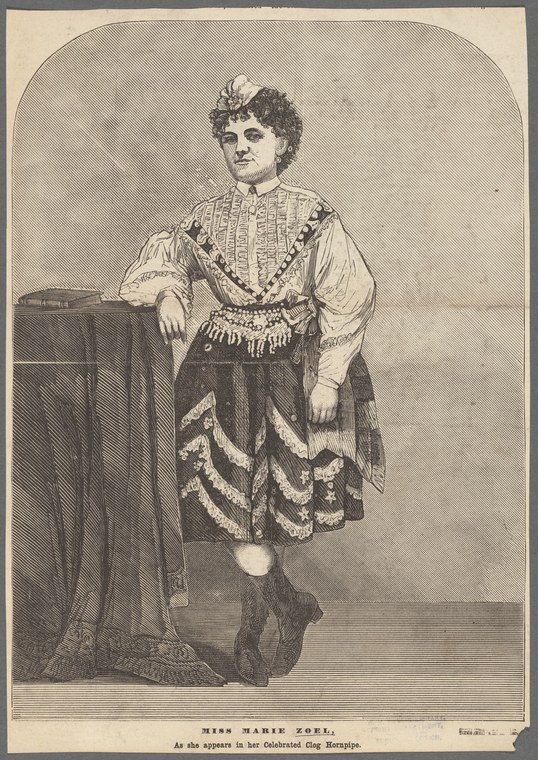
Miss Marie Zoel, as she appears in her celebrated clog hornpipe
Unknown artist
- Collection:
- Prints depicting dance
- Source:
- New York Public Library
- Rights:
- Public domain — free to use, share and adapt.
- Recorded as:
- Public Domain
This is a historical document of a working theatrical dancer and a now-marginal dance form that was once central to popular entertainment. It shows us how clog dancers dressed, how they were marketed to audiences, and confirms the existence of celebrated performers whose names have otherwise vanished from the historical record. For historians of vernacular and popular dance, particularly the step-based traditions that fed into later American tap and clogging, this image is evidence of an earlier professional practice.
What you are looking at
A young woman stands in three-quarter pose against a neutral background, her weight supported on her right leg in a characteristic performance stance. She wears a white cotton chemise with gathered sleeves and ornate pleating across the chest, typical of mid-19th-century theatrical costume. Over this sits a richly decorated dark skirt with scalloped appliqué and ornamental fringe at the waist, and what appears to be a decorative sash or belt with tassel trim. A small white cap or bonnet sits atop her curled dark hair. Her left arm rests casually at her side while her right arm is positioned with hand on hip, a pose suggesting confidence and readiness. The composition is intimate and portrait-like rather than action-filled; the dancer is presented to the viewer as a personality and performer rather than caught mid-movement. A draped fabric falls from the left edge of the frame, and the overall engraving technique creates a soft modeling of form through careful cross-hatching.
The dancing
A single female performer occupies the frame, depicted in a standing position with a slight sway to the hips and an alert, engaged posture. The body language suggests performance confidence—shoulders back, gaze forward and slightly to the side, one arm relaxed and one hip cocked. The weight distribution and the slight twist through the torso suggest a dancer between movements rather than in mid-step, a moment of presentation rather than active execution. The proportions and the way the body is modeled suggest this is a portrait of a known performer rather than a generic dance figure.
The dance depicted
The title identifies this as Miss Marie Zoel performing her celebrated clog hornpipe. The hornpipe was a common theatrical solo dance of the Gilded Age, performed by both male and female dancers, characterized by lively footwork and rhythmic percussion from wooden-soled shoes or clogs striking the stage floor. The costume—a modest working-class or country-style dress with sturdy skirts rather than a tutu—is consistent with the theatrical hornpipe tradition as distinct from ballet. The clog hornpipe was typically a virtuosic display piece showcasing rapid, complex footwork and sharp rhythmic articulation. This image presents the dancer in performance attire and in the confident, forward-facing pose conventional for theatrical portraits of solo performers, but the stillness of the engraving prevents us from seeing the actual footwork or the dynamic quality that would define the dance itself.
How it was made
This is a wood engraving or steel engraving, a relief or intaglio process that creates fine lines through the interaction of burin and metal. The technique allows for precise rendering of fabric texture, the delicate pleating of the chemise, and the subtle modeling of the face and hands through cross-hatching. The image is printed rather than drawn, as evidenced by the uniform tone and the character of the line work. This suggests a work intended for mass circulation—likely a theatrical print published for sale to audiences, collectors, or as part of a theatrical publication. The care taken with the rendering of costume detail and the quality of the printing suggest a commercial venture aimed at a middle-class audience interested in theatrical performers and fashionable dress.
About this work
This engraved portrait documents Miss Marie Zoel in the costume and pose of her signature performance piece, a clog hornpipe—a solo dance form that was a staple of English and American theatrical entertainment in the mid-to-late 19th century. The work belongs to the tradition of theatrical portraiture that celebrated individual performers and their signature roles, circulating their image and helping to build their fame and draw audiences. It is a historical record of a dance form and a performer now lost to memory, preserved in the documentary detail that theatrical prints could achieve. The clog hornpipe was a display piece for virtuosic footwork and rhythmic precision, standing apart from the ballet aesthetic that was simultaneously gaining prestige on the theatrical stage; this image records a moment in the contest between different performance vocabularies.
How to look at it
Attend to the costume: the sturdy working-dress aesthetic, the emphasis on the legs and feet (visible and unencumbered by the skirt), and the practical nature of the outfit, which contrasts sharply with the ethereal tutus and satin slippers of ballet contemporaries. The pose itself—standing, alert, self-possessed—is typical of theatrical portraiture of the period, designed to convey the performer's personality and professional confidence rather than to capture a moment of choreography. The engraving technique, with its fine detail and formal framing, positions the dancer as a subject worthy of artistic documentation, a claim to respectability for a performer from the popular rather than the elite theatrical world.
The period
In the mid-19th century, the theatrical landscape was divided between the prestige world of ballet, which looked to Europe and to pointe work and romantic narratives, and the popular world of music hall, pantomime, and variety entertainment. The clog dance belonged to the latter sphere—it was a virtuosic but working-class form, performed by men and women in theaters and music halls throughout Britain and America. The hornpipe itself had earlier roots in sailor culture and folk tradition; the clog version was a theatrical elaboration, performed in costume with an emphasis on visible, percussive footwork that delighted audiences through technical display rather than narrative or ethereal movement. This period saw the rise of the celebrity performer and the theatrical print as a medium for circulating their image; unlike earlier dance forms documented in prints, the clog hornpipe was contemporary, urban, and commercial.
Where it lives
This print is held in the New York Public Library's collection of prints depicting dance. It belongs to the category of 19th-century theatrical prints, commercial engravings produced for sale to audiences and collectors interested in theatrical performers and their roles.
Dance in this work
Questions about this work
What is a clog hornpipe?
A clog hornpipe is a solo dance performed to hornpipe music, in which the dancer wears wooden-soled shoes or clogs that strike the stage floor to produce rhythmic percussion. The dance emphasizes rapid, complex footwork and articulate rhythmic patterns, and was a popular display piece in 19th-century English and American theaters. It belongs to a tradition of step-based, rhythm-focused dance that is ancestral to later American tap dance.
Who was Marie Zoel?
Marie Zoel was a theatrical dancer celebrated for her performance of the clog hornpipe, as documented by this print. Beyond the evidence of this portrait, little else is recorded about her life or career, making this engraving one of the primary documents of her existence and fame.
Why did theatrical dancers wear clogs?
The wooden sole of a clog produces a sharp, loud percussion when struck against the stage floor, allowing the audience to hear as well as see the dancer's footwork. This made the rhythmic complexity and technical precision of the dance audible, and was part of the appeal of clog dancing as a virtuosic display form.
How does clog hornpipe relate to tap dance?
Clog dancing and tap dance are related forms that developed in parallel in the 19th century, both emphasizing percussive footwork and rhythmic articulation. Tap dance, which emerged in America in the late 19th and early 20th centuries, incorporated elements of clog technique alongside Irish step traditions and African-American rhythmic traditions, synthesizing them into a new form.
More dance artwork





