49 works in this view — arrow keys or swipe to move between them.
Dance in Art
The reel; Breaking up for the holidays
Unknown artist
- Collection:
- Prints depicting dance
- Source:
- New York Public Library
- Rights:
- Public domain — free to use, share and adapt.
- Recorded as:
- Public Domain
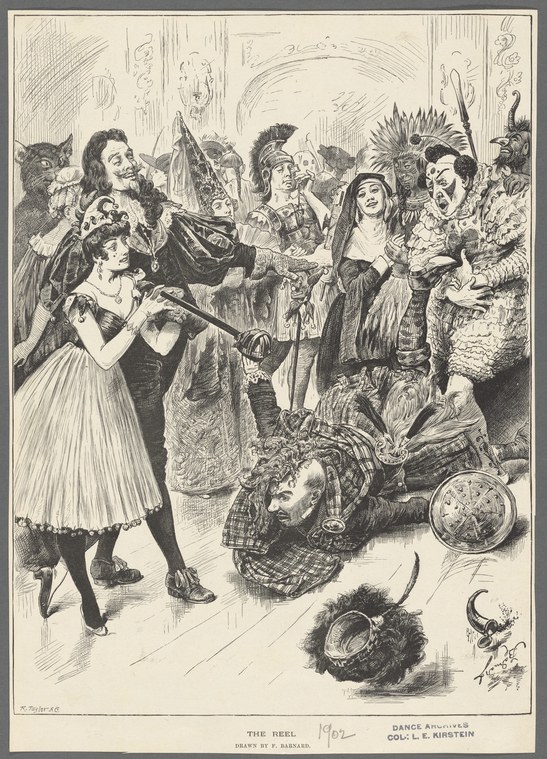
The image captures reel-dancing as lived social practice rather than as a formal or theatrical pursuit, showing how the dance functioned in mixed-gender, multi-generational community settings. The composition—with its emphasis on gesture, costume, and moment rather than footwork—reveals what the artist and audience considered visually significant about social dance: sociability, festive mood, and the breakdown of formal decorum, not technical mastery.
What you are looking at
A crowded interior scene alive with festive energy, captured in energetic pen and ink linework. A group of costumed revelers occupies the center and right side of the composition—some in elaborate fancy dress including what appears to be a figure with a spiked headdress, another in checked or patterned clothing crouched low, figures in flowing skirts and period costume. A young woman in a simple white dress and dark shoes stands prominent at left-center, her body angled into the crowd with one arm raised as though participating in or reacting to the merriment. The setting is an interior space with decorative architectural details visible—paneled walls, ornamental designs—suggesting a private house or ballroom. The artist has used vigorous cross-hatching and varied line weight to suggest movement and shadow, creating a sense of chaos and liveliness appropriate to what the title suggests is the breaking up of a dance or gathering for holiday leave. Small still-life elements in the foreground—what appear to be dishes or household objects—anchor the scene in a domestic or semi-public space.
The dancing
The figures are rendered in varied states of motion and repose, clustered tightly without the formal positioning of ballroom dance. The woman in white stands with her weight shifted, arms open or raised, her posture suggesting spontaneous movement or response rather than trained technique. The crouching figure in checked clothing and several of the costumed figures adopt exaggerated, playful poses—leaning, bending, gesticulating—that suggest folk, carnival, or social dance rather than ballroom form. There is no evidence of closed holds or the upright frame of formal dance. The composition emphasizes chaos and informal sociability over the geometric order of partnered dance.
The dance depicted
This appears to document a reel—a folk-regional dance of Scotland and Northern England, typically performed in groups with quick, energetic footwork and traveling steps. The title explicitly names it: *The Reel*. The 'breaking up for the holidays' subtitle suggests this captures the moment when dancers and revelers are concluding a gathering, perhaps transitioning from structured dance to informal celebration. The costume and domestic setting place this in the nineteenth century, when reels were danced in village halls, at celebrations, and in homes. The artist has chosen a moment of social exuberance rather than technical precision, emphasizing the festive, communal nature of the reel as popular entertainment rather than performance spectacle.
How it was made
This is a pen-and-ink drawing or engraving, likely a wood engraving or steel engraving given the fine, controlled linework and the density of hatching used to model form and create tonal variation. The medium allows for precise rendering of costume and facial expression while maintaining the spontaneity of sketch. The publication source (NYPL) and the finished quality suggest this was a print intended for periodical or book illustration, circulating widely rather than as a unique work. The technique—particularly the use of linear hatching to suggest movement and the economical rendering of architectural space—is consistent with nineteenth-century illustrated journalism.
About this work
This is a scene of social dance captured at the moment of dissolution—not the formal execution of steps but the joyous, chaotic aftermath of a reel at a holiday celebration. The work documents both the dance itself and the culture surrounding it: a mixed group of costumed or ordinarily dressed people in a domestic interior, the emphasis on communal participation and festive mood rather than technical display. It is an engraving or wood-cut print, a medium suited to the rapid circulation that such scenes enjoyed in illustrated periodicals of the nineteenth century. The work belongs to a tradition of depicting folk and social dance as a window into popular life and manners.
How to look at it
Attend to the artist's choice of the moment of *dissolution* rather than the moment of execution: the dance is ending, the formal structure is breaking apart, and the figures are captured in the transition to informal social interaction. This choice reveals what made the reel culturally significant—not the steps themselves but the communal and festive experience. Notice how the artist uses posture and gesture rather than footwork to convey the sense of movement; the exaggerated, playful attitudes of the costumed figures are legible as dance-related joy even without understanding the actual steps. The composition is deliberately crowded and asymmetrical, avoiding the geometric order that would be expected in a formal ballroom scene.
The artist
The artist is not recorded in the catalogue. The style and technique—the fine, controlled pen-work, the sophisticated use of hatching to model figures and create depth, and the apparent publication context—suggest a professional illustrator or print-maker active in the nineteenth century, likely trained in wood or steel engraving for periodical illustration.
The period
The nineteenth century saw both the professionalization of ballroom dance (waltz, quadrille, polka becoming standardized and taught formally) and a parallel artistic and literary interest in folk and 'traditional' dances as expressions of authentic popular culture. Reels remained central to Scottish and Northern English social life, but increasingly were viewed through the lens of antiquarianism and national sentiment. Illustrated periodicals and gift books made images of social dance widely available, often with an admixture of humor and sentiment. This work sits within that tradition of documenting the reel as part of British folk heritage and seasonal celebration.
Where it lives
Held in the New York Public Library's Prints collection, which documents the work as part of the broader archive of dance-related imagery in periodical and book illustration. The inscription visible in the image ('S. Murdoch' and what appears to be publication information) may identify the artist or engraver, though the catalogue record does not confirm this.
Dance in this work
Questions about this work
What is a reel?
A reel is a Scottish and Northern English folk dance performed in a group, typically in a line or circular formation, with rapid footwork and traveling steps. It is danced to Scottish reel music in quick 4/4 time. Reels were (and remain) central to Scottish social dance and community celebration, performed at holidays, weddings, and ceilidhs. Unlike ballroom dances of the same period, reels emphasize participation over formality.
Why would a reel be 'breaking up for the holidays'?
The subtitle suggests this image captures the moment when a reel dance or a broader holiday gathering is concluding—perhaps at the end of an evening, or at a transition point when the formal dancing gives way to informal socializing and departure. Holiday gatherings often culminated in reels as a way to send guests off in high spirits.
Is this a photograph or a drawing?
This is a print—likely an engraving or wood engraving, made from a drawn image. The fine, controlled linework and the pattern of hatching used to create shadow and depth are characteristic of nineteenth-century engraving technique. It was created for circulation in a periodical or illustrated book, not drawn from life in the moment.
How do we know this is a reel and not some other dance?
The title explicitly identifies it as 'The Reel.' The costume, setting (a domestic or semi-public interior), and the informal, mixed-gender grouping are consistent with how reels were danced in the nineteenth-century British Isles. The emphasis on group participation and exuberant, playful gesture aligns with the social function of the reel in popular culture.
More dance artwork





