49 works in this view — arrow keys or swipe to move between them.
Dance in Art
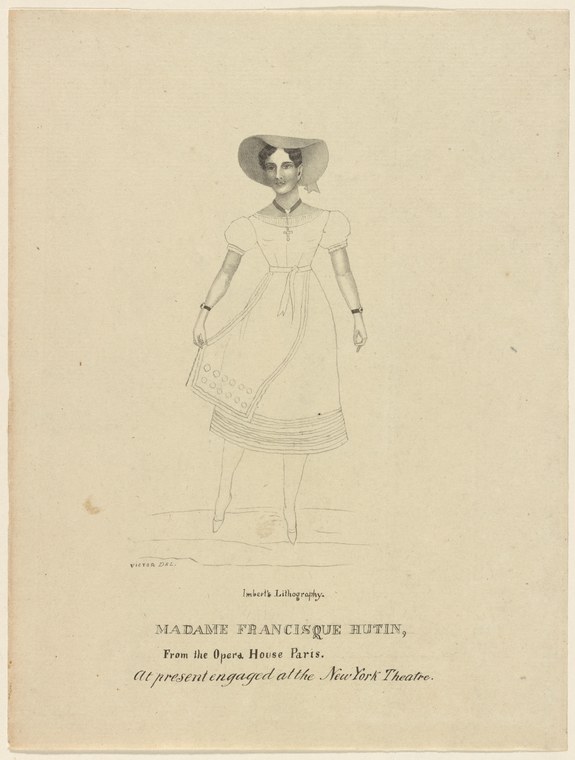
Madame Francisque Hutin, from the Opera House Paris, at present engaged at the New York Theatre
Unknown artist
- Collection:
- Prints depicting dance
- Source:
- New York Public Library
- Rights:
- Public domain — free to use, share and adapt.
- Recorded as:
- Public Domain
This print is evidence of the transatlantic circulation of romantic ballet and its stars during the early 19th century. It shows how performers' images were commodified and mass-produced for popular consumption, and it captures the exact details of stage dress and grooming at a formative moment in ballet history. For dancers and historians, it documents the physical presentation and public persona of a named principal dancer whose own choreographic contributions have largely been forgotten.
What you are looking at
A single female figure stands in a three-quarter frontal pose against a blank ground, depicted in a refined line engraving or lithograph. She wears a high-waisted white muslin dress of early 19th-century cut, with short puffed sleeves and a deep hem decorated with embroidered or printed ornament arranged in horizontal bands. Over this she wears a long shawl or wrap draped across one arm. Her posture is upright and dignified, with one arm held loosely at her side and the other extended slightly as if in gesture. She wears a large plumed bonnet that frames her face and extends well above her head in the fashion of the 1810s–1820s. Her stance suggests neither active motion nor a stable rest; she appears caught between positions, the weight distributed evenly, as if pausing mid-movement or presenting herself to the viewer's regard. The composition is formal and frontal, in the manner of theatrical portraiture.
The dancing
The single dancer is shown in an erect, elongated frame typical of romantic-era theater portraiture. Her weight appears evenly distributed; there is no visible turnout or formal ballet posture, nor any suggestion of tension or athletic engagement. The extended arm and slight forward tilt of the torso suggest a gesture of presentation or acknowledgment rather than active dancing. Her stance is neither grounded nor lifted; it reads as a pause or a bow, the body held in a state of theatrical display rather than kinetic momentum.
The dance depicted
The image appears to be a theatrical portrait of a named performer rather than a representation of a specific dance or choreographic moment. Madame Francisque Hutin was a principal dancer of the Paris Opéra in the early 19th century. The dress and setting suggest this is a record of her appearance in a fashionable theatrical role—likely in a romantic ballet or opera-ballet of the 1810s–1820s—but the pose itself does not depict active dancing. She is shown as a performer presented to the public eye, in her stage costume and bearing, rather than at a moment of choreographic action.
How it was made
This is a lithograph, a process that allowed for rapid reproduction and wide circulation of theatrical portraits. The medium enabled artists to capture fine detail—the plumage of the bonnet, the embroidered hem, the folds of the shawl—with great clarity, while maintaining the economy of line suitable for a portrait print. Lithography was the dominant technology for theatrical publicity in the early 19th century, and the signature or publisher's mark on such works often identifies the performer and the theater. The technique's accessibility made such prints an important means of publicizing performers and theatrical fashion to a broad audience in Paris, London, and beyond.
About this work
This is a theatrical portrait print of Madame Francisque Hutin, a leading dancer of the Paris Opéra, made to publicize her appearance at the New York Theatre. The print records her appearance in an early 19th-century theatrical dress, capturing the fashion and public image of a star performer of the romantic ballet era. Such prints served as advertisements, souvenirs, and records of theatrical celebrity, circulated among audiences on both sides of the Atlantic. The work belongs in a dance gallery as a historical document of how dancers were presented to the public, how their bodies were dressed and posed for display, and how theatrical fame was manufactured and distributed through popular media.
How to look at it
The pose is formal and still, not a moment captured mid-movement. Attend to the costume details—the cut of the dress, the style of the bonnet, the embroidered hem—which are precisely rendered and constitute the 'news' the print conveys to its audience. The extended arm and frontal orientation belong to a tradition of theatrical portraiture in which the performer is displayed for admiration rather than shown dancing. The flatness and clarity of the lithographic line give equal weight to the figure's face and body, emphasizing the importance of the performer's public image and stage presence.
The artist
The catalogue record does not identify the artist. The lithograph is marked 'Imprinted Lithography' and published, as indicated, in connection with the New York Theatre. It is likely the work of a commercial lithographic firm or a theatrical portraitist active in the 1810s–1820s. Such prints were often produced quickly and in series by publishers based in Paris, London, and New York, and individual artists' names were frequently not recorded on theatrical prints of this period.
The period
This print dates to the era of romantic ballet, a period (roughly 1830–1850) marked by the rise of the ballerina as a principal theatrical attraction and the celebration of ethereal, otherworldly female beauty. However, the dress and style of the portrait suggest a date in the 1810s–1820s, before the full codification of romantic ballet aesthetic. This was a transitional period in which ballet was moving away from classical court dance toward a new emphasis on the ballerina as soloist and theatrical star. The rise of lithographic portraiture in this period made possible the mass circulation of dancers' images, transforming them into public celebrities. The print's reference to both the Paris Opéra and the New York Theatre attests to the growing transatlantic exchange of theatrical talent and fashion.
Where it lives
The print is held in the New York Public Library's collection of prints depicting dance. It is a commercial theater portrait, published to advertise and memorialize a performer's engagement at a specific theater. Such prints were produced in runs and distributed as souvenirs, advertisements, and keepsakes for audiences and theatrical professionals.
Questions about this work
Was Madame Hutin a ballet dancer or an opera singer?
The catalogue identifies her as a dancer at the Paris Opéra, where ballet and opera were performed together as part of a unified theatrical tradition. In the early 19th century, principal dancers at the Opéra were often required to perform in both ballet and opera-ballet works. Her costume here is consistent with theatrical dress of the era; the print does not indicate whether she performed primarily in danced or sung roles.
Why is she not shown dancing?
This is a theatrical portrait—a published image of the performer in costume, designed for publicity and sale to the public. Such prints were typically formal and posed, showing the performer's stage appearance and bearing rather than a specific choreographic moment. The pose suggests acknowledgment or presentation rather than active motion, which was conventional for such portraits.
What does the costume tell us?
The high-waisted muslin dress with short puffed sleeves, the large plumed bonnet, and the embroidered hem are all consistent with European theatrical fashion of the 1810s–1820s. The simplicity and lightness of the muslin suggest a fashionable, modern dress for the period. The bonnet and shawl indicate a lady of rank and fashion. Together, they present the performer as a woman of refinement and taste, appealing to a middle- and upper-class audience.
More dance artwork





