49 works in this view — arrow keys or swipe to move between them.
Dance in Art
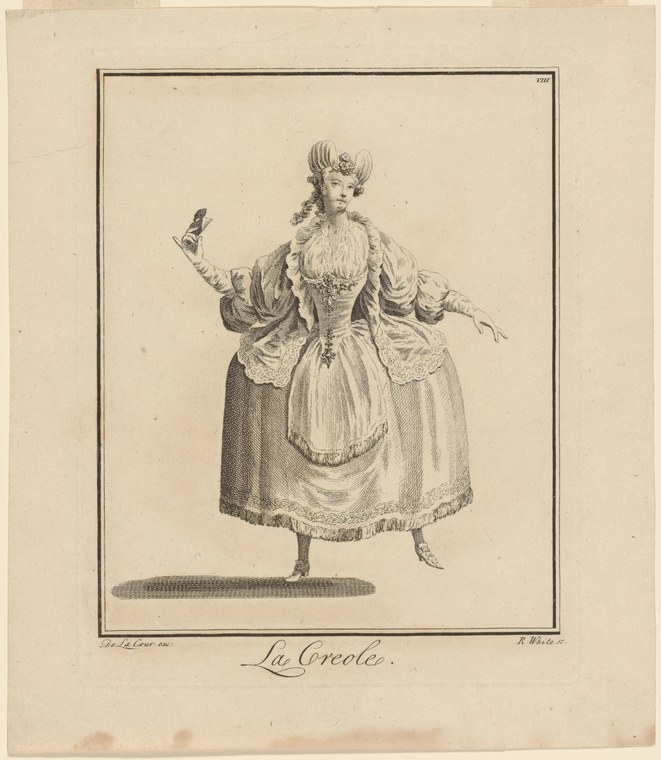
La Creole
Unknown artist
- Collection:
- Prints depicting dance
- Source:
- New York Public Library
- Rights:
- Public domain — free to use, share and adapt.
- Recorded as:
- Public Domain
This image documents the appearance, costume, and bodily aesthetics of late 18th-century European theatrical dance at a moment when such dances were beginning to absorb themes and imagery of European colonialism. It is evidence of how dance imagery was packaged and distributed as fashion and entertainment, and of the specific visual language used to convey feminine beauty and refined movement in the period.
What you are looking at
A single female figure stands against a plain background in a three-quarter pose, gazing toward the viewer's left while raising her right arm in a gesture of acknowledgment or invitation. She wears an elaborate late 18th-century dress: a full skirt with decorative trim at the hem, a fitted bodice with ornamental detail, and voluminous sleeves that drape from the shoulders. Her hair is dressed high in the fashion of the period, adorned with what appears to be feathers or plumes. Her left arm extends downward, and her posture is upright and dignified. The figure is rendered in fine pen work against a cream ground, enclosed within a simple rectangular border. The title "La Creole" appears in script beneath the image.
The dancing
A solitary dancer in a relaxed but poised stance, weight distributed evenly, one arm raised to approximately shoulder height in a welcoming gesture, the other hanging naturally. Her gaze is directed away from the vertical axis of her body, creating a sense of engagement with an unseen partner or audience. The pose suggests a moment between movements rather than a dynamic leap or turn—something closer to a presented position or the opening moment of a dance.
The dance depicted
The image depicts a solo female dancer of the late 18th century, most likely performing a theatrical or salon dance of the period. The title "La Creole" suggests a piece associated with Caribbean or colonial themes, popular in European ballrooms and theaters of this era. The dancer's dress and bearing indicate a work from the world of fashionable court or theatrical dance rather than folk practice. Without additional inscription or documentation, the specific dance form cannot be determined with certainty, though the posture and dress are consistent with the refined social and theatrical dances of the 1770s–1790s.
How it was made
This is a finely executed engraving or etching, likely hand-colored or left in monochrome, executed in the late 18th century. The delicate line work and careful attention to the pleats, texture, and dimensional qualities of the fabric suggest a skilled printmaker working in a medium that allowed for wide circulation and reproduction. The technique enabled this image to be distributed as a fashionable print—a common way for dance styles, costume designs, and performance moments to travel between European cities.
About this work
"La Creole" is a late 18th-century engraved print depicting a fashionable female dancer in the refined dress and posture of late Georgian theatrical dance. The work captures a single figure in a moment of presentation or pause, her gaze and raised arm suggesting interaction with an unseen partner or audience. The title invokes the exotic appeal of colonial themes that fascinated European salons of this period, while the execution as a printed image speaks to the circulation of dance imagery as a commodity and a record of contemporary performance practice.
How to look at it
Attend to the dancer's posture and the direction of her gaze: they suggest a moment of address or acknowledgment rather than a leap or turn. Notice the precision with which the artist has rendered the construction and volume of the dress, particularly the sleeves and bodice—these details were as important to the dance as the body inside them. The engraving technique allows for fine gradations of tone that model the fabric and create a sense of three-dimensionality, a skill that would have been essential to convincing the viewer of the figure's presence and elegance.
The period
The late 18th century saw a flowering of engraved and etched prints documenting fashionable dance, costume, and theater. Dance was increasingly professionalized and commodified; images of dancers circulated widely among the urban middle and upper classes as prints to be collected, displayed, or used as models for dress and deportment. The vogue for "exotic" themes—including "creole" subjects—reflected European colonial expansion and the romanticization of distant lands. Simultaneously, the formal vocabulary of neoclassical dance (which would eventually lead to Romantic ballet) was being codified, emphasizing verticality, lightness, and an ethereal quality of movement.
Where it lives
The work is held in the New York Public Library's Prints collection. It is catalogued as a print from an unknown date by an unrecorded artist, suggesting it was either a commercial product whose authorship was not deemed important, or that the relevant information has been lost.
Dance in this work
Questions about this work
What does 'Creole' mean in this context?
In the late 18th century, 'Creole' was used loosely to evoke Caribbean or tropical themes, which held an exotic appeal for European audiences. It did not necessarily reflect accurate representations of Caribbean culture; rather, it was part of a European fashion for 'exotica' tied to colonialism and the Atlantic slave trade. The dance, costume, and setting were entirely European inventions.
Is this a record of an actual dance performance?
Probably. Prints like this were often based on specific performances or established dances in the repertory of theaters or ballrooms. However, without additional documentation, we cannot identify which performance or which dancer this represents. The image may have also served as a design or costume illustration rather than a record of a specific event.
What was the purpose of printing dance images like this?
Such prints served multiple purposes: they recorded fashionable dances and costumes, provided models for dress and deportment, circulated knowledge of theatrical performances to those who had not seen them live, and functioned as luxury commodities for collectors. They were part of a broader print culture that made dance visible and portable.
More dance artwork





