49 works in this view — arrow keys or swipe to move between them.
Dance in Art
Harlequin
Unknown artist
- Collection:
- Prints depicting dance
- Source:
- New York Public Library
- Rights:
- Public domain — free to use, share and adapt.
- Recorded as:
- Public Domain
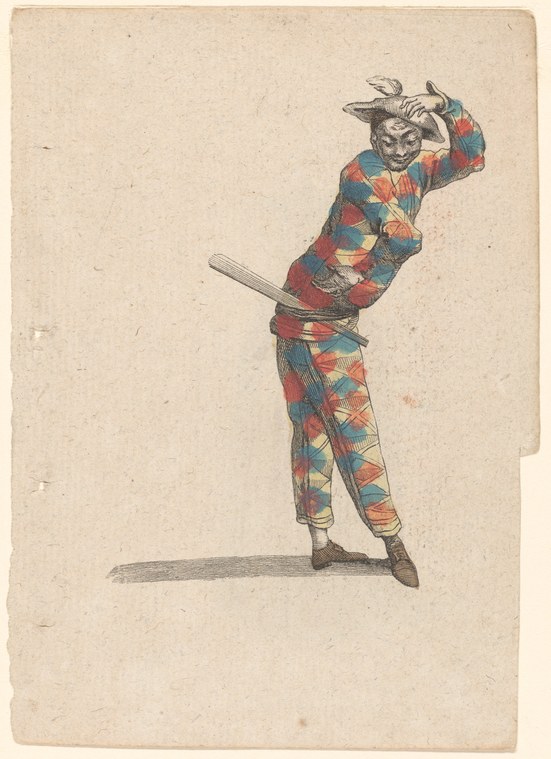
Harlequin's physical vocabulary shaped European theatrical movement for 300 years and influenced the development of ballet and modern theater. This image captures the character type at the moment of performance, showing how commedia's physicality was codified and transmitted—not through written notation, but through portable, hand-colored prints like this one, which traveled across Europe and taught performers and audiences what the character looked like and how he moved.
What you are looking at
A single figure in theatrical costume stands against a plain background in a pose of exuberant performance. The dancer wears a diamond-patterned costume in red, blue, and gold or yellow, divided into vertical sections with a close-fitting cut that emphasizes the body's line. A white collar or ruff frames the neck. The figure's head is tilted upward and back at an extreme angle, one hand raised toward the head in a gesture of flourish or surprise, while the other arm extends outward holding what appears to be a wooden staff or stick. The legs are positioned in a wide stance, one foot forward, clad in dark stockings and shoes with defined heels. The pose conveys playfulness, wit, and the controlled exaggeration typical of commedia dell'arte performance—a moment of comic business captured in mid-gesture.
The dancing
The single dancer is framed in three-quarter view, weight distributed between both feet in a stable but energetic stance. The extreme backward tilt of the head and the raised hand create an S-curve through the torso that reads as both comic and technically controlled. The staff held loosely in the other hand is characteristic of comic stage business rather than a weapon; it appears an accessory to the performance rather than functional. The overall frame suggests a trained performer comfortable with exaggerated, asymmetrical positions—the kind of physical vocabulary that demands practice and spatial awareness.
The dance depicted
This is commedia dell'arte, the Italian masked theatrical form that dominated European entertainment from the 16th through 18th centuries. The figure is almost certainly Arlecchino (Harlequin), identifiable by the diamond-patterned costume and the staff (the *slapstick* or *bastone*), and by the character's association with physical comedy and acrobatic mime. Commedia was not 'dance' in the ballroom or theatrical ballet sense, but it was fundamentally movement-based performance—a vocabulary of exaggerated gesture, comic tumbling, and rhythmic business with props. Harlequin was the nimble, mischievous servant figure, known for quick footwork, pratfalls, and witty physical gags. The pose here captures the theatrical *attitude*—a moment of performed personality rather than a step or sequence.
How it was made
This is a hand-colored engraving or etching on laid paper, made from an inked metal plate and finished with watercolor or gouache. The fine black lines of the printed image are evident in the contours and internal modeling, while the colors—the precise diamond pattern, the red and blue grounds, the gold accents—are applied by hand. This technique allowed for multiple impressions from a single plate, each then colored individually, making the work reproducible and affordable for a broad audience. The style and execution suggest a production for theatrical documentation or popular circulation, likely 16th–18th century.
About this work
This hand-colored engraving documents Harlequin, the central comic character of commedia dell'arte, captured in a moment of theatrical self-presentation. The work is a record of how this character appeared on stage: the costume, the staff, the exaggerated posture that defines his performance idiom. Although commedia was not codified dance, it was entirely a form of physical theater, and Harlequin's repertoire included acrobatic movement, quick footwork, and rhythmic comic business that required trained performers. The image belongs in a gallery of dance because it documents a theatrical movement language—one that influenced ballet, pantomime, and popular performance across centuries.
How to look at it
Notice the extreme tilt of the head and the asymmetry of the pose—this is theater's exaggeration, designed to be readable from the back of a hall and to express character through body language alone. The staff is not threatening but playful, held like a toy or a wand. The backward head and raised hand together suggest a moment of comic shock or delight, a frozen instant from a sequence of quick, energetic business. The precision of the diamond pattern and the well-fitted costume suggest a performer of some status, not a ragged servant—by this period, Harlequin had become a virtuoso role.
The artist
Unknown. The print belongs to a large tradition of commedia dell'arte character sheets and costume documentation produced across Europe, particularly in Italy and France, from the 16th century onward. These prints served as theatrical reference material, souvenirs, and teaching tools. They were often produced in series and colored individually, sometimes by different hands, making attribution difficult. The execution here is competent and the costume rendering precise, suggesting a producer or publisher with access to actors or reliable theatrical records.
The period
Commedia dell'arte flourished from the mid-16th century through the 18th century, particularly in Italy and France. By the 17th and 18th centuries, the form had become internationally famous, with traveling companies performing across Europe. Harlequin evolved from a simple peasant or servant character into the most beloved and complex figure in the commedia repertoire—witty, physically gifted, and capable of both slapstick and subtle mime. The character was adopted into ballet and pantomime in the 18th and 19th centuries; many of the earliest ballets and English pantomimes featured Harlequin as a protagonist. This print likely dates to a period when Harlequin was at peak popularity and standardization of costume was well established.
Where it lives
The work is held in the New York Public Library's collection of prints depicting dance. It is catalogued by genre and subject rather than by artist or date, which is typical of large institutional collections of theatrical ephemera and popular prints.
Questions about this work
Was Harlequin a real person or a character?
Harlequin is a character type created by commedia dell'arte, the Italian improvisational theater tradition. Different actors played Harlequin over centuries, each bringing their own interpretation, but the role had recognizable traits: quick wit, physical agility, mischief, and loyalty to his employer or fellow servants. The character became so famous that he appeared in ballets, pantomimes, and popular theater well into the 19th century.
What is that stick he is holding?
That is a *slapstick* (Italian *bastone*), a flat wooden paddle or stick that Harlequin and other commedia characters used in comedy. Actors would slap the stick against scenery, props, or (very carefully) other actors to create comic sound effects and physical gags. It was both a weapon of sorts and a prop, always handled with theatrical flair.
Is commedia dell'arte a dance form?
Commedia dell'arte is not dance in the technical sense—it is improvisational theatrical performance based on stock characters and scenarios. However, it is fundamentally movement-based. Harlequin and other characters were known for acrobatic feats, quick footwork, and rhythmic physical business. The form influenced the development of theatrical dance and pantomime, and many early ballets incorporated commedia characters and their movement vocabulary.
Why are there so many hand-colored prints of Harlequin?
Commedia characters were celebrities of their day, and prints served multiple purposes: theater promotion, souvenirs for audiences, reference materials for other performers and theaters, and general popular entertainment. A single engraved plate could be printed many times and colored by hand, making it an affordable and reproducible way to spread knowledge of a character's appearance and costume across regions and generations.
More dance artwork





