49 works in this view — arrow keys or swipe to move between them.
Dance in Art
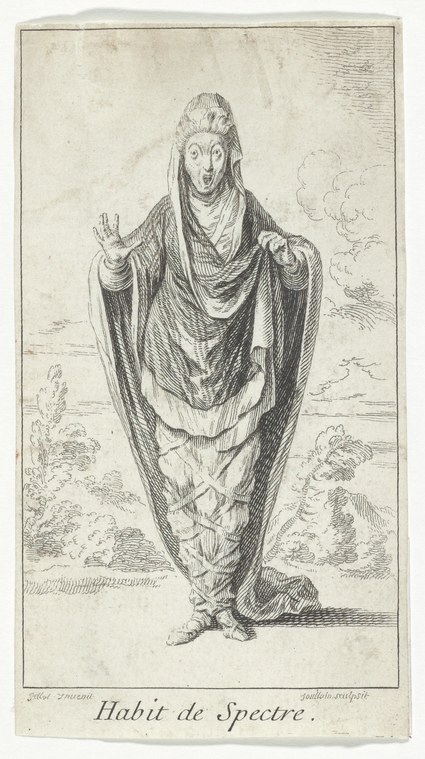
Habit de spectre
Unknown artist
- Collection:
- Prints depicting dance
- Source:
- New York Public Library
- Rights:
- Public domain — free to use, share and adapt.
- Recorded as:
- Public Domain
This work documents an important tradition in early modern performance: the visual codification of supernatural and fantastical characters through costume and gesture. The intensity of the facial expression and the rigid, symmetrical presentation suggest a figure designed to frighten or astonish—a character type that appears in carnival, masquerade, and early modern theatrical spectacle, all of which informed later dance practice.
What you are looking at
A single draped figure stands frontally against a distant landscape of rolling hills and clouds. The person wears voluminous dark fabric—a long cloak or robe—that wraps entirely around the body, leaving only the face and hands visible. The head is covered with a close-fitting hood or cap, and the face is rendered with an expression of intense, almost shocked surprise: wide eyes, open mouth, raised eyebrows. The hands are positioned at shoulder height with palms forward in a gesture of alarm or entreaty. The figure's posture is rigid and vertical, the drapery falling in heavy, sculptural folds that obscure the legs entirely. The setting is sparse and atmospheric: the landscape recedes dramatically into mist, with a single small figure visible in the middle distance to the left, suggesting this apparition is observed from afar. The engraving technique creates fine parallel lines (hatching) to model the fabric's volume and the face's emotional intensity.
The dancing
A single standing figure with arms raised to approximately shoulder height, palms facing outward—a posture of alarm, warning, or supernatural manifestation. The body beneath the heavy drapery is entirely immobilized; no sense of weight distribution, no counterpose, no indication of weight shift or locomotion. The face is the emotional center: the eyes are enlarged and the mouth is open as if crying out. The overall frame is symmetrical and frontal, like a heraldic emblem or religious apparition rather than a dancing body. There is no evidence of any movement vocabulary or dance hold.
The dance depicted
This is not a dance image. The title 'Habit de spectre' (Spectre's Costume) and the figure's rigid, symmetrical stance indicate this is a representation of a ghost or supernatural being, likely from theatrical or masquerade tradition—possibly a costume design or character study. The raised hands and open-mouthed expression suggest alarm or otherworldly warning rather than any choreographic content. The complete stillness and frontality of the composition, combined with the immobilizing heavy drapery, place this firmly outside kinetic dance practice.
How it was made
This is an engraving or etching on paper, executed in fine linear hatching characteristic of early modern printmaking. The technique creates tonal modeling through density of parallel lines, particularly visible in the rendering of the drapery's volume and the face's emotional expression. The fine detail and precision suggest a professional print, likely produced for circulation as a single sheet—possibly a costume design document, a theatrical record, or a work of fantastical imagination. The print's small size and portable format would have made it accessible to theater practitioners, collectors, and the educated public.
About this work
This is an engraved print depicting a ghostly or supernatural figure in heavy, concealing drapery, titled 'Habit de spectre.' The work does not depict dance but rather theatrical costume design or character representation from the early modern period. The figure's rigid frontality, immobilizing garments, and expression of alarm mark it as a study of an otherworldly or supernatural character—possibly from masquerade tradition, carnival, or theatrical spectacle. While costume and masquerade are adjacent to dance history, this particular work represents a non-dancing theatrical figure. It belongs in a dance archive primarily as evidence of the visual culture surrounding performance traditions, costume practice, and the boundaries between theatrical character and choreographic movement.
How to look at it
Attend to the facial expression first: the wide eyes, raised eyebrows, and open mouth convey an emotion of alarm or supernatural presence. Then observe how the heavy drapery completely encloses the body, rendering it immobile and abstract—a costume rather than a body in motion. The artist has chosen a moment of stillness and confrontation; the figure addresses the viewer directly, frontally, with no suggestion of the weight shifts, flow, or spatial projection that would characterize dance. The symmetry and formality of the composition emphasize the otherworldly, symbolic nature of the costume over any naturalistic representation of a moving body.
The period
The style and technique suggest this print dates from the 16th–18th centuries, when costume designs and theatrical character studies were widely circulated as engravings. Masquerade and carnival traditions throughout Europe included ghost figures, spectral beings, and supernatural characters, often represented through heavy drapery and startling facial expressions. The print's formal qualities—the frontality, the precision of the engraved line, the atmospheric landscape background—are consistent with Northern European or Flemish print traditions of the Renaissance and early modern period.
Where it lives
The work is held in the New York Public Library's collection of prints depicting dance, though it does not itself depict dance. It appears to be catalogued as a theatrical or masquerade costume design document.
Questions about this work
Is this a dance image?
No. While the work is catalogued in a dance collection, it depicts a ghostly or supernatural theatrical character in a non-dancing pose. The rigid frontality, immobilizing drapery, and expression of alarm indicate a figure designed to represent or frighten rather than to move. The title, 'Habit de spectre' (Spectre's Costume), confirms this is a costume study, not a choreographic record.
What period is this from?
The engraving technique and style suggest the 16th–18th centuries, when costume designs and character studies were widely circulated as prints. The composition and formal qualities are consistent with Northern European or Flemish printmaking traditions.
Why would a ghost costume be in a dance collection?
Masquerade, carnival, and early modern theatrical spectacle—all of which incorporated supernatural and fantastical characters—were important contexts for the development of dance and performance. Such costume designs document the visual culture surrounding performance traditions, even when the individual figure is not depicted in motion.
More dance artwork





