49 works in this view — arrow keys or swipe to move between them.
Dance in Art
The polka on 19th-century music covers
Unknown artist
- Collection:
- Prints depicting dance
- Source:
- New York Public Library
- Rights:
- Public domain — free to use, share and adapt.
- Recorded as:
- Public Domain
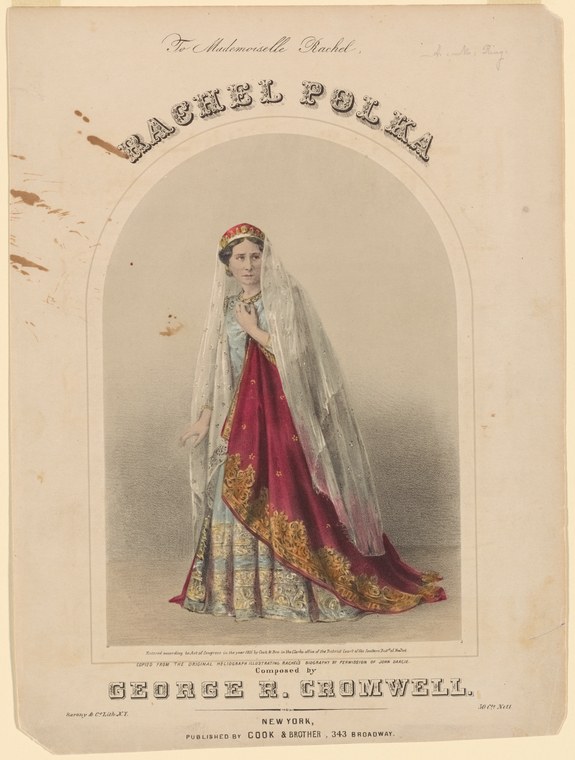
The polka was a revolutionary social dance that broke down older barriers between folk and ballroom, and between audience and performer; studying how it was marketed and represented tells us what made it so powerful. This image is evidence of how rapidly dance fashion could spread through print culture and commercial popular music in the nineteenth century, and how a single published cover could serve as both advertisement and instruction manual for a dance that millions wanted to learn.
What you are looking at
A single female figure stands in formal pose wearing a grand Romantic-era ball gown. The dress consists of a deep crimson skirt with ornate gold embroidery at the hem, worn over what appears to be a full crinoline or hoop skirt to achieve the characteristic bell silhouette of the 1840s–1850s. Over her shoulders and flowing down her back is a gossamer white lace veil or shawl, secured by a jeweled coronet or tiara. She wears what appear to be formal white or pale gloves extending to the elbow. Her posture is upright and dignified, with one arm relaxed at her side and the other held gracefully. The figure is posed within an oval tondo or circular frame, a convention of formal theatrical portraiture. The background is neutral and shaded, throwing the figure and her elaborate costume into high relief. The print is titled in large letters at the top: "RACHEL POLKA," and attributes the music to "GEORGE E. CROMWELL" at the bottom, with publication information for New York.
The dancing
A single standing figure in ballroom posture—upright carriage, weight evenly distributed, arms positioned with classical restraint and grace. The dancer's stance is formal and presentational rather than dynamic; she is frozen in a moment of dignified stillness rather than mid-movement. The costume and pose suggest the conventions of mid-nineteenth-century theatrical dance portraiture, where the dancer is presented to the viewer as an object of admiration rather than caught in the act of performance.
The dance depicted
This is a polka, as stated in the title. The polka was one of the most fashionable social and theatrical dances of the 1840s–1860s, originating in Bohemia and spreading rapidly through Europe and America. The figure's dress—the formal ball gown with crinolined skirt—indicates this is not a performance costume designed to show off footwork or athletic movement, but rather theatrical presentation of the polka as a ballroom dance. The image documents how the polka was understood and marketed in mid-Victorian America: as an elegant, refined social dance that a woman of standing might perform in formal dress, not as a folk or peasant dance.
How it was made
This is a hand-colored lithograph or lithographed engraving, characteristic of popular music-cover artwork of the mid-nineteenth century. The reproduction technique allowed for relatively inexpensive mass production and wide circulation of theatrical imagery. The use of color—particularly the rich crimsons and gold—and the careful gradation of shading in the background suggest hand coloring applied to a lithographed or printed base. This format and method of distribution placed the image within a commercial popular-music market: this was the cover of a published musical composition, meant to be sold as sheet music and to circulate through domestic piano use.
About this work
This is a theatrical music-cover print, circa 1840s–1850s, documenting the polka craze that swept America and Europe in the mid-nineteenth century. It presents the polka not as a folk or peasant dance but as a refined ballroom entertainment suitable for formal theatrical presentation and domestic performance. The image shows us how the polka was marketed and understood in urban American popular culture: as an elegant social dance whose main costume was the fashionable crinoline ball gown. The attribution to the dancer "Rachel"—likely a known performer of the period—and the publication by Cook & Brother in New York place this within the commercial infrastructure of mid-nineteenth-century American entertainment. This is one of thousands of similar covers produced to capitalize on the social dance fads of the era.
How to look at it
The figure is presented in formal pose—neither caught mid-movement nor in the energetic, hopping step the polka required—but rather as a costume and a vision to be admired. The effect is theatrical rather than documentary: this is not a record of how the polka actually looked when danced. Instead, attention to the ornate costume, the delicate veil, and the formal bearings tells us what values the image is promoting: refinement, elegance, and theatrical presentation of the female dancer as object of desire. The polka itself—fast, energetic, requiring quick footwork and a playful rhythmic accent—is entirely absent from what we see. The visual strategy is to claim the polka as a ballroom entertainment suitable for the drawing room and the theater, not a folk dance for peasants.
The artist
The artist is not recorded. The work is attributed to George E. Cromwell as composer of the music. The print was published by Cook & Brother, a New York music publisher active in the mid-nineteenth century. The production of such theatrical music covers was a commercial industry employing numerous anonymous lithographers and colorists whose work circulated widely but whose names were often not recorded.
The period
The polka emerged in Bohemia in the 1830s and by the mid-1840s had become the dominant social dance of Europe and America, surpassing the waltz and quadrille in popularity. The dance was associated with modernity, energy, and a democratic mixing of social classes—it was danced in ballrooms by the wealthy but had folk origins and peasant associations that made it thrilling to urban audiences. In the 1840s–1850s, the polka was constantly reinvented and marketed through popular media: sheet music, theatrical performances, instructional books, and prints like this one. Lithographic music covers became a major vehicle for promoting specific dances and the performers associated with them. The simultaneous development of the steel hoop skirt and crinoline in the 1840s–1850s meant that women's ballroom dress became increasingly elaborate and voluminous, creating a visual spectacle around the female dancer's body that music covers like this one exploited.
Where it lives
This is a music-cover lithograph from the New York Public Library's collection of prints depicting dance, held in their dance iconography or theater collection. It is a commercial print product: the cover of published sheet music for a musical composition titled "Rachel Polka," published by Cook & Brother in New York in the mid-nineteenth century.
Dance in this work
Questions about this work
Who was Rachel?
The catalogue record does not identify her beyond the attribution on the print itself. She was likely a known dancer or performer of the 1840s–1850s, and the polka was probably associated with her or performed by her in a well-known theatrical context. Many such performers are now obscure; the name "Rachel" was borne by at least one celebrated French actress of the mid-nineteenth century, but we cannot confirm her identity from the print alone.
Was the polka really danced in crinolines like this?
Yes, by the 1850s wealthy women did perform polkas in full ball gowns with crinolines; the fashion for wide skirts grew throughout the decade. However, the polka was also danced in simpler dress, and the fastest, most athletic versions of the dance required more freedom of movement than a heavily boned crinoline permitted. This image presents an idealized, theatrical version of the polka suited to formal performance rather than the social versions that ordinary people danced.
Why is this image on a music cover rather than a stage photograph?
Photography existed in the 1840s–1850s but was still expensive and technically difficult. Lithography was faster, cheaper, and allowed hand coloring and idealization. Theater music covers were a major marketing and promotional medium: they advertised both the music and the performer, and families would buy sheet music to play the tune at home on the piano. The cover image served the same function as a photograph or advertisement would today.
More dance artwork





