49 works in this view — arrow keys or swipe to move between them.
Dance in Art
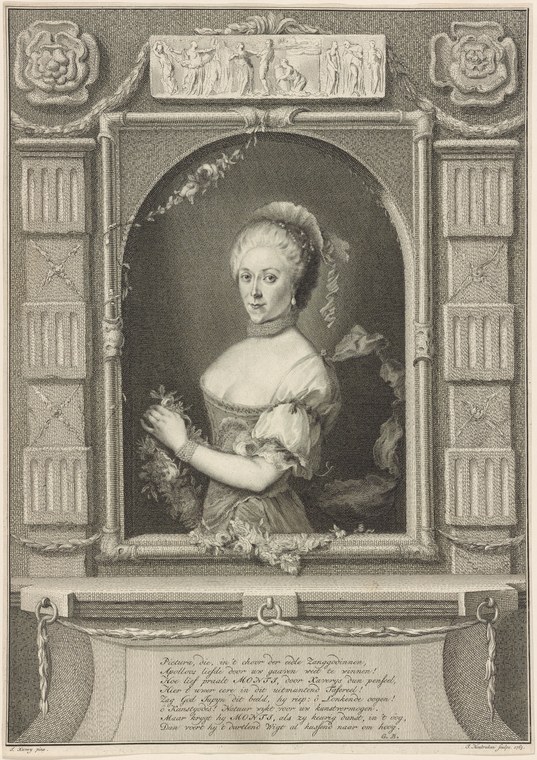
Portrait of Regina Monti
Unknown artist
- Collection:
- Prints depicting dance
- Source:
- New York Public Library
- Rights:
- Public domain — free to use, share and adapt.
- Recorded as:
- Public Domain
For dancers and historians, this engraving documents how a woman identified as or connected to performance was presented to the public in the late 18th century. The image reveals the intersection of fashion, courtly deportment, and the visual culture of celebrity in the period before modern photography—showing us how dancers and performers were expected to embody refinement and elegance even in their still portraits.
What you are looking at
A half-length portrait of a young woman set within an elaborate neoclassical architectural frame. She is shown from roughly the waist up, turned three-quarters to the viewer's right, wearing a sheer, high-waisted white or cream-colored gown with delicate puffed sleeves and decorative drapery at the bodice. Her hair is styled in the fashionable arrangement of the late 18th century, pulled up and back with ringlets or curls escaping at the sides and back, adorned with what appears to be a feathered ornament or aigrette. She holds flowers—likely roses—in her right hand, resting against her body. Her gaze is direct and composed. The frame itself is ornamental, featuring fluted pilasters on either side, decorative rosettes at the corners, and a frieze of classical figures at the top. Below the portrait hangs a draped swag with rings or clasps. The entire composition is rendered as an engraving in fine lines and careful cross-hatching, creating a tonal depth against the white paper. There is an inscription at the very bottom in what appears to be German script, though it is not fully legible in reproduction.
The dancing
The woman's posture is upright and graceful, with her shoulders relaxed and her weight centered. Her arms frame her body loosely—the left arm hangs naturally while the right rests with the flowers at her lap. There is no active dance gesture or balletic port de bras; the pose is that of a fashionable portrait subject. Her bearing suggests training in deportment and courtly grace, but no specific choreographic vocabulary is visible.
The dance depicted
This is not a depiction of dance in action. Rather, it is a formal portrait of what appears to be a named individual—likely a performer or public figure—rendered in the neoclassical portrait style of the late 18th century. The flowers and the refined dress suggest she may have been a dancer, actress, or court musician, but the image captures only her social presentation, not her art. The elegant, unstudied posture and the fashionable silhouette align with the refined aesthetic values of the period in which dancers and performers were celebrated as cultured individuals.
How it was made
This is an engraving, executed in the classical linear style typical of portrait engravings from the late 18th century. The fine, parallel lines (hatching and cross-hatching) create modeling and depth without color, allowing for wide distribution and collecting. The architectural frame is characteristic of German and Austrian portrait engravings of this era, suggesting this was a work intended for a cultivated audience familiar with neoclassical design. The precision of the work and the formal framing indicate this was a commercial publication or commission, likely produced in multiple impressions.
About this work
This is a formal portrait engraving of Regina Monti, rendered in the refined neoclassical style of the late 18th century. The sitter is presented as a fashionable and cultured woman of her time, her appearance aligned with contemporary ideals of elegance and refinement. While the catalogue record attributes it to a 'Prints depicting dance' collection, the image itself contains no dance action or choreographic content—only the portrait of an individual whose name or reputation may have been connected to performance or the theatrical world. It belongs in a dance collection as evidence of how performers were pictured and celebrated in their era, and possibly to document a named historical dancer or musician whose biography connects to the dance world.
How to look at it
Attend to the architectural frame as much as the figure within it. The neoclassical ornament—the fluted columns, the classical frieze, the restrained geometry—frames the sitter as a cultured subject worthy of formal commemoration, elevating her from mere entertainer to an object of refined interest. Notice also the handling of the white silk drapery: the engraver uses fine lines and gentle hatching to suggest the translucent, weightless quality of high-waisted Regency fashion, a technical achievement that would have been admired by contemporary collectors. The flowers in her hand are a traditional symbol of feminine grace, but also of the sensibility and refined taste expected of educated women of the period.
The artist
The artist is not recorded in the catalogue. The engraving is executed in the professional linear style of late 18th-century German or Austrian portrait production. The work shows technical competence in the handling of light and drapery, and the ornamental architectural frame suggests it was produced as a formal publication for distribution among cultivated patrons and collectors.
The period
This portrait belongs to the late 18th century, when neoclassicism dominated European visual taste and dance was undergoing a major aesthetic shift. This was the era of Jean-Georges Noverre's *Lettres sur la danse* (1760) and the rise of the *ballet d'action*—a period in which dancers gained status as serious artists and intellectuals rather than mere entertainers. Portraits of dancers and performers began to be produced as luxury engravings for collectors, a sign of their rising cultural prestige. The refined, understated costume and pose reflect Enlightenment ideals of taste and reason applied to the representation of the human body.
Where it lives
The work is held in the New York Public Library's collection of prints depicting dance. No other provenance information is recorded. It appears as an item in a thematic collection rather than a well-documented individual work with acquisition history.
Questions about this work
Is this engraving showing Regina Monti dancing?
No. This is a formal portrait, not a depiction of dance in motion. Regina Monti is shown in standing dress pose, suitable for a print to be hung or bound into a collection. Her identity may have been connected to performance or music, but the image itself is a social or commemorative portrait rather than a record of choreography or movement.
Who was Regina Monti?
The catalogue record does not provide biographical information. Based on the style of the engraving and her name, she may have been an Italian or German performer active in the late 18th century. The presence of her portrait in a dance collection suggests a connection to theater or music, but without further research, her profession and dates are unknown.
Why is this in a dance collection if there is no dancing?
Portraits of named dancers, musicians, and performers are historically important documents of how these individuals were presented to the public and how they saw themselves. This engraving records a moment when performers began to be celebrated as cultured, refined individuals worthy of formal portraiture—a shift in how dance and dancers were valued in society.
More dance artwork





