49 works in this view — arrow keys or swipe to move between them.
Dance in Art
The polka on 19th-century music covers
Unknown artist
- Collection:
- Prints depicting dance
- Source:
- New York Public Library
- Rights:
- Public domain — free to use, share and adapt.
- Recorded as:
- Public Domain
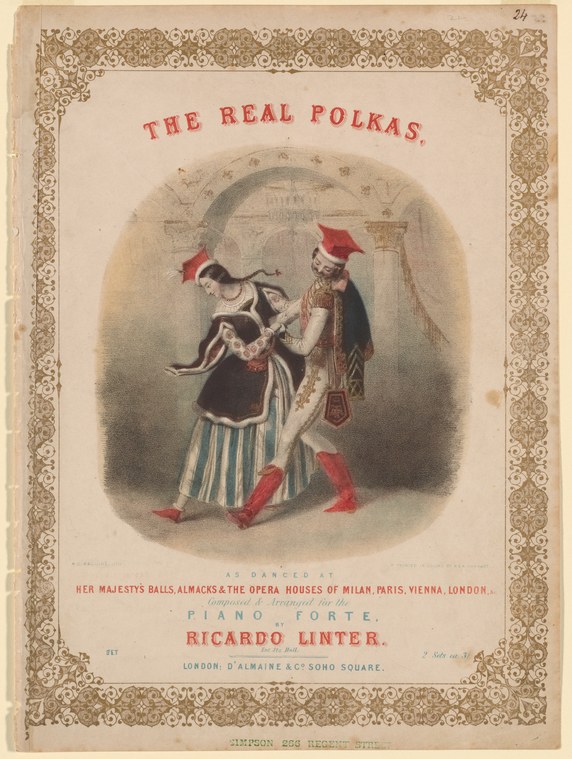
The polka was the first truly international dance craze of the mass-media age, and this image is one of thousands that codified how it should look and be danced. For historians of 19th-century dance, popular culture, and lithography, such covers are primary evidence of how dance imagery was produced, circulated, and consumed at scale. The image also documents a critical moment: the emergence of the middle-class ballroom as the primary site of social dance, and the rise of the fashionable dance as a consumer good and status marker.
What you are looking at
This is a colored lithograph showing two figures in 19th-century dress engaged in a polka, a social dance that became wildly fashionable in Europe during the 1840s–50s. The composition frames them in an oval vignette against a neutral background suggesting an interior space—likely a ballroom or salon. The woman wears a dark dress with a full skirt in the style of the 1840s–50s, with a white or cream underskirt visible as she turns. The man wears formal attire including a dark coat and trousers, and both figures wear the small red hat or cap characteristic of period caricature and popular imagery. The moment captured shows the woman mid-turn, her skirt lifting with the momentum of the dance, while the man guides her with one arm raised. The lithographic technique allows for soft modeling of form and the warm color palette typical of mid-19th-century music-cover printing. The ornamental decorative border in gold filigree frames the scene in the style of commercial sheet music for piano or popular song.
The dancing
The couple is shown in a close social dance hold typical of the polka: the man's right hand guides the woman's waist while his left arm is raised, suggesting he holds her hand or arm in the frame position of partner dancing. The woman leans slightly into the turn with visible forward momentum, her weight on the balls of her feet in a way that suggests springing or hopping action. Her full skirt swirls outward with the centrifugal force of rotation, a key visual signature of the polka in period imagery. Both figures are upright and energetic rather than languid, consistent with a dance known for its brisk, bouncing tempo.
The dance depicted
This is unambiguously a polka, one of the most popular couple dances of the mid-19th century. The polka originated in Bohemia in the 1830s and swept European ballrooms, concert halls, and music halls from the 1840s onward—it became a symbol of modernity and cosmopolitan sophistication. The title *The Real Polkas* and the subtitle advertising its performance "at Her Majesty's Balls, Almacks & the Opera Houses of Milan, Paris, Vienna, London" confirms this was commercial dance music for fashionable venues. The footwork in the image—the bouncing, upright posture and the rapid turning motion—matches period descriptions of the polka's characteristic hop-step pattern. The swirling skirt and the close partnering both emphasize the polka's essential qualities: it was faster, more vigorous, and more intimately partnered than the waltz, and it generated intense social commentary about propriety.
How it was made
This is a hand-colored lithograph, a technology that dominated popular music publishing from the 1840s to the 1890s. Lithography allowed for soft tonal gradations and atmospheric effects impossible in woodcut or engraving, and hand-coloring added commercial appeal and visual richness at affordable cost. The ornamental border and the composition suggest this was the cover or a page from sheet music for piano or small ensemble—Ricardo Linter is credited as the composer, and the format (D'Almaine & Co., London, Song Square) confirms it as commercial music publishing. Lithography was the technology that made dance imagery massively reproducible: thousands of copies could be distributed to drawing rooms, concert halls, and dance schools across Europe and North America, making it a primary vehicle for standardizing and promoting dance imagery to the middle class.
About this work
This is a music-cover lithograph advertising a polka composition, one of hundreds of such images produced in the 1840s–60s to capitalize on the craze for this newly fashionable dance. The image documents both the dance itself—the close partnership, the energetic bounce, the turning action—and the commercialization of dance as popular entertainment. It shows the polka as it was performed in elite ballrooms and music halls across Europe's major cities, not as a folk dance but as a cosmopolitan drawing-room fashion. The lithographic medium ensured that this image of the polka—dynamic, respectable, fashionable—reached a mass audience and shaped how middle-class Europeans understood and performed social dance.
How to look at it
Look at the woman's skirt: the billowing fabric is not incidental decoration but visual evidence of the specific footwork and tempo of the polka. The bouncing, upright posture of both figures—neither the fluid glide of the waltz nor the processional dignity of earlier dances—captures the polka's essential character. Notice also the close partnership and the level of bodily contact: this was controversial in its time, and the image unapologetically displays it as desirable and glamorous. The ornamental frame and the labeled performance venues anchor this as fashionable entertainment, not folk tradition.
The artist
The image is credited to Ricardo Linter as composer, but the artist/lithographer is not recorded. However, the style and execution are consistent with London music-publishing practice of the 1840s–50s, when firms like D'Almaine & Co. employed studio lithographers to produce hundreds of dance and popular-music covers. The decorative style and figure work suggest a professional commercial practice familiar with ballroom dance conventions and with the tastes of upper-middle-class consumers.
The period
The polka arrived in Western Europe around 1840 and became a defining dance of the 1840s–60s, displacing the quadrille and rivaling the waltz in popularity. It was associated with youth, energy, modernity, and (initially) with Bohemian and Central European culture—thus it carried both cosmopolitan prestige and a frisson of transgression. The period saw an explosion of dance-related print culture: lithographed sheet-music covers, dance instruction manuals, satirical prints, and fashion imagery all reinforced and normalized the polka as a respectable middle-class practice. At the same time, the polka generated intense debate about propriety, physical exertion in women, and the degree of bodily contact permitted in public dance. This image, published for sale at the most elite venues in Europe, represents the polka at the height of its fashionable legitimacy.
Where it lives
This lithograph is held in the New York Public Library's collection of prints depicting dance. It is a page or cover from a published sheet-music edition, one of a vast archive of such commercial dance imagery produced for distribution across Europe and North America.
Dance in this work
Questions about this work
What is the polka and why was it so popular?
The polka was a fast, energetic couple dance that originated in Bohemia in the 1830s and swept European and American ballrooms from the 1840s onward. It was faster and more vigorous than the waltz, required close partnering, and was associated with modernity and cosmopolitan sophistication. It generated intense social comment—both celebration and moral panic—about propriety and the physical exertion of women.
Who danced the polka?
The polka was primarily a middle and upper-class ballroom dance, performed at balls, opera houses, and music halls. This image advertises performances at "Her Majesty's Balls, Almacks & the Opera Houses of Milan, Paris, Vienna, London," confirming it as elite entertainment. However, the polka also filtered into popular and folk practice across Europe and North America.
Why was a music cover illustrated with a dance scene?
Sheet-music covers were primary marketing tools in the 19th century, and dance imagery was visually arresting and commercially valuable. A striking image of fashionable dancers executing a recognizable step would appeal to amateur musicians and dancers buying the music for home use, while also advertising the dance and the venues where it was performed.
What can we learn about polka technique from this image?
The upright posture, the visible spring or bounce in the legs, the swirling of the skirt, and the close partnering all reflect the polka's essential footwork: a hop-step pattern danced at a brisk tempo (around 120–130 bpm) with forward momentum and rotational turning. The woman's position mid-turn and the lift of her skirt are accurate to how the polka was actually danced.
More dance artwork





