49 works in this view — arrow keys or swipe to move between them.
Dance in Art
Fanny Cerrito
Unknown artist
- Collection:
- Prints depicting dance
- Source:
- New York Public Library
- Rights:
- Public domain — free to use, share and adapt.
- Recorded as:
- Public Domain
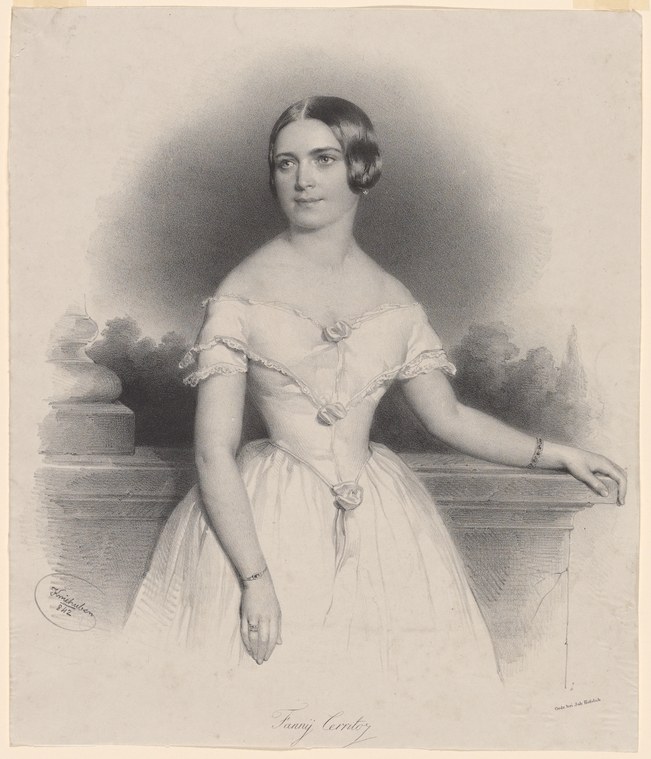
Cerrito was not only a major ballerina but also a choreographer and creator—her roles in the great ballets of the 1840s shaped Romantic ballet. This portrait, circulated as a print, is evidence of how dancers' images were commodified and distributed to fans and the public, and how the dancer's body was presented as an object of beauty rather than technical skill.
What you are looking at
This is a portrait-format lithograph of a young woman identified as Fanny Cerrito, a celebrated dancer of the mid-19th century. She stands in a relaxed three-quarter pose against a soft, atmospheric background with vegetation suggested behind her. She wears a white off-shoulder ball gown with short puffed sleeves and decorative buttons or ornaments down the front of the bodice. Her hair is parted and arranged in the fashion of the 1840s, with waves framing her face. Her right arm rests lightly at her side while her left arm extends gracefully, hand open, in a pose that suggests both the languor of portraiture and the trained carriage of a professional dancer. The lithographic technique creates soft tonal gradations around the figure, emphasizing her presence against the pale ground.
The dancing
The single figure stands in a characteristic pose of the era—weight balanced, shoulders relaxed and turned slightly. The arm positions are restrained and elegant rather than dynamic: there is no indication of active movement or performance. Her posture shows the upright, elongated line cultivated in ballet training, and the ease of bearing expected in a portrait of a society dancer. The hand gesture of the extended left arm is gentle and open, the kind of placement a trained dancer would naturally hold.
The dance depicted
Fanny Cerrito was one of the principal ballerinas of the Romantic era, celebrated across Europe in the 1840s and 1850s. This is a portrait of the artist rather than a record of a specific performance or choreography. The image does not depict her dancing, but rather presents her as a celebrated public figure in the conventional format of a mid-century theatrical portrait. The soft, idealized rendering and fashionable dress position her as much as a society figure as a performing artist.
How it was made
This is a lithograph, a printing technique that allowed for soft tonal modulation and was the standard medium for theatrical and celebrity portraits in the mid-19th century. Lithography permitted wide circulation and made these images affordable for collectors and theatregoers. The stone surface allowed the artist to build atmosphere through careful gradation, creating the halo of shadow around the figure. The signature mark visible in the lower left indicates the lithographer's hand; the artist's name is not recorded in the catalogue, but the technique and quality suggest professional theatrical print production.
About this work
This is a mid-19th-century lithographic portrait of Fanny Cerrito, one of the great stars of Romantic ballet. While it does not depict dance itself, it is a document of how a celebrated dancer was presented to the public: as an idealized figure of grace and refinement, captured in a moment of repose rather than performance. The image belongs in a dance collection as a record of theatrical celebrity and the visual culture surrounding dance at its peak moment of international popularity.
How to look at it
Attend to the contrast between the formal portraiture convention (the standing pose, the neutral ground, the fashionable dress) and the subtle traces of the dancer's training visible in the carriage and the elongated line of the body. The artist has chosen not to depict movement or performance, but rather the dancer in a moment of stillness, which was itself a kind of performance—the presentation of the self as an object of beauty. The soft lithographic tone creates an almost dreamlike quality appropriate to Romantic aesthetics.
The artist
The artist is not recorded. The print was produced by a professional theatrical lithography firm, likely in Paris, London, or another major European theatrical center. Such portraits were standard output for commercial print publishers and were sold at theatres and through print sellers to audiences hungry for images of celebrated performers.
The period
This portrait dates to the height of the Romantic ballet era, when dancers like Cerrito, Marie Taglioni, and Carlotta Grisi were international celebrities and the ballet d'action had become the dominant theatrical form. The 1840s were a period of intense print culture around dance: lithographs of dancers in costume and in street dress circulated widely and were collected as objects of both artistic and theatrical interest. The Romantic period privileged the ethereal, the poetic, and the idealized—qualities this portrait emphasizes through its soft focus and languorous pose.
Where it lives
The work is part of the New York Public Library's collection of prints depicting dance. It is a lithograph of the type produced for commercial sale and theatrical distribution in the mid-19th century.
Questions about this work
Who was Fanny Cerrito?
Fanny Cerrito (1817–1909) was an Italian-Swiss dancer and choreographer who became one of the greatest stars of Romantic ballet. She was celebrated across Europe and the Americas for her technical brilliance and her ability to create roles and choreographed pieces. She retired from performance to open a school and remained influential in dance pedagogy.
Why is this a portrait rather than a performance image?
Theatrical portrait prints of the period often presented dancers in their street clothes or fashionable evening wear rather than in costume, emphasizing them as society figures and celebrities rather than as characters in specific roles. These images were sold to fans and collectors and served a function similar to modern celebrity photography.
What is a lithograph?
Lithography is a printing process based on the repulsion of oil and water. An image is drawn on a stone with a greasy crayon, then ink is applied; it adheres only to the drawn areas. The technique allowed for subtle tonal variation and was ideal for reproducing the effects of a drawing. It was the dominant medium for theatrical prints in the 19th century.
More dance artwork





