49 works in this view — arrow keys or swipe to move between them.
Dance in Art
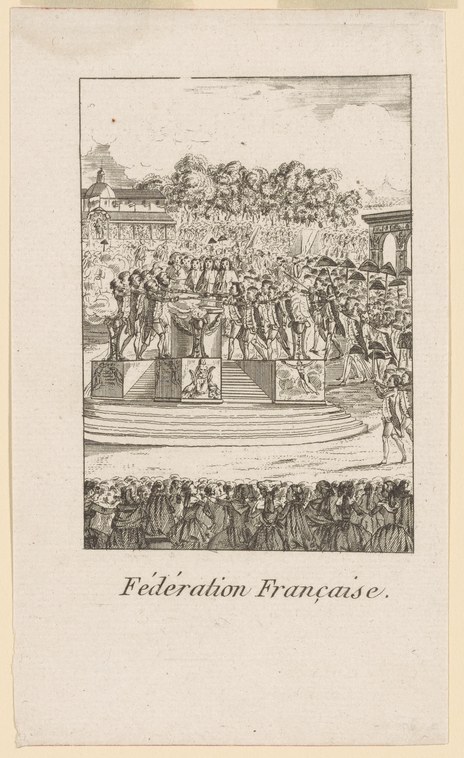
Fédération Française
Unknown artist
- Collection:
- Prints depicting dance
- Source:
- New York Public Library
- Rights:
- Public domain — free to use, share and adapt.
- Recorded as:
- Public Domain
This print is a rare visual record of the French Federation celebrations and shows how revolutionary politics mobilized mass public witnessing of ceremonial movement. It documents a historical moment when formal procession and civic choreography were tools of nation-building and collective identity, a practice that would echo through the 19th and 20th centuries.
What you are looking at
A large public gathering depicted in a late 18th-century engraving, centered on an elevated platform or stage structure where figures in formal dress conduct what appears to be an official ceremony or formal dance. The scene is organized in depth: the platform stage occupies the middle ground with densely packed figures arranged in rows, while crowds of spectators press forward in the foreground and line the background, flanking the stage on both sides. The setting suggests an urban plaza or courtyard with architectural elements—a building with a tower visible at upper left, and what may be a classical gateway or structure at right. The composition creates a sense of civic spectacle, with the viewing masses as important as the central action. The engraving style is characteristic of Gillray or late 18th-century commercial satirical work, with fine parallel hatching for shadows and precise linear detail throughout.
The dancing
The central figures on the platform stand in formal, aligned rows rather than in active dancing movement. Their upright postures and the geometric arrangement of bodies suggest processional or ceremonial formation rather than social dance. Some figures appear to hold objects or wear insignia. The spectators surrounding them occupy a far greater visual mass—hundreds of heads and shoulders create a churning, undifferentiated crowd. The compositional hierarchy places the formal figures as both the focus and curiously small compared to the sea of witnesses.
The dance depicted
This does not depict dance in the conventional sense of coordinated body movement. The engraving appears to illustrate a civic or state ceremony, possibly related to the French Federation movement of 1789–1790 (suggested by the title and the gathering's scale and formality). If dance occurs here, it would be a formal processional or ceremonial movement—the slow, hierarchical progression of officials or military ranks that was part of revolutionary civic ritual. The artist has chosen to emphasize the public, witnessed nature of the event over any actual choreographic content.
How it was made
This is an engraving, rendered in fine parallel lines (hatching) and executed with precision typical of late 18th-century commercial and political prints. The technique allowed for rapid reproduction and wide distribution, suggesting this was made as a news image or commemorative record for a broad audience. The fine detail and uniform scale indicate a professional hand, likely by an established print shop rather than a folk or amateur artist. The medium's association with political commentary and public record implies this was aimed at an educated urban readership familiar with current civic events.
About this work
This engraving records a mass civic ceremony associated with the French Federation of 1789–1790, a series of celebrations and oath-takings that marked early revolutionary solidarity across regions and social classes. The work is a historical document as much as a theatrical image: it depicts the *witnessing* of ceremonial action by an enormous crowd, rather than choreographed dance. The formal figures on the platform are almost incidental to the vast human gathering they have drawn. This belongs in a gallery of dance in art not because it shows dancers, but because it captures an emerging use of formal, witnessed movement—the public procession and ceremony—as a tool of political meaning-making.
How to look at it
Notice first the sheer mass of the crowd—the hundreds of small heads and shoulders that occupy most of the visual field. Then look upward to the formal, still figures on the platform: their geometric arrangement and upright postures contrast sharply with the chaos of the crowd. The artist has chosen to freeze a moment of collective witnessing rather than action. Observe how the architecture frames the scene and how the viewer's eye is drawn into depth by the receding rows of spectators. This is a print designed to communicate scale, public involvement, and civic solemnity.
The artist
The artist is not recorded in the catalogue. The style and execution suggest a professional engraver working for a commercial print house in Paris or London in the late 1780s or 1790s. The work's subject matter and precision indicate it was commissioned as a news print or commemorative image for distribution to an educated readership interested in revolutionary events.
The period
The French Federation ceremonies of 1789–1790 were a major innovation in the use of mass public spectacle as political performance. They formalized and celebrated regional and military unity in the early years of the French Revolution, drawing hundreds of thousands of witnesses. At the same time, late 18th-century engraving was undergoing explosive growth as a medium for political commentary, satire, and news—allowing artists like Gillray and Rowlandson to reach mass audiences with images that mixed observation and critique. This print sits at the intersection of revolutionary politics and the rise of visual journalism.
Where it lives
This work is held in the New York Public Library's collection of prints depicting dance. It is catalogued without a recorded artist, date, or medium specification, though the visual evidence points clearly to late 18th-century commercial engraving.
Questions about this work
Does this actually show dancing?
Not in the sense of choreographed movement or social dance. The figures on the platform appear to be engaged in a formal civic or military ceremony—possibly an oath-taking or procession. The engraving emphasizes the witnessing crowd more than any active dancing. It is included here because it documents a moment when formal, ceremonial public movement was used as a tool of political meaning.
What is the 'Federation Française'?
The French Federation (Fédération Française) refers to a series of mass public celebrations held in 1789–1790 during the early French Revolution, celebrating regional unity and revolutionary ideals. Citizens, soldiers, and officials gathered in huge numbers to witness ceremonies, oaths, and processions. These were among the first large-scale experiments in using mass public spectacle and movement as political performance.
Who made this print?
The artist is unknown. The style and precision suggest a professional engraver working for a commercial print house in the late 18th century, but no signature or attribution has been recorded. Such prints were often made anonymously or under shop names rather than individual artists' names.
Why is the crowd so prominent?
The artist's compositional choice to fill the frame with witnessing spectators reflects the revolutionary significance of these events: the Federation ceremonies were meant to demonstrate collective popular support and unity. By making the crowd the dominant visual element, the engraver emphasizes that this is an event *for* the people as much as *by* them.
More dance artwork





