49 works in this view — arrow keys or swipe to move between them.
Dance in Art
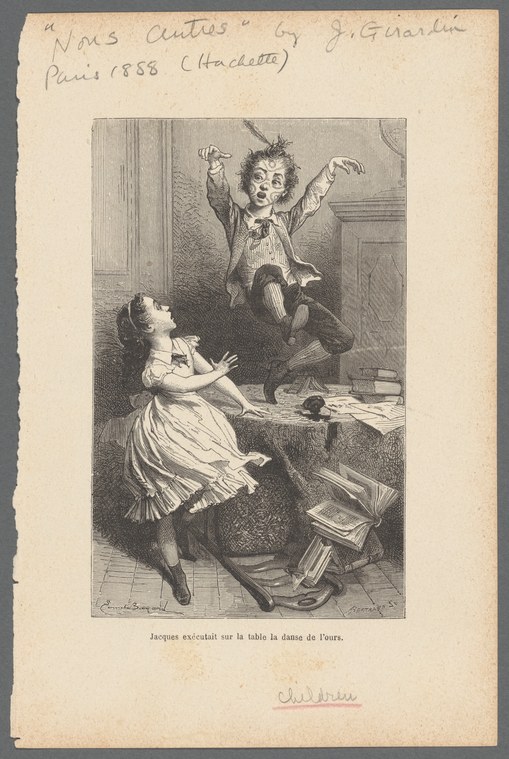
Jacques executait sur la table la danse de l'ours
Unknown artist
- Collection:
- Prints depicting dance
- Source:
- New York Public Library
- Rights:
- Public domain — free to use, share and adapt.
- Recorded as:
- Public Domain
The bear dance represents a category of movement—informal, playful, often involving role-play or animal imitation—that rarely appears in formal dance histories but was central to how people actually moved and socialized. This print is evidence that such games were recognized as worth documenting and circulating, suggesting they held cultural significance beyond mere amusement. For anyone studying the lived experience of dance, play, and the body in the 18th century, this image captures a moment that formal dance notation and technique manuals completely omit.
What you are looking at
A young boy in striped clothing leaps exuberantly from a table while a girl in a white dress watches from below, caught in a moment of playful domestic chaos. The boy's body is airborne, arms raised high with fingers splayed, his face animated with joy or mischief. Papers and what appear to be books or documents scatter across and beneath the table, suggesting the boy has disrupted a workspace or study area. The setting is an interior room with classical architectural details—fluted columns and paneled walls visible in the background. The composition captures a split second of uninhibited movement, with the girl's upward gaze and raised hands suggesting surprise or delighted encouragement. The engraving's fine hatching creates depth and shadow, particularly in the folds of the girl's dress and the darker recesses of the room.
The dancing
The boy demonstrates explosive upward momentum with both arms elevated and slightly bent, fingers extended, his torso extended vertically. His legs are bent, feet off the table surface, achieving considerable height. The girl below stands in an open stance, one knee bent slightly, arms raised to roughly shoulder height with palms outward in a gesture of surprise or participation. Neither figure maintains any formal dance frame; the movement is entirely gestural and reactive. The compositional relationship—one figure elevated, the other grounded and responding—creates a dynamic vertical exchange rather than a partnered hold.
The dance depicted
This is not a formal dance but rather a representation of the 'bear dance' (danse de l'ours), a popular parlor game and physical jest of 18th-century European social life in which one participant (typically a young person) would leap about in exaggerated, animal-like movements while others reacted with amusement. The inscription 'Jacques exécutait sur la table la danse de l'ours' identifies the boy as Jacques performing this particular gambit. The dance was more rowdy play than choreographed movement, capturing a moment of social entertainment in domestic space. Its appearance in printed form suggests it was a recognizable enough social practice to merit illustration and circulation.
How it was made
This is an engraving on paper, executed with fine parallel hatching lines to create tone, shadow, and dimensionality. The technique allows for precise rendering of facial expression, fabric texture (particularly the girl's pleated dress), and architectural detail. The quality of line work and the composition suggest this was a commercial print, likely produced for a book, periodical, or standalone series documenting social customs or humorous domestic scenes. Engravings of this type circulated widely and were affordable enough for middle-class households, making them significant documents of period behavior and attitudes.
About this work
This engraving depicts the bear dance, a lighthearted 18th-century parlor entertainment in which young people performed exaggerated, playful movements for the amusement of household members. The boy Jacques is frozen mid-leap on a table, his body expressing unrestrained energy, while a girl watches from below with raised hands. The print records not a formal dance tradition but rather the social rituals of leisure and play that occurred in domestic interiors, revealing what people found entertaining and how they understood physical play, youth, and household authority. Such images are valuable documents of everyday social practice and the aesthetics of movement in pre-industrial European life.
How to look at it
Notice the engraver's choice to freeze the boy at the apex of his leap—the moment of maximum extension and energy—rather than a moment of descent or repose. This choice emphasizes the vigor and joy of the movement. Observe how the girl's pose (lower, grounded, responsive) creates a visual hierarchy that frames the boy's action as the primary spectacle. The scattered papers on the table suggest that this is a transgression of household order—the boy has literally jumped on the work table—which was part of what made such antics amusing and worth recording. The architectural formality of the room contrasts with the informality of the bodies within it.
The artist
The artist is not recorded. However, the quality and style of the engraving suggest a commercial print shop production, possibly French given the French caption and the dress styles. The inscription attributes the scene to observation of identifiable people (Jacques and an unnamed girl), suggesting the print may have been based on a known anecdote or family scene. The signature 'Cambricoua' or similar visible in the lower left corner may be the engraver's mark, though it remains unconfirmed.
The period
The 18th century saw a flourishing of printed images documenting manners, amusements, and social behavior—particularly in France and England. This period witnessed both the formalization of dance through the development of classical ballet technique and a concurrent appetite for images of informal, comedic social life. The domestic interior was becoming a subject of artistic interest as print culture made such scenes widely available. The bear dance sits in the gap between folk entertainment and fashionable society: playful enough for the parlor, energetic enough to merit artistic attention, but too undignified for formal choreography.
Where it lives
The work is held in the New York Public Library's prints collection depicting dance, described in their catalogue as part of a broader holding of printed images documenting social and theatrical movement. No accession number or full publication information is recorded in the available metadata.
Questions about this work
What is the bear dance?
The bear dance was an 18th-century parlor game and social entertainment in which a young person, often a child, would leap and cavort in exaggerated, animal-like movements to amuse household members. It was not a formal dance but rather a form of physical play and role-play that occurred in domestic interiors. The performance combined acrobatic movement, playfulness, and an element of transgression—often involving jumping on furniture or disrupting the order of a room.
Who were the performers?
The caption identifies the boy as Jacques, suggesting he was a specific, recognizable person whose bear dance was known or notorious enough to be documented in print. The girl is unnamed. They may have been members of a particular household, or the scene may represent a generalized type rather than a specific documented event. The use of identifiable names suggests the print had a somewhat limited, informed audience who would recognize these individuals.
Why would anyone document a children's game?
Eighteenth-century print culture was fascinated by images of manners, social behavior, and domestic life. Such prints circulated as entertainment, as documents of how people lived, and often with a gently comic or satirical intent. Children's games and domestic amusements were considered worthy subjects because they revealed something about family life, education, and social values. The print offers a window into what people found amusing and what kinds of physical behavior were acceptable or entertaining in the home.
Is this dance related to formal ballet or folk traditions?
No. The bear dance is an example of informal, improvisational play rather than either a codified dance tradition or a learned technique. It belongs to the category of social games and physical amusements that existed outside the formal dance world. However, its appearance in printed form shows that such informal movement was considered significant enough in 18th-century culture to merit documentation and circulation.
More dance artwork





