49 works in this view — arrow keys or swipe to move between them.
Dance in Art
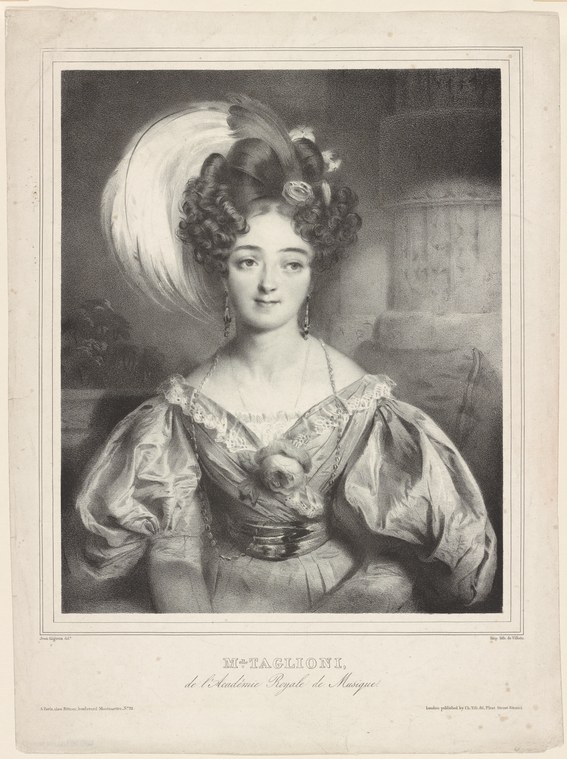
M'elle Taglioni, de l'Académie royale de musique
Unknown artist
- Collection:
- Prints depicting dance
- Source:
- New York Public Library
- Rights:
- Public domain — free to use, share and adapt.
- Recorded as:
- Public Domain
As a named portrait of a Paris Opera performer from the Romantic era, this engraving records both the celebrity status of individual dancers and the visual conventions through which they were marketed to the public. It illustrates how early 19th-century dance culture generated a substantial body of portraiture distinct from performance documentation—a parallel visual economy that shaped how dancers were perceived and remembered.
What you are looking at
A three-quarter-length portrait of a young woman in elegant early 19th-century dress, presented against a softly rendered neutral background. She wears a high-waisted white gown with voluminous puffed sleeves and delicate lace trim at the neckline, the silhouette characteristic of Regency fashion. Her dark hair is swept up in an elaborate arrangement with ringlets framing her face and what appears to be a white feathered or gauze headdress. She gazes directly outward with a composed expression, one hand resting gracefully near her bodice. The engraving employs fine tonal gradations to suggest the shimmer of silk and the softness of fabric; the lighting is even and flattering, consistent with the conventions of fashionable portraiture of the period. No movement or dance gesture is evident—this is a formal presentation of a named individual.
The dancing
A single standing figure in a frontal or near-frontal pose. The posture is upright and formal, with shoulders slightly back and one arm relaxed at the side while the other is positioned near the torso. There is no indication of active movement, weight shift, or the postural specificity that would mark a dancer mid-gesture. The body presents an idealized stillness suited to portrait convention rather than the dynamism of a choreographed moment.
The dance depicted
This is not a depiction of dance. The image is a fashionable portrait of a named individual—identified in the inscription as a member of the Académie Royale de Musique (the Paris Opera). While the subject may have been a dancer or performer, the portrait itself captures her in formal dress, not in performance or demonstrating dance technique. No dance hold, footwork, or gestural language is visible.
How it was made
This is an engraving, recognizable from the fine parallel and cross-hatched line work used to build tone and shadow, particularly visible in the background and in the rendering of fabric textures. The technique allows for the subtle gradation of light across the face and the precise delineation of the lace and trim details. Engravings of this quality and subject matter were produced in significant numbers during the early 19th century and circulated widely among the fashionable classes and opera patrons, suggesting this was a work of commercial portraiture aimed at a literate, affluent audience.
About this work
This is a portrait engraving of a named performer at the Paris Opera during the early 19th century, likely produced between 1800 and 1830. The work belongs to the genre of fashionable theatrical portraiture—images of celebrated opera dancers and singers distributed to admirers and collectors. While the subject's profession connected her to the world of theatrical dance, the image itself is not a documentation of choreography or performance but rather a display of fashionable dress and refined beauty, a product of the same culture that made Romantic ballet a dominant art form. The work is held among dance-related prints, which reflects the historical archive's interest in preserving images of named dancers even when those images capture them outside the act of dancing.
How to look at it
Examine the inscription carefully to identify the named subject and confirm her institutional affiliation. Note the high quality of the engraving technique—the fine hatching and tonal subtlety—as evidence of the prestige accorded to theatrical portraiture. Observe how the dress, while fashionable, contains subtle references to stage costume: the neoclassical high waist, the delicate sleeve treatment, and the ornamental headdress all reflect the aesthetic of early Romantic ballet even in street dress. This is a portrait that documents not a dance but the public presentation of a dancer as a fashionable celebrity.
The artist
The engraver's name is not recorded in the catalogue. The style and quality suggest a professional workshop of the period, likely working in Paris. The inscription credits are not fully legible in the image, which is typical of commercial theatrical portraiture of the era, where engravers and printmakers worked as anonymous craftspeople within publishing businesses.
The period
This portrait dates to the era of Romantic ballet (approximately 1830–1850s), though the dress and styling suggest it may be slightly earlier, closer to 1810–1825. This was a period of extraordinary growth in the celebrity of individual ballet dancers, particularly women, and in the commercial production of their portraits. The Paris Opera had just solidified its position as the capital of European dance, and prints of famous dancers—whether in costume or, as here, in fashionable dress—became luxury commodities and tokens of admiration. The rise of lithography and commercial engraving made such portraits accessible beyond aristocratic patrons, extending to the middle classes and creating a new form of theatrical fame.
Where it lives
Held in the New York Public Library's prints collection relating to dance. This work belongs to a large archival category of theatrical and dance-related portraits, engravings, and lithographs collected in the 19th and 20th centuries to document the history of performance.
Questions about this work
Is this a picture of someone dancing?
No. It is a formal portrait of a named performer in street dress. While the subject was a member of the Paris Opera (and likely a dancer), the image does not show her performing or demonstrating any choreography. It is a celebrity portrait of the kind produced in large quantities during the Romantic era to be purchased by admirers and collected as mementos.
Why is a portrait included in a collection of dance imagery?
Named performers, especially celebrated dancers, are part of dance history even when pictured outside of performance. Such portraits document the celebrity culture surrounding dance, the fashion associated with dancers, and the identity of individuals who shaped theatrical dance. Archives collect them to preserve the historical record of performers and how they were publicly presented.
What does the inscription tell us?
The inscription identifies the subject as a member (or associate) of the Académie Royale de Musique, the official name of the Paris Opera. This confirms her professional status and institutional affiliation but does not specify her rank, specialty, or exact dates of service, which would require additional research in institutional records.
More dance artwork





