49 works in this view — arrow keys or swipe to move between them.
Dance in Art
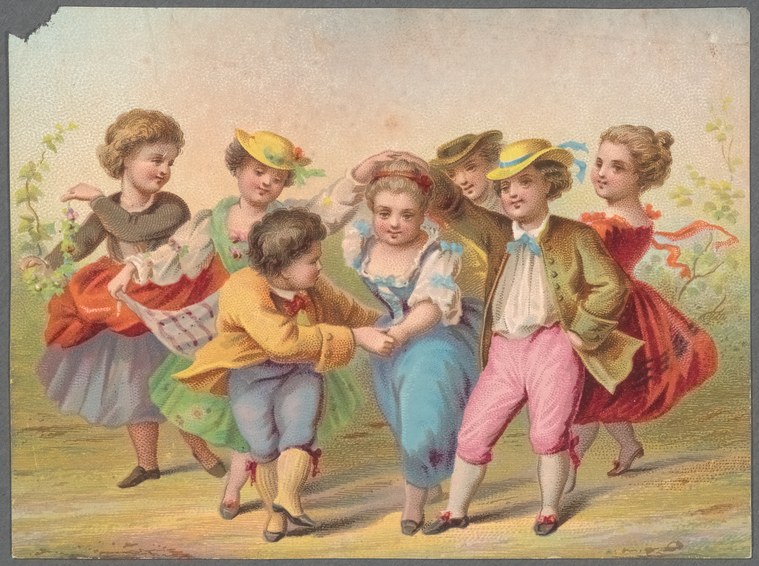
Dancing children in rustic costume
Unknown artist
- Collection:
- Prints depicting dance
- Source:
- New York Public Library
- Rights:
- Public domain — free to use, share and adapt.
- Recorded as:
- Public Domain
This print is a rare visual record of children's recreational dancing outside formal institutions, showing how dance functioned as play and social bonding in ordinary communities. For historians of folk dance and childhood studies, it documents the costumes, group formations, and atmosphere of village or working-class festivity. For dancers, it offers a window into movement cultures that left few other traces—the stuff of lived, embodied tradition rather than codified technique.
What you are looking at
Six children in bright, colorful costume parade or dance together outdoors in a pastoral setting, with green grass, flowering plants, and pale sky behind them. They wear an assortment of period dress—one in a yellow jacket and blue breeches, another in red skirts with white apron, a third in green with a red cape, and others in complementary rustic or peasant garments with hats or headpieces. The children are arranged in a loose, joyful group, their bodies angled toward each other in an informal cluster rather than a formal line. The style is chromolithography, rendered with soft shading and the saturated colors typical of Victorian-era children's prints. The mood is playful and celebratory, with no suggestion of formal instruction or structured technique—this is childhood dance as social play.
The dancing
The children's bodies are upright but relaxed, with arms in varied positions—some raised, some at the sides, one child appearing to hold hands with another. There is no closed ballroom hold or rigid frame; instead, the grouping suggests spontaneous movement and mutual engagement. Their feet are planted lightly on the ground with no visible turnout or formal positioning. The smallest child appears to be in the center of the group, drawn toward the taller children around them, suggesting playful inclusion rather than hierarchical partnering.
The dance depicted
This image documents folk or children's play-dancing of the late nineteenth century, likely a country reel, quadrille figure, or children's game-dance rather than a trained style. The rustic costume—peasant skirts, simple jackets, straw hats—and the informal grouping suggest folk tradition or village celebration rather than ballroom or theatrical dance. The composition captures a moment of casual, community-based movement typical of rural or working-class children's entertainment of the period, when dancing was an everyday social activity rather than a specialized discipline.
How it was made
This is a chromolithograph, a color printing process that allowed mass production of vividly colored images at modest cost. The soft gradations, the clear registration of multiple colors, and the characteristic slight flatness of the forms are all consistent with chromolithography. This technique democratized access to colorful imagery and made such prints extremely common in Victorian households, schools, and gift books—indicating this was created for popular circulation rather than fine art exhibition. The technical capabilities of chromolithography, particularly the ability to achieve saturated colors and smooth gradations, shaped the sunny, optimistic aesthetic of the piece.
About this work
This chromolithograph documents children's folk dancing in late-nineteenth-century rustic dress, capturing a moment of joyful, unstructured play rather than formal choreography. The work sits within the Victorian tradition of sentimental genre prints celebrating childhood innocence and rural life. It belongs in a dance gallery because it preserves evidence of how children actually moved in social, community contexts—not the ballet academy or ballroom, but the village green. The informal grouping and bright costumes reveal the period's attitudes toward childhood, folk tradition, and the social role of dance in everyday life.
How to look at it
Attend to the informality of the grouping and the absence of any fixed choreographic frame—no couples in closed position, no line, no symmetry. Notice how the artist has frozen a moment of collective movement without stiffness, capturing the spontaneous, social character of the dance. The bright, saturated colors and the pastoral setting work together to situate this dancing in an idealized rural or village context, distinct from the urban, indoor spaces where ballroom and theatrical dance took place. The faces are turned toward each other and toward the viewer with expressions of pleasure, emphasizing sociability over technical accomplishment.
The period
The late nineteenth century saw a romantic revival of interest in folk costume and rural life among urban, educated audiences. Simultaneously, chromolithography had made color printing affordable and ubiquitous, flooding the market with sentimental imagery of childhood, nature, and picturesque village scenes. This print reflects both trends: an urban audience's nostalgic idealization of rural innocence, rendered in a new mass medium. At the same time, formal dance training—ballet, ballroom technique—was becoming increasingly professionalized and gendered, making informal, mixed-gender children's dancing an image of a disappearing or imagined past.
Where it lives
The work is held in the New York Public Library's Prints collection, specifically within a grouping labeled 'Prints depicting dance.' This suggests it was catalogued and preserved as a dance document rather than as fine art or portraiture—a modern institutional choice that privileges its value as historical evidence.
Dance in this work
Questions about this work
What kind of dance are these children doing?
The image does not show a recognizable, named dance style with technical vocabulary. Instead, it captures informal, social dancing—the kind children would do at village celebrations, fairs, or family gatherings. The loose grouping and relaxed posture suggest folk tradition or play-dancing rather than a codified form like ballet or ballroom.
Why are they wearing such colorful, old-fashioned clothes?
These are rustic or peasant costumes, suggesting either an actual rural or working-class context, or—more likely for a Victorian-era print—an idealized or theatrical representation of 'the folk.' By the late nineteenth century, urban audiences had a sentimental attachment to folk costume as a marker of authenticity and innocence.
Is this a record of a real event or an imagined scene?
It is almost certainly imagined or at least staged for the chromolithograph. The composition is too carefully balanced and the mood too consistently cheerful to be documentary. However, it is based on real social practices—children did dance together in village and family contexts—so it documents a real phenomenon even if this particular scene is idealized.
Why would this be in a dance collection?
Because it shows how dance functioned in everyday life outside academies and theaters, and because the costumes, formations, and movement qualities offer clues to folk traditions that are otherwise poorly documented. It is historical evidence of embodied culture.
More dance artwork





