49 works in this view — arrow keys or swipe to move between them.
Dance in Art
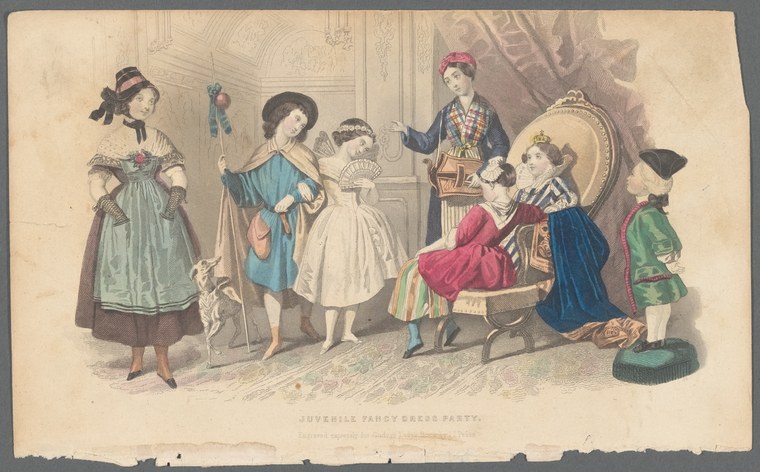
Juvenile fancy dress party
Unknown artist
- Collection:
- Prints depicting dance
- Source:
- New York Public Library
- Rights:
- Public domain — free to use, share and adapt.
- Recorded as:
- Public Domain
This image documents the domestic theatricality and costume culture of 19th-century childhood entertainment, showing how dance and movement were embedded in social play rather than formalized instruction. For historians of dance, it illustrates the informal, game-based context in which children encountered music, costume, and movement before the era of competitive children's dance.
What you are looking at
A lively indoor gathering of children and young people in fancy dress, arranged in a parlor or drawing room with classical architectural detail visible in the background. The composition centers on a seated figure in a red dress and cap, facing right, around whom the other figures cluster and gesture. A large drum sits prominently in the foreground right, and various costumed children occupy the space in animated poses—some standing, some in motion, all wearing elaborate period costumes in rich colors: greens, blues, reds, and golds. The figures nearest the seated child appear to be in conversation or performance, creating a scene of social play and entertainment. The hand-colored engraving technique has rendered the costumes in jewel tones against a pale background, emphasizing the theatrical nature of the gathering.
The dancing
The arrangement is deliberately theatrical rather than ballroom-formal. The seated figure in red and cap appears to be an audience member or participant receiving attention, while surrounding figures adopt varied poses—some leaning in, some gesturing expressively with arms raised, one figure holding what may be a fan or implement. The spacing is intimate and conversational rather than in a dance hold or formation. The bodies suggest spontaneous, playful movement: one child on the right appears caught mid-step or gesture, another leans forward with apparent excitement, and the overall composition reads as charades, games, or costume display rather than coordinated partner dance.
The dance depicted
This depicts children's costume play and parlor games rather than a specific dance style. The drum and the theatrical arrangement of costumed figures suggest musical entertainment and possibly simple movement games or promenade play common in 19th-century children's gatherings. The title 'Juvenile Fancy Dress Party' confirms this is documentation of a social occasion for young people in costume, where dance may have been one element alongside games, display, and theatrical amusement. No specific dance form—baroque minuet, quadrille, or other period dance—is clearly performed; this is social play in a fashionable domestic setting.
How it was made
Hand-colored engraving on paper, characteristic of mid-19th-century popular illustration. The technique allowed for wide circulation as a print, making such scenes affordable decoration and documentary records for middle-class households. The hand-coloring—applied after printing—shows variable precision in some areas and creates the jewel-toned effect that emphasizes the fancy dress spectacle. As an engraved print, it would have been produced in multiple impressions and likely published commercially, serving both as entertainment and as a guide to costume and behavior for its viewers.
About this work
This is a hand-colored engraving documenting a 19th-century children's costume party, captured as a moment of social play and theatrical display in a fashionable interior. The work belongs to a large genre of popular prints that recorded and promoted genteel domestic entertainment, especially occasions organized around children's participation in costume and performance. While the scene includes music (the drum) and likely incorporated movement and games, it is not a record of a specific dance style, but rather of the social occasion within which dance was one possible element of amusement. The work offers evidence of how children's entertainment, fashion, and theatrical play were visualized and circulated in Victorian visual culture.
How to look at it
Attend to the variety of costumed figures and their poses: this is not a choreographed moment but a captured instant of social chaos and play. The seated figure in red commands attention, but the surrounding figures in their varied gestures—some leaning, some apparently speaking, one possibly dancing—show the mixed nature of the occasion. The drum in the foreground indicates music as a source of amusement, but the composition emphasizes social interaction and display over dance as a primary activity. Notice how the hand-coloring differentiates each costume, inviting the viewer to appreciate the range of fanciful dress as much as any movement.
The period
This engraving dates to the mid-to-late 19th century, when printed illustrations of domestic life, children's activities, and fashionable entertainment were in high commercial demand. The fancy dress party—a costume gathering for amusement and display—became a fashionable middle-class entertainment form during this period, influenced by Victorian enthusiasm for theatrical spectacle and historical costume. Such prints served both as entertainment and as instruction in taste and social behavior, circulating widely to a domestic audience interested in genteel amusement and children's education.
Where it lives
The print is held in the New York Public Library's collection of prints depicting dance, part of their broader ephemera and illustration holdings. As a mass-produced engraving, it would have circulated widely; the current holding represents one impression among likely many.
Questions about this work
Is this a record of an actual dance?
Not primarily. While the scene includes music (the drum) and movement, it documents a children's costume party as a social occasion. Any dance would have been informal and game-like rather than a codified style such as a minuet or quadrille.
What are the children dressed as?
The elaborate costumes suggest historical and fantastical dress: one figure wears what may be a Scottish or military costume, another a continental fancy dress with a cap, and others wear richly colored gowns and jackets. The costumes are chosen for theatrical effect and fashionable display rather than to represent specific characters.
Why is one child seated while others stand?
The seated figure may be a guest of honor receiving entertainment, or the moment captures a game in progress where one player is the focus of the others' attention and amusement.
More dance artwork





