49 works in this view — arrow keys or swipe to move between them.
Dance in Art
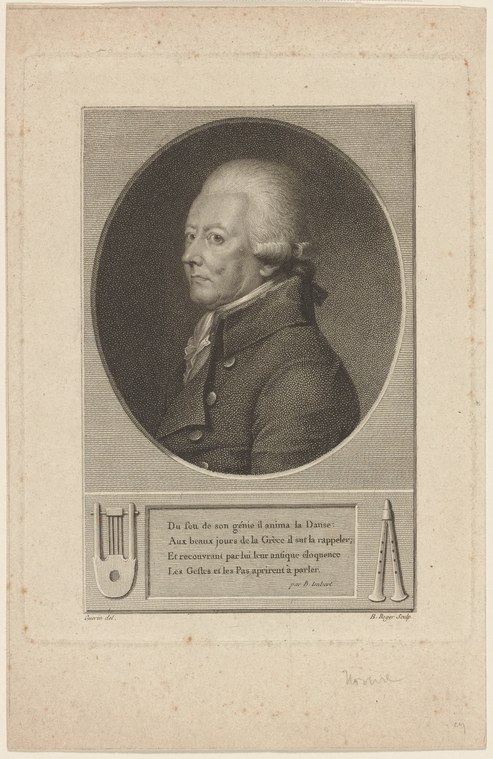
Du feu de son génie il anima la danse... par B. Imbert
Unknown artist
- Collection:
- Prints depicting dance
- Source:
- New York Public Library
- Rights:
- Public domain — free to use, share and adapt.
- Recorded as:
- Public Domain
This work is a valuable historical document of how dance and its practitioners were honored and commemorated in the 18th century. For historians of dance, it provides evidence of who was celebrated during this period and how dance was understood as an art form worthy of formal tribute and fine artistic production. The inscription suggests a figure whose influence on dance was considered transformative, yet the subject remains unidentified in the current record—a gap that represents an opportunity for research.
What you are looking at
This is an 18th-century engraving depicting a distinguished gentleman in three-quarter profile, shown from the shoulders up within an oval frame. He wears the formal dress of the period: a dark coat with a high collar, a light-colored cravat or neck cloth, and his gray or white hair is styled in the fashion of the time, pulled back and possibly powdered. The background is rendered in fine parallel lines typical of engraving technique, creating a subtle gradient that emphasizes the figure. Below the portrait is an inscription in French in an ornamental cartouche, incorporating decorative elements that suggest musical or theatrical associations—possibly a flute or recorder on the left side and what appears to be a cone or architectural element on the right.
The work is not a scene of dance in action but rather a commemorative portrait, likely of a significant figure in dance or music of the period. The inscription references the subject's role in animating or inspiring dance—"Du feu de son génie il anima la danse" (From the fire of his genius he animated dance)—suggesting this is a tribute to a dancer, choreographer, or dance master whose influence was recognized as transformative. The engraving's formal presentation and fine execution indicate this was a work of some prestige, intended for circulation among educated audiences.
The dancing
A single figure dominates the composition—an older man with refined features, viewed in a dignified three-quarter pose that was conventional for portraits of cultural authorities in this period. The pose conveys authority and contemplation rather than physical movement; the neck is slightly extended and the gaze directed outward in the manner of neoclassical portraiture. There is no depiction of dance movement or the body in action.
The dance depicted
This is not a depiction of dance being performed, but rather a portrait of a person identified by the inscription as a significant figure in dance—likely a choreographer, dance master, or celebrated dancer of the 18th century. The French inscription explicitly attributes to this person the power to animate and enliven dance ("animer la danse"), suggesting his work was considered revolutionary or exemplary. Without a readable signature or inscription identifying the subject, the specific identity cannot be determined from the image alone, but the formal treatment and high-quality execution suggest this was a person of considerable standing in the artistic world.
How it was made
This is an engraving, recognizable from the fine parallel lines (hatching and cross-hatching) used throughout to create tone, shadow, and texture. The technique allows for precise linear detail and was ideal for reproduction and distribution to a wide audience. The oval portrait format was popular in the 18th century, and the decorative cartouche below shows the careful attention to ornamental framing typical of high-quality print work from this period. The inscription and date mark suggest this was likely published or widely circulated as a print—a standard way of honoring and memorializing influential figures in the arts.
About this work
This is an 18th-century engraved portrait of an unnamed dancer, choreographer, or dance master, identified by an inscription in French as someone who 'animated dance' through the fire of his genius. The work belongs to a tradition of commemorative portraiture in print that celebrated cultural authorities—visual records created to honor and preserve the memory of significant artistic figures. The formal presentation and skilled execution indicate it was intended for educated audiences and likely circulated in artistic and musical circles. While the image itself shows no dancing, it is an artifact of dance history: visual evidence of how the period valued and memorialized its dance practitioners, and testimony to the prominence of this particular figure within 18th-century dance culture.
How to look at it
Attend to the formal conventions of 18th-century portraiture: the three-quarter pose, the refined handling of light and shadow through engraving technique, and the dignity conveyed by the sitter's bearing. Note how the oval frame and ornamental cartouche elevate the subject, treating him as a person of cultural consequence. The inscription is key—it tells us this is not merely a portrait but a tribute, and its language suggests the subject was understood as revolutionary or exemplary in some way. The presence of what may be musical instruments in the cartouche frames dance within a broader context of the arts.
The artist
The signature or attribution on the engraving is not clearly legible in the image. The work is attributed to 'B. Imbert' in the title, though it is unclear whether Imbert was the engraver, the designer, or the subject. If Imbert was the engraver, he was one of many skilled printmakers of the 18th century producing commemorative and portrait engravings for circulation. The style and quality are consistent with French engraving practice of the mid-to-late 18th century.
The period
The 18th century saw the rise of choreography as a recognized art form and the emergence of the professional dancer as a cultural figure worthy of honor and commemoration. In France particularly, where ballet was a court art with royal patronage, celebrated dancers and choreographers achieved significant social status. The tradition of engraved portraits—distributed to audiences and patrons—was a way of elevating cultural figures to the status of historical importance. The inscription's language emphasizes genius and creative power, reflecting Enlightenment values that celebrated individual artistic innovation. This portrait sits within a broader tradition of honoring dance and its practitioners through fine art reproduction.
Where it lives
The work comes from the New York Public Library's collection of prints depicting dance. It is part of a broader archive of visual dance history, primarily comprising prints and engravings from the 17th through 19th centuries—a collection that documents how dance was represented, valued, and circulated in printed form.
Questions about this work
Who is this portrait of?
The subject is not identified in the current record, though the French inscription indicates he was a celebrated dancer, choreographer, or dance master of the 18th century whose work was recognized as transformative. Research into French dance history and 18th-century engraving records may help identify him.
What does the inscription mean?
The inscription reads 'Du feu de son génie il anima la danse / Aux honneurs que la Grèce a dit l'appelot / On reconnoîtront par les antiques disparûs / Les Grâces et les Pas aperceûrent à parler.' This translates roughly to: 'From the fire of his genius he animated dance / With the honors that Greece said called him / In the recognition of ancient disappearances / The Graces and the Steps began to speak.' It is a tribute to his power to bring dance to life and elevate it to an art form.
Is this a scene of dancing?
No. This is a portrait of a person associated with dance, not a depiction of dance being performed. It is a commemorative engraving honoring a figure in dance history.
Why was this engraved and printed?
Engravings were the primary means of circulating portraits and commemorating important figures in the 18th century. This work would have been distributed to patrons, audiences, and fellow artists as a way of honoring and preserving the memory of a significant dance figure.
More dance artwork





