49 works in this view — arrow keys or swipe to move between them.
Dance in Art
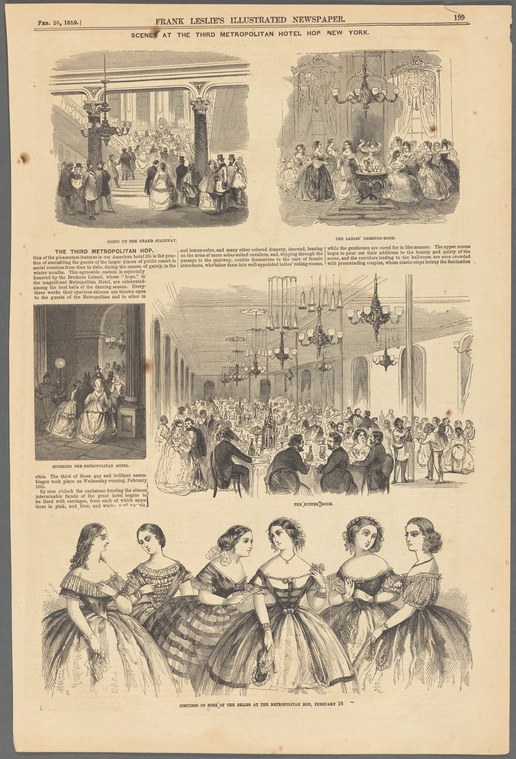
Scenes at the third Metropolitan Hotel hop, New York: Going up the grand stairway, The ladies' dressing-room, Entering the Metropolitan Hotel, The supper room, Costumes of some of the belles at the Metropolitan hop, February 16
Unknown artist
- Collection:
- Prints depicting dance
- Source:
- New York Public Library
- Rights:
- Public domain — free to use, share and adapt.
- Recorded as:
- Public Domain
This work documents the historical reality of ballroom dancing in America at mid-century, showing not idealized or theatrical dance but the actual social practice of elite Americans. It is also a rare explicit depiction of how women's fashion—the full crinoline skirt—shaped and constrained the body's movement in dance. For historians of dance and dress, this image is primary evidence of how the two were mutually constitutive.
What you are looking at
This engraved newspaper page from Frank Leslie's Illustrated Newspaper documents a grand ball at the Third Metropolitan Hotel in New York on February 16. The composition is divided into five scenes arranged vertically, each capturing a different moment of the evening's social dance. In the upper left, guests ascend the grand staircase in formal dress—women in crinolined gowns and men in tailcoats and evening wear. The upper right shows the ladies' dressing room, a crowded interior scene with seated and standing women adjusting their appearance. The middle section depicts the entry into the hotel, with formally dressed attendees arriving through a columned portico. Below that, the supper room appears as an ornate interior with hanging chandeliers, filled with diners and dancers in animated conversation and movement. The bottom strip shows a line of six women in a row, their full-skirted ball gowns displayed in profile and three-quarter view, illustrating the fashionable silhouettes of the evening. The engraving's fine linework and cross-hatching create depth and texture, with particular attention to the architectural details of the hotel's interior and the elaborate construction of the women's garments.
The dancing
The dancers and dancers-to-be are uniformly dressed in mid-nineteenth-century formal wear: women in low-necked, off-shoulder ball gowns with full skirts supported by crinolines, and men in black tailcoats with white shirts. The women's arms are bare or covered only by short sleeves; their posture is upright and composed. In the dancing scenes, the figures are shown in the close proximity and upright stance typical of ballroom partnering, though the engraving's small scale makes specific holds difficult to discern. The costume display at the bottom shows women standing in relaxed but dignified poses, arranged for the viewer's inspection of dress rather than to depict active movement.
The dance depicted
This is documentary evidence of the social ballroom dancing that dominated elite American social life in the 1850s, almost certainly focusing on the waltz, polka, and quadrille—the standard repertory of such events. The image captures the entire social machinery around dancing, not dancing itself: the preparation, the display, the dining, the courtship and sociability of which dance was the centerpiece. The formal attire, the architectural grandeur, and the emphasis on women's appearance confirm that this was fashionable society dance of the Gilded Age, a realm of prescribed roles and careful choreography where dancing was inseparable from courtship, status display, and social hierarchy.
How it was made
This is an engraving, almost certainly a wood engraving, reproduced as a newspaper illustration. The fine parallel lines and cross-hatching typical of the medium create tonal modeling and texture, allowing the artist to render fabric, architecture, and human form with considerable detail despite the small size. The technique's precision and the print's appearance in a mass-circulation newspaper—Frank Leslie's was one of the most popular illustrated papers of its era—meant this image reached tens of thousands of American readers. The wood-engraved newspaper illustration was the dominant form of visual journalism in the 1850s, before photographic reproduction became standard.
About this work
This is a newspaper illustration documenting a fashionable ball in New York, capturing the social dance culture of the American elite in the 1850s. Rather than a single frozen moment of dance, it is a composite image showing five aspects of the evening: arrival, preparation, dancing, dining, and the display of formal dress. The work exemplifies how dance and fashion were inseparable in Gilded Age social life, and how the press used engraved illustrations to give readers visual access to the manners and aesthetics of high society. The image belongs in a dance gallery because it shows dance not as an isolated art but as embedded in ritual, fashion, architecture, and social power.
How to look at it
Attend to the costumes: the women's off-shoulder necklines, bare arms, and full skirts; the men's formal tailcoats and white ties. Notice how the crinoline creates a barrier of fabric around each woman's legs, making certain kinds of movement and proximity impossible. Look at the architectural setting—the columned portico, the ornate chandeliers, the formal interior spaces—which frames the dance as an event of civic and social importance. The costume strip at the bottom is not a dance depiction but a fashion display, showing how the newspaper used dance occasions as occasions to display and circulate images of fashionable dress to readers who could not attend such events.
The artist
The engraving is uncredited. Frank Leslie's Illustrated Newspaper, founded in 1855, employed a large staff of engravers and illustrators, many of them anonymous. The newspaper's visual style emphasized social reportage and spectacle, with a particular focus on fashionable society, theater, and public events. The skill evident in this engraving—the rendering of textile, spatial depth, and human anatomy—was typical of the mid-century American newspaper engraver's craft.
The period
In the 1850s, the waltz and polka had become the dominant forms of ballroom dancing among European and American elites, gradually replacing earlier quadrille-based repertories. Dancing remained a central courtship ritual and a marker of social class and refinement. At the same time, the crinoline had reached its fullest extent, creating the bell-shaped silhouette visible in the costume display at the bottom of this page. The illustrated newspaper itself was a new technology, rapidly becoming the primary means by which urban Americans encountered visual images of fashionable society and public events. Frank Leslie's in particular specialized in detailed social reportage that appealed to the middle classes aspiring to understand elite manners.
Where it lives
This work comes from the New York Public Library's holdings of prints depicting dance, drawn from Frank Leslie's Illustrated Newspaper, one of the most widely circulated illustrated newspapers of the nineteenth century.
Dance in this work
Questions about this work
What dances would actually have been performed at this ball?
Almost certainly the waltz, polka, and quadrille. The waltz was by this date the dominant dance among American elites, but the quadrille was still danced. The polka was also fashionable in the 1850s. These were not choreographed or performed dances but social dances in which participants followed an agreed-upon structure.
Why does the image focus so much on women's clothing?
Because this newspaper was aimed at a large female readership, and the crinoline-era ball gown was a primary object of fashion interest and aspiration. The costume display at the bottom made the newspaper useful as a fashion reference. For working- and middle-class women, images of elite ball dress were both desirable and instructive.
Why are there five separate scenes rather than one continuous dance floor?
The engraver used a composite structure to show the reader the entire social experience of the ball: arrival, preparation, dancing, dining, and costume display. This allowed more visual information to be packed into the page and gave the newspaper's readers a more complete picture of the event than a single scene could.
More dance artwork





