49 works in this view — arrow keys or swipe to move between them.
Dance in Art
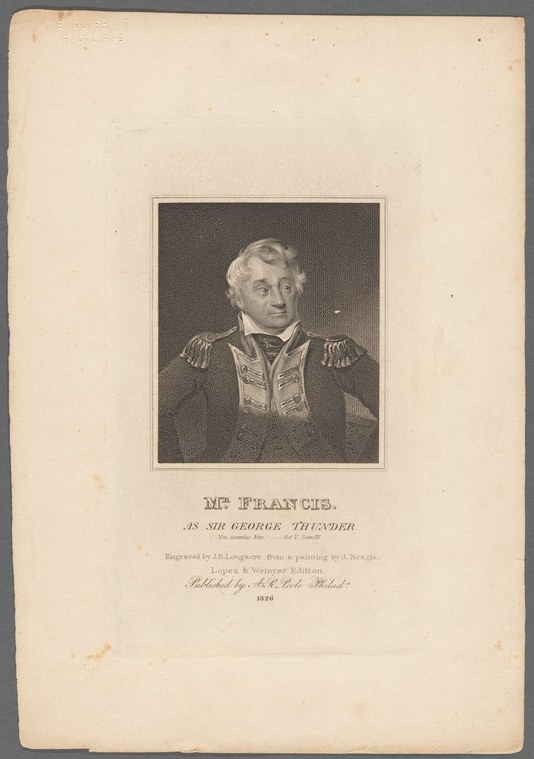
Mr. Francis as Sir George Thunder
Unknown artist
- Collection:
- Prints depicting dance
- Source:
- New York Public Library
- Rights:
- Public domain — free to use, share and adapt.
- Recorded as:
- Public Domain
This engraving is a rare surviving document of a specific named performance by an actor now otherwise obscure, preserving the costume, appearance, and role identity with the precision only theatrical portraiture can achieve. For historians of Regency theatre and performance culture, such portraits are primary sources for understanding who performed what roles and how costume conveyed character and rank on the stage.
What you are looking at
A three-quarter-length portrait of a man in early 19th-century military dress, shown against a dark background. He wears a dark coat or jacket with ornate gold epaulettes on both shoulders, indicating military rank. The garment appears to be a formal dress coat with decorative frogging or braided fastenings down the front. His white shirt is visible at the neck, and his light-colored hair is styled in the fashion of the Regency era. The figure is rendered in mezzotint or stipple engraving, creating soft modeling of the face and careful attention to the texture of the fabric. The composition is frontal and dignified, with the subject gazing slightly to the left of the viewer. The portrait follows the conventions of theatrical portraiture from the 1820s–1830s, presenting the sitter in costume rather than street dress.
The dancing
A single standing male figure, viewed from the waist up, in a composed and formal stance. The body faces forward with shoulders squared; the head turns slightly, creating a naturalistic but controlled pose. There is no active gesture or movement—this is portraiture rather than action. The weight is evenly distributed, and the figure has the stillness of a posed studio session or theatrical portrait carte.
The dance depicted
This is not a depiction of dance in action but a theatrical portrait of an actor in character as 'Sir George Thunder.' The identity of the character suggests a comedic or dramatic role from a play of the period. Without knowledge of the specific play or performance tradition, the dance content cannot be established. The costume and formal pose indicate this is a record of theatrical presentation rather than an image of dance technique or movement.
How it was made
This is a mezzotint or mixed-process engraving, likely produced in the early 1820s based on the printing style and paper quality. The medium allowed for fine gradations of tone and subtle modeling of the face, which are evident in the soft rendering of the subject's features and the careful differentiation of the coat fabric. Such theatrical portraits were commonly produced by London publishing houses for both popular circulation and archival record of notable stage performers. The technique's precision made it suitable for capturing costume detail and facial likeness, important for an image meant to commemorate a specific actor in a specific role.
About this work
This is a theatrical portrait engraving documenting an actor named Mr. Francis in the character of Sir George Thunder. It belongs to a substantial tradition of Regency-era theatrical portraiture—engravings made to circulate among playgoers and to preserve records of celebrated performances. The work is not a representation of dance but of theatrical costume and character, preserved in the NYPL collection of prints depicting dance likely because the play from which this character derives may have contained dance, or because such theatrical portraits were collected as part of broader documentary interest in stage entertainment. The image is valuable as evidence of Regency theatrical presentation, costume practice, and the circulation of actors' likenesses in this period.
How to look at it
Attend to the costume detail: the specific style of epaulettes, the frogging, the cut of the coat, and the quality of the tailoring all convey both the character's rank and the production's investment in authenticity. The slight turn of the head and the gaze create the illusion of a living person captured in a moment of repose rather than in performance. The background is entirely neutral—the focus is on the figure and costume as a complete unit. The printing technique allows for a subtle range of grays and blacks that gives the image depth and presence despite its small scale.
The artist
The artist is not recorded. The engraving bears the mark of a professional London print shop, likely working in the 1820s. The competence of the execution—the careful modeling of tone, the attention to fabric and epaulette detail, and the refined printing—suggests a skilled practitioner, possibly a specialist in theatrical portraiture. Many such works were produced anonymously or with publication attribution only.
The period
The Regency era (1811–1820) and the decades immediately following saw a boom in theatrical portraiture and print culture. Actors became celebrities, and engraved portraits were collected and displayed both at home and in print-shop windows. The military costume here reflects the era's preoccupation with Napoleonic Wars and military spectacle, themes that also featured prominently in theatrical entertainment. Plays often featured comic or romantic military characters, and such costume portraits were part of the machinery by which theatregoers could acquire mementos of performances and of beloved actors.
Where it lives
The print is held in the NYPL's collection of prints depicting dance, catalogued under an era label of 'unknown.' The work is a typical theatrical portrait engraving of the early 19th century, likely one of many such prints produced for popular circulation and now preserved in institutional collections.
Questions about this work
Who was Mr. Francis?
The catalogue does not identify him beyond the name and the character he played. Without additional research into Regency theatre records, his full name, career span, and other roles remain unknown. Such 'Mr.' credits in theatrical prints often referred to minor or moderately prominent actors whose later careers are now obscure.
What is Sir George Thunder?
This appears to be a character name from a Regency-era play, likely comedic given the surname. Without access to the play itself, the character's dramatic function and the role of dance (if any) in that play cannot be determined.
Why is this in a dance collection?
The print may have been acquired because the play featured dance, because theatrical portraiture was collected as part of performance history, or by cataloguing convention that treats all theatrical imagery as dance-adjacent. The current record does not clarify the reason.
How was this engraving made?
This is a mezzotint or stippled engraving, a printmaking technique that allowed engravers to render soft tones and fine detail. The plate was worked by hand, then inked and printed on paper, making it suitable for circulation in multiple copies. Each print was hand-finished, which accounts for minor variations between impressions.
More dance artwork





