49 works in this view — arrow keys or swipe to move between them.
Dance in Art
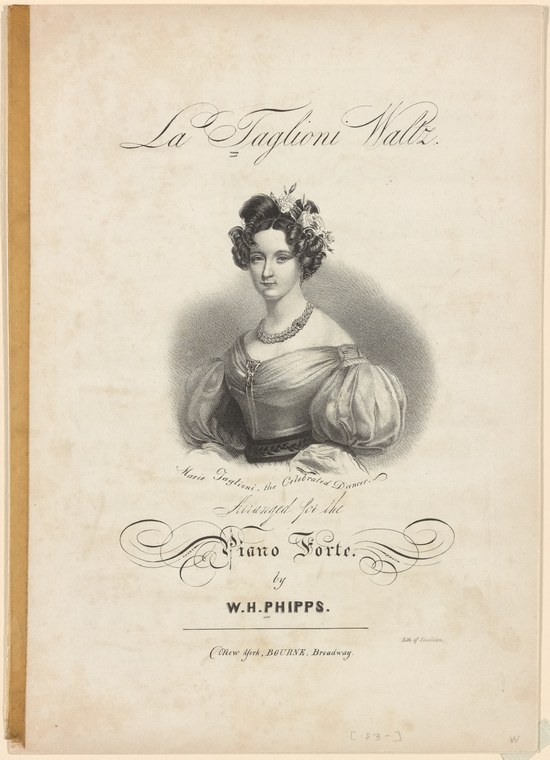
La Taglioni waltz, arranged for the piano forte by W. H. Phipps
Unknown artist
- Collection:
- Prints depicting dance
- Source:
- New York Public Library
- Rights:
- Public domain — free to use, share and adapt.
- Recorded as:
- Public Domain
This object reveals how Romantic-era ballet dancers were commodified and circulated through popular music publishing, extending their fame beyond the stage into the home. It shows that the waltz—both as a ballroom dance and as a musical form—was deeply connected to ballet culture and to the cult of individual dancers. The work is evidence of how dance history intersected with musical publishing and visual portraiture in the period.
What you are looking at
This is the title page of a published piano arrangement, not a depiction of dance in performance. The sheet music cover features an engraved portrait of a woman in early 19th-century dress, positioned in the upper half of the page. She wears an off-shoulder gown with voluminous puffed sleeves in the Romantic-era style, her dark curled hair adorned with a decorative comb or ornament. The portrait is rendered as a bust in three-quarter view, set against a plain background with subtle shading that gives it dimensionality. The woman's expression is serene and her gaze directed outward. Below the portrait, ornamental script identifies the subject as a dancer (the inscription reads "...dancing, the celebrated Danseuse / Arranged for the / Piano Forte"), and the composer's name W. H. Phipps appears in larger capitals. The publisher's imprint cites New York and Broadway as the location.
The dancing
The figure shown is a static portrait bust, not a dancer captured in motion. There is no visible dance posture, hold, or footwork—this is a commemorative image of a performer rather than a representation of movement or choreography. The subject's bearing is upright and dignified, with shoulders relaxed and arms not visible in the composition. The portrait format itself signals that this is a souvenir or memento rather than a scene of dancing.
The dance depicted
This is a title page for a piano arrangement, not a primary source of dance content. The work is named 'La Taglioni waltz,' referring almost certainly to Marie Taglioni, the legendary Romantic-era ballet dancer. Taglioni was famous in the 1830s-1840s as the leading dancer of the Romantic ballet, and the waltz—a fashionable triple-time ballroom dance—became one of the most popular domestic piano pieces of the era. The arrangement suggests that Taglioni's fame had extended into the parlor and concert hall, where her name could sell sheet music. However, the image itself shows no evidence of how the Taglioni waltz was actually danced, either as a staged ballet or as a social dance.
How it was made
This is an engraving, likely a steel or copper-plate engraving based on the fine line work and the date of publication. The technique allowed precise portraiture and was ideal for mass-produced sheet-music covers. The engraving would have been hand-colored or left in monochrome for printing. Such covers were inexpensive to produce in quantity and reached a broad middle-class audience of piano students and amateur musicians. The inclusion of a recognizable portrait of a famous performer was a standard marketing device for popular piano pieces.
About this work
This is a sheet-music cover for a piano arrangement of a waltz named after Marie Taglioni, one of the most celebrated ballet dancers of the Romantic era. Rather than depicting a dance scene, it uses a portrait of the eponymous dancer—presumably Taglioni herself, though this cannot be confirmed from the image alone—as a selling point for the domestic arrangement. The work sits at the intersection of theatrical ballet celebrity and parlor music culture, where famous performers' names lent cachet to pieces for amateur musicians. It is a document of early 19th-century cultural celebrity and the commercialization of dance through print media.
How to look at it
Attend to the date and style of dress: the off-shoulder gown and puffed sleeves are characteristic of the 1830s-1840s Romantic period, confirming the date of the work. The engraving technique—its precision and the way shading is built from fine parallel lines—is typical of the commercial sheet-music covers of that era. Note that the portrait is presented as a memorial or tribute rather than as a moment of performance; it is a fashionable face designed to appeal to buyers, not a study of dance technique.
The artist
W. H. Phipps is credited as the arranger, but nothing further is known from the record. Piano arrangements of popular dances and operatic themes were a standard commercial product of the 19th century, and arrangers often remained anonymous or lightly credited. The work was published by a New York firm active on Broadway, suggesting a transatlantic circulation of Romantic-era theatrical culture.
The period
The Romantic ballet reached its peak popularity in the 1830s-1840s, with Marie Taglioni as its reigning star. The waltz, imported from Vienna and popularized across Europe and America, became the most fashionable ballroom dance of the period and inspired countless piano compositions. The same decades saw a boom in parlor music publishing, driven by the growth of the piano-owning middle class and the expansion of musical literacy among women. Famous performers' names and faces were routinely used to market sheet music, creating a feedback loop between theatrical performance and domestic music-making.
Where it lives
This is held by the New York Public Library as part of its collection of prints depicting dance. It is a sheet-music cover, a mass-produced commercial object, and should be understood as one of many such souvenirs and home-music items circulating in the 19th-century American cultural market.
Questions about this work
Is this Marie Taglioni?
The engraving commemorates Taglioni and bears her name, but the catalogue record does not confirm that the portrait is actually of her. It may be an imagined or idealized likeness rather than a direct portrait from life. Such sheet-music covers often presented generic or stock portraits of celebrated performers.
What was the Taglioni waltz danced as?
This cover does not show how the waltz was performed, only that a piano arrangement existed. The Taglioni waltz was likely both a ballroom social dance for amateurs and possibly a choreographed piece in theatrical contexts, but the image does not reveal either version.
Why do dancers care about sheet-music covers?
Sheet-music covers are artifacts of dance history that show how performers were branded and marketed, how the fame of theaters and dancers extended into domestic spaces, and how dance was mediated through other cultural forms like music and visual portraiture. They document the celebrity culture of the Romantic era.
More dance artwork





