49 works in this view — arrow keys or swipe to move between them.
Dance in Art
Lola Montez, Countess of Mansfeldt
Unknown artist
- Collection:
- Prints depicting dance
- Source:
- New York Public Library
- Rights:
- Public domain — free to use, share and adapt.
- Recorded as:
- Public Domain
This item's presence in a dance archival collection raises questions about what Victorian theater historians and archivists considered relevant to dance history—possibly the work was known to include choreographed scenes not visible in this excerpt, or it may reflect broader interests in theatrical movement and physical comedy of the period. Without access to the complete text or performance records, the specific reason for its inclusion in the dance collection remains unclear.
What you are looking at
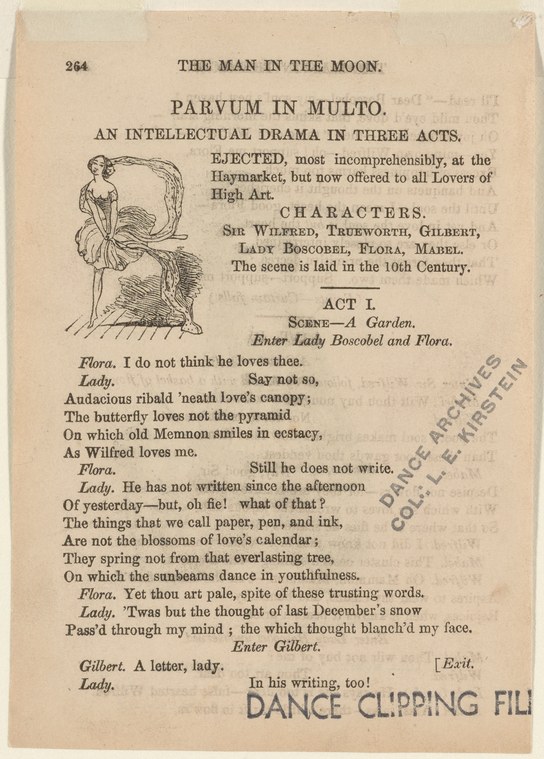
This is a page from a printed dramatic work, "Parvum in Multo," subtitled "An Intellectual Drama in Three Acts." The text shows Act I, Scene: A Garden, with dialogue between Lady Boscobel and Flora establishing a scene of romantic tension and wit. The dialogue concerns love, writing, and the absent Sir Wilfred. A decorative initial letter and ornamental border frame the text, suggesting this is from a bound volume or periodical of the 19th century. The typography and layout are consistent with Victorian-era theatrical publication, with character names in small capitals and stage directions in italics. The page carries a stamp reading "Dance Clipping File," indicating it was collected as relevant to dance history, though the text visible contains no stage directions for movement or explicit choreographic content.
The dancing
No figures or bodies are depicted in this image. The page is entirely textual—dialogue between two female characters—with no visual representation of performers, gesture, or physical action.
The dance depicted
The text of this dramatic dialogue does not indicate dance or choreographed movement. While the work is theatrical in nature, the visible scene concerns courtship and romantic repartee, not dance performance. The catalogue description notes the work was "ejected, most incomprehensibly, at the Haymarket, but now offered to all Lovers of High Art," but no dance content is evident in this excerpt.
How it was made
This is a typeset page from a printed book or periodical, reproduced photographically or scanned. The page bears evidence of age—yellowing paper, faint markings, and visible damage—suggesting it is either a photographic print of a historical original or a digitized archival document. The typography, page layout, and ornamental borders are consistent with Victorian commercial printing, circa mid-to-late 19th century.
About this work
This is a page from a Victorian theatrical work titled "Parvum in Multo," a three-act intellectual drama that was performed at the Haymarket Theatre. The page shown is the opening of Act I, presenting dialogue between two female characters, Lady Boscobel and Flora. It has been collected in the "Dance Clipping File" at the New York Public Library, though the visible text contains no explicit dance content. The work appears to be a drawing-room comedy concerned with romance and social wit rather than a dance drama.
How to look at it
Read the dialogue carefully for any implicit stage business or physical action that might be signaled through the repartee between the characters. The mention of love, writing, and absent figures suggests romantic comedy conventions of the period, which often included physical expression and movement to convey emotion and relationship. The layout and typography—character names, stage directions in italics—follow theatrical conventions and should guide attention to moments of implied action.
The artist
The author of "Parvum in Multo" is not identified in the visible text or the catalogue record. The work was theatrical and circulated commercially, suggesting a professional playwright working within the Victorian commercial theater system.
The period
This work dates to an era when Victorian theater was highly popular and commercial, with plays often published in both acting editions and trade volumes. The Haymarket Theatre, where this play was performed, was a major London venue. The intellectual comedy and drawing-room setting reflected fashionable theatrical taste of the mid-to-late 19th century, when witty dialogue and romantic entanglement were stock theatrical materials.
Where it lives
This page is held as part of the "Prints depicting dance" collection at the New York Public Library, catalogued under their archive system. It was collected as a clipping or extract, as indicated by the "Dance Clipping File" stamp.
Questions about this work
Why is this theatrical text in a dance archive?
The visible page contains no dance content. It is possible that the complete work includes choreographed scenes not shown here, or that the archivists determined the work's theatrical context or physical comedy made it relevant to dance history. Without additional performance records or a complete text, the precise reason cannot be determined from this excerpt alone.
What is the Haymarket Theatre and why does it matter?
The Haymarket Theatre (also known as the Theatre Royal Haymarket) was a major London playhouse with a long history of hosting theatrical productions. It was one of the significant commercial theaters of the Victorian era, so a work performed there would have reached a substantial audience.
What does the title mean?
"Parvum in Multo" is Latin for "much in little," suggesting the work presents significant intellectual or dramatic content in compact form. The subtitle describes it as an intellectual drama, positioning it as a work of wit and ideas rather than melodrama or spectacle.
More dance artwork





