49 works in this view — arrow keys or swipe to move between them.
Dance in Art
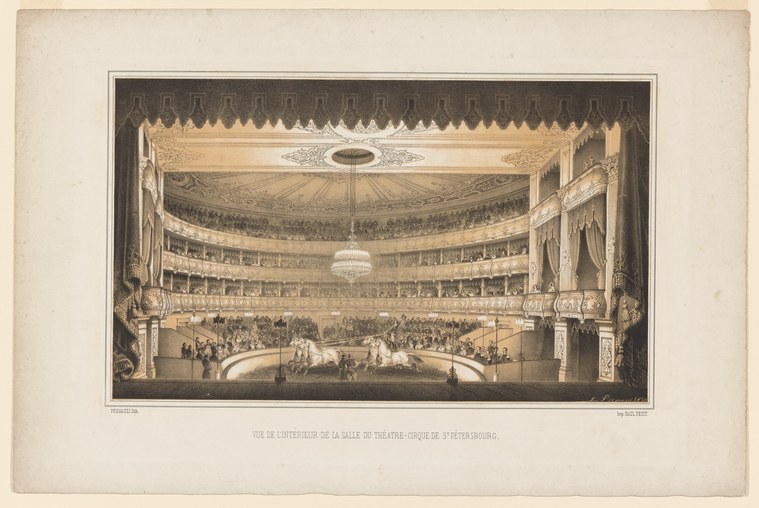
Vue de l'intérieur de la salle du Théâtre-Cirque de St. Pétersbourg
Unknown artist
- Collection:
- Prints depicting dance
- Source:
- New York Public Library
- Rights:
- Public domain — free to use, share and adapt.
- Recorded as:
- Public Domain
The print documents a significant Russian theatrical venue and its social function as a gathering space for the St. Petersburg public. For dance history, it provides evidence of the physical conditions—scale, sight lines, audience configuration—that shaped performance possibilities and conventions in early 19th-century Russia.
What you are looking at
A perspectival view of a grand theater interior filled with spectators across multiple tiers of boxes and galleries. The stage itself is empty or occupied by minimal figures, with a broad proscenium arch framing a shallow stage space. The theater's architecture features ornate gilt decoration, multiple curved levels of seating arranged in a steep amphitheater formation, and a coffered ceiling lit from above. The viewing angle is from the stage looking out toward the auditorium, emphasizing the vastness of the space and the density of seated patrons. The print uses hand-coloring with pale yellows, grays, and blacks to establish depth; the foreground stage is brightly lit while the galleries recede into shadow. The overall effect is one of architectural spectacle and social gathering rather than focused dance performance.
The dancing
The human figures are rendered at such a distance and small scale that individual gesture and hold cannot be discerned. The audience members seated in the tiers appear to be stationary observers in formal dress. Any performers on the stage are too distant or unclear to identify specific body positions, weight distribution, or dance technique. The composition prioritizes the architecture and audience over the legibility of any dance action.
The dance depicted
If dance is the primary subject of this image, it is not clearly readable in the composition. The print documents a theater interior—presumably the Theatre-Cirque of St. Petersburg—but the stage action is subordinate to the architectural record. The title suggests a circus theater (Théâtre-Cirque), which would have hosted acrobatic and spectacular performance, but the scale and distance of the reproduction prevent identification of specific dance, circus, or performance styles. This appears to be a documentary print of the venue itself rather than a depiction of performance technique.
How it was made
This is a hand-colored engraving or aquatint, identifiable by the fine linear hatching visible in shadow areas and the controlled tonal gradations achieved through the plate. The pale coloring—pale ochre for lit surfaces, gray for shadows, blue-gray for receding architectural elements—is typical of early 19th-century theater documentation prints. The technique allows precise architectural recording and atmospheric perspective, well-suited to commemorating a specific building. Such prints were produced for circulation among the educated public and served as records of important civic or architectural achievements.
About this work
This is a documentary architectural print recording the interior of the Theatre-Cirque of St. Petersburg at an unspecified date, likely early to mid-19th century. It captures the auditorium filled with spectators but does not foreground any dance or performance action. The work belongs in a dance gallery not as a record of choreography or technique but as evidence of the venues and audiences that shaped theatrical and circus performance in Russia during this period. The image shows how spectacle was framed, distributed across social strata through tiered seating, and integrated into civic culture.
How to look at it
Attend first to the architectural shell: the curved tiers, the coffered ceiling, the ornate proscenium. This is the primary subject. Then trace the distribution of the audience across social strata (the tiered hierarchy of boxes). Finally, notice how small and subordinate the stage space is relative to the auditorium—a reminder that the spectacle in early 19th-century circus and theater was as much about the social experience of assembly as about the action on stage. The emptiness or near-emptiness of the stage may be intentional, emphasizing the architecture itself.
The artist
The artist is not recorded in the catalogue. The print shows professional competence in perspective, architectural detail, and tonal management typical of commercial theater documentation of the period. Such prints were often produced by specialized theater engravers, sometimes after drawings by architects or theatrical designers.
The period
In the early 19th century, theaters underwent rapid architectural and social transformation across Europe. The rise of the circus as a distinct entertainment form, combined with the ballet's growing prestige in Russia, created demand for larger, more mechanically sophisticated venues. The Theatre-Cirque, as its name suggests, occupied an intermediate space between circus amphitheater and theatrical stage. Prints like this one satisfied public curiosity about these new monuments to entertainment and served as records of civic progress.
Where it lives
The print is held in the New York Public Library's collection of prints depicting dance. It originates from a European print tradition of theatrical documentation, likely produced in Germany or France for circulation to Russian patrons or to international audiences interested in Russian architecture and culture.
Questions about this work
Is this a ballet performance?
The print is a record of a theater building, not a specific performance. The stage is too distant to identify any dance. The title indicates the building was the Theatre-Cirque, suggesting it hosted both circus and theatrical events, including possibly ballet, but this print does not document a particular dance performance or style.
When was this print made?
The catalogue record does not give a date. Based on the hand-coloring technique, the architectural style, and the naming convention (Theatre-Cirque), it likely dates to the early or mid-19th century, but this cannot be confirmed from the image alone.
Why is the stage so empty?
The print is an architectural record of the building itself, not a performance documentation. The emptiness or minimal stage activity allows the viewer to see the full geometry of the space and its capacity. The focus is the auditorium and its social arrangement, not the action taking place upon the stage.
What was a 'Theatre-Cirque'?
A theater-circus was a hybrid venue combining the amphitheater design of a circus ring with theatrical staging and machinery. It could accommodate equestrian acts, acrobatics, and spectacle-heavy theatrical productions. These buildings were common in 19th-century Europe and Russia.
More dance artwork





