49 works in this view — arrow keys or swipe to move between them.
Dance in Art
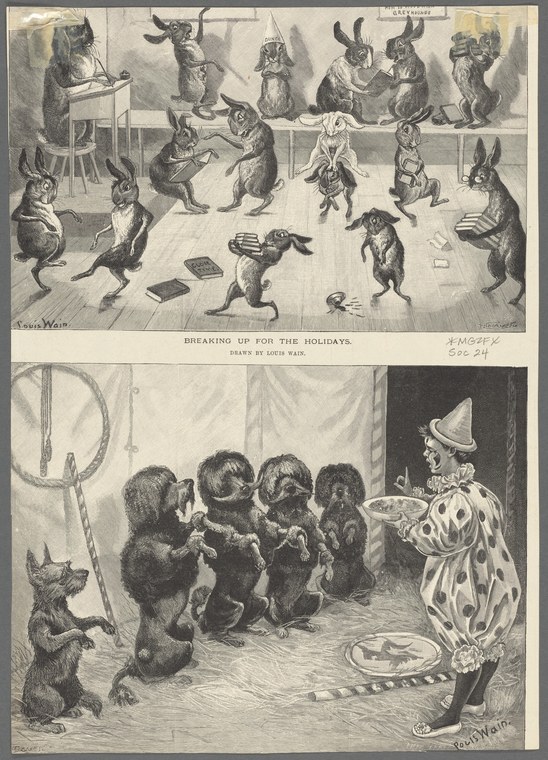
The reel; Breaking up for the holidays
Unknown artist
- Collection:
- Prints depicting dance
- Source:
- New York Public Library
- Rights:
- Public domain — free to use, share and adapt.
- Recorded as:
- Public Domain
The image preserves a visual record of how the reel—a central form of social dance in rural and working-class Britain—was experienced and understood in the 19th century: as vigorous, democratic, and fundamentally unpolished. For dancers and historians studying vernacular dance practice outside the ballroom, this engraving is a rare source that prioritizes energy and spontaneity over technical accomplishment or formal structure.
What you are looking at
This composite image presents two contrasting dance scenes. The upper panel, titled 'Breaking up for the holidays,' depicts a raucous gathering of anthropomorphic animals—goats, rabbits, and other creatures—in what appears to be a tavern or public house. They are captured mid-celebration: some leap and cavort with abandon, others engage in vigorous partnered movement, and several are drinking or gesturing wildly. The space is crowded and chaotic, with figures scattered across a wooden floor beneath a simple interior. The lower panel shows a quite different tableau: a clown or performer in a patterned costume and pointed hat stands before a group of four smaller figures (possibly children or animal characters) seated on the ground. The performer appears to be presenting or entertaining them, with what may be bowls of food or refreshment visible. Both scenes are rendered as wood engravings or relief prints with fine cross-hatching to suggest volume and shadow.
The dancing
In the upper scene, the animal dancers display exuberant, unstructured movement: legs kicked high, bodies twisted, arms flung about. There is no formal hold or frame—this is social, populist dancing marked by spontaneity and physical comedy. Some figures support one another or clasp hands, but the primary impression is of individual, energetic bodies packed into a confined space. In the lower scene, the performer stands upright in a gestural pose of address or presentation, while the audience sits passively, creating a clear performer-spectator divide that contrasts sharply with the participatory chaos above.
The dance depicted
The upper panel depicts social dancing of the 19th-century working or rural classes—likely a reel, as the title suggests. The reel was a vigorous group dance performed at holidays and celebrations, particularly in Britain and Scotland, characterized by rapid footwork and high spirits rather than technical precision. The image captures the democratic, almost anarchic energy of such occasions: the formal rules of ballroom dancing are absent. The lower panel appears to document a different tradition of festive entertainment—circus or pantomime performance—suggesting the image may be a composite commentary on holiday revelry across social strata.
How it was made
Both panels are wood engravings, a relief printing technique that favors crisp lines and bold contrast. The artist has used fine parallel lines (hatching) to model form and create tonal gradation, particularly in the rendering of fur, fabric, and shadow. This technique was well-suited to reproduction and distribution in 19th-century periodicals and books, indicating a work intended for a popular audience. The precision required by wood engraving would have made the artist's control over compositional chaos a notable achievement—the crowded scene is legible despite its bustle.
About this work
This two-part engraving documents two forms of holiday celebration and entertainment as understood in the 19th century: an unruly, exuberant country reel danced by rural or working-class revelers, and a performance by a professional entertainer before an audience. The work belongs to a tradition of satirical or observational social commentary common in Victorian graphic art—depicting dance not as an elite accomplishment but as a populist pleasure. The animals serve a dual purpose: they allow the artist to render human behavior with comic distance while maintaining sympathy for the joy and fellowship the dances represent. This is a document of how dance functioned in working life and holiday custom, rendered with the sharp eye for detail and movement that engraving technique demands.
How to look at it
Attend first to the compositional principle: the artist has frozen a moment of maximum chaos and energy, with figures overlapping and gesturing in multiple directions simultaneously. This choice—rather than a single focal couple—conveys the collective, participatory nature of the reel. Notice how the engraving technique, despite its precision, actually enhances the sense of movement through the visual texture created by hatching; the small parallel lines make the figures shimmer with activity. The contrast between the ordered lower panel and the tumultuous upper panel is itself a statement about performance, audience, and spontaneous social dance.
The artist
The artist is not recorded in the catalogue. The style and execution are consistent with mid-to-late 19th-century British commercial engraving practice; the signature on the lower panel appears to read 'Louis Wain,' though this cannot be confirmed without additional documentation. If this attribution is correct, the work would belong to the large body of social satirical graphic work produced for periodicals and book illustration during this period.
The period
In the 19th century, the reel remained a vital form of social dancing in rural Britain and Scotland, even as the middle class increasingly codified ballroom dancing into formal styles. Simultaneously, wood engraving and lithography were the dominant media for social commentary and satirical illustration, particularly in periodicals like Punch. The image dates to an era when dance was understood as both a marker of social class (formal ballroom vs. rough country dancing) and a universal pleasure accessible to all. The choice to render the dancers as animals may reflect Victorian attitudes toward working-class leisure—both sympathetic and slightly mocking.
Where it lives
The work is held in the 'Prints depicting dance' collection at the New York Public Library, indicating it was preserved as a document of dance practice and representation. The catalogue record provides minimal detail beyond the title and collection, suggesting the work entered the collection based on its dance content rather than authorial prominence.
Dance in this work
Questions about this work
What is the reel?
The reel is a vigorous group dance performed in lines or circles, with rapid footwork and high energy. It was central to rural and working-class celebration in Britain and Scotland, particularly at holidays and communal gatherings. Unlike ballroom dances, the reel emphasized participation and exuberance over formal technique, making it accessible to dancers of all abilities.
Why are the dancers depicted as animals?
The use of animal characters allowed 19th-century artists to represent human behavior with comic distance and social commentary. Here, the animals permit the artist to depict working-class or rural revelry with sympathy while maintaining a degree of genteel irony—a common practice in Victorian satirical illustration.
What does this image tell us about how dance was understood at the time?
The engraving documents a clear division between formal ballroom dancing (implicitly the province of the middle and upper classes) and vigorous, unstructured social dancing. It shows that dance historians can observe working-class practice through satirical or observational illustration when more formal records do not exist.
Why is this a wood engraving rather than a painting?
Wood engraving was the standard commercial medium for book and periodical illustration in the 19th century because it could be reproduced many times and combined with text in the printing process. This suggests the image was made for popular distribution, not as a unique work of fine art.
More dance artwork





