49 works in this view — arrow keys or swipe to move between them.
Dance in Art
The polka on 19th-century music covers
Unknown artist
- Collection:
- Prints depicting dance
- Source:
- New York Public Library
- Rights:
- Public domain — free to use, share and adapt.
- Recorded as:
- Public Domain
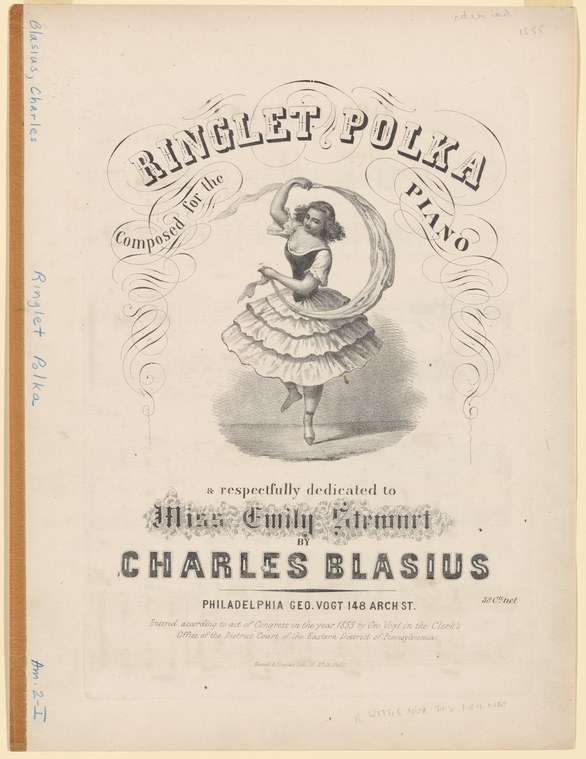
The polka was one of the most significant popular dances of the nineteenth century, and this cover image preserves how it was visualized and marketed to the public through the economics of sheet music sales. It demonstrates the tight relationship between dance, fashion, music publishing, and theatre in the mid-1800s—a moment when new dances could be sold, taught, and performed through illustrated printed material.
What you are looking at
A young woman in theatrical costume dominates this sheet music cover, posed in a moment of spirited movement. She wears a voluminous white or pale dress with deep flounces and ruffles—the skirts caught and held up to reveal layers of petticoats and her lower leg—and her hair is pinned in period style. Her left arm curves overhead in a graceful arc; her body turns slightly, weight on one leg, capturing the instant of a quick, turned figure. The composition is a formal portrait within ornamental borders, with the title "Ringlet Polka" arched above her figure and the composer and publisher information inscribed below. The engraving technique renders the costume with crisp detail: the fine pleating of the flounces, the taper of her leg, the carriage of her head.
The dancing
A single dancer, shown in three-quarter view with weight shifted to the supporting leg. Her raised arm traces a graceful line overhead; her torso is lifted and turned. The silhouette suggests a moment of turning or spinning—the skirts lifted and arranged to display the structure of the costume. The pose is balletic in its verticality and control, with the body elongated and the limbs positioned for visual effect rather than naturalistic rest.
The dance depicted
This is a polka, as named on the cover—one of the most popular social dances of the mid-nineteenth century. The polka was a Czech-derived couple dance performed in ballrooms across Europe and America, characterized by a quick hopping step, a 2/4 time signature, and lively, energetic rhythm. The image shows the polka as theatrical spectacle rather than ballroom social dance: a single woman in costume on stage, posed for visual drama rather than captured mid-step in a social setting. The dress and the theatrical presentation suggest this was polka as performed in variety entertainment or musical theatre.
How it was made
The work is a wood or steel engraving, executed in fine lines to capture texture, fabric weight, and the play of light on the dancer's form and dress. The formal title block, ornamental borders, and publisher's imprint indicate this was a commercial music cover printed for mass distribution—standard practice for popular dances of this era. The engraving technique allowed for sharp detail and precise reproduction, suited to the precision typography and ornamental lettering of the title.
About this work
This is the cover of a published polka piece titled 'Ringlet Polka,' composed for piano and dedicated to Miss Emily Stornart. The work sits at the intersection of dance, music publishing, and theatrical costume culture in the mid-nineteenth-century American ballroom and stage. The polka itself—a Czech couple dance that swept European and American society in the 1830s and beyond—was performed both as a fashionable social dance and as staged entertainment. This image documents how the polka appeared to audiences through the lens of commercial music publishing: as a spectacle of costume, energy, and feminine grace.
How to look at it
Observe the pose: the lifted torso, the curved arm, the turned position, and the carefully arranged skirts. This is not a candid moment of social dancing but a composed theatrical image designed to showcase costume and body in an idealized moment. The artist has chosen a turning or spinning instant—the moment when the skirts would billow and reveal the layers underneath. Notice how the engraver has rendered the texture of the fabric: the weight of the flounces, the transparency of the overskirt, the definition of the leg. This is costume as spectacle, and the dance as an occasion for displaying it.
The artist
The composer Charles Blasius is listed in the imprint. Blasius was a Philadelphia musician active in the mid-nineteenth century. The work was published by Geo. Vogt at 146 Arch Street in Philadelphia. Beyond these details, little more can be established from the cover itself about Blasius's broader practice or reputation.
The period
The polka emerged in Prague in the 1830s and reached Vienna by the 1840s, becoming an international craze within a decade. It arrived in America in the late 1840s and quickly became the dominant social dance, displacing earlier favorites like the quadrille and cotillion. The 1850s–1870s saw an explosion of polka variants and themed polka compositions. Sheet music covers of the period typically featured elaborately dressed female dancers in theatrical poses, reflecting both the commercial appeal of attractive costume and the way polkas were promoted through theatrical performance as well as ballroom dancing. Philadelphia was a center of music publishing in nineteenth-century America.
Where it lives
This sheet music cover is held in the New York Public Library's collection of prints depicting dance. It is a commercial music publication from mid-nineteenth-century Philadelphia, one of thousands of such covers produced to accompany the sale of instrumental dance music to households and performers.
Dance in this work
Questions about this work
What is a polka?
A polka is a lively couple dance in 2/4 time, originating in Prague in the 1830s. It is characterized by a hopping step and a quick tempo, and it became enormously popular across Europe and America by the mid-nineteenth century. It was danced both as a social ballroom dance and, as this image shows, as theatrical entertainment.
Why is she alone if the polka is a couple dance?
This is a theatrical or promotional image, not a documentary picture of actual dancing. The polka was always a couple dance in social ballroom contexts, but when performers danced it on stage, they might be pictured solo in costume for dramatic effect. The sheet music cover used an attractive image to promote the music, and a solo figure in theatrical costume was more visually striking than a couple.
What is a 'ringlet' polka?
Polka compositions were often given fanciful titles or named after fashionable elements of the day. 'Ringlets' refers to the fashion for ringlet curls in women's hair during the nineteenth century. The title may refer simply to the hairstyle visible in the image, or it may be a playful marketing name for the tune, without deeper significance.
More dance artwork





