49 works in this view — arrow keys or swipe to move between them.
Dance in Art
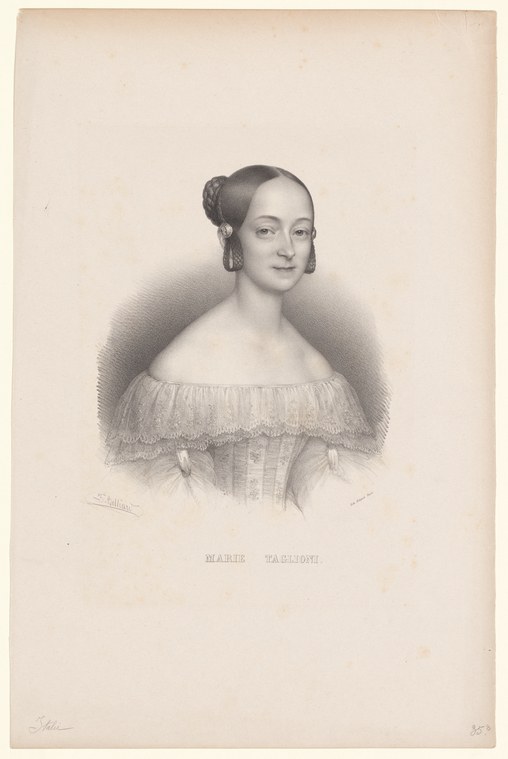
Marie Taglioni
Unknown artist
- Collection:
- Prints depicting dance
- Source:
- New York Public Library
- Rights:
- Public domain — free to use, share and adapt.
- Recorded as:
- Public Domain
Taglioni defined Romantic ballet and the figure of the ballerina as a transcendent, almost supernatural being. This portrait documents how she was presented to the public as an ideal of feminine grace and refinement, an image as carefully constructed as any choreography. For historians of dance and celebrity, the work is evidence of how the cult of the individual dancer took root in nineteenth-century culture.
What you are looking at
A three-quarter-length portrait of a young woman in Romantic-era dress, shown against a plain pale background. She wears a white off-shoulder gown with deep ruching across the décolletage and upper bodice, typical of 1830s–40s fashionable dress. Her dark hair is parted in the center and drawn back smoothly, gathered at the crown with what appears to be a decorative comb or ornament; ringlets fall softly at the sides of her face. Her posture is upright and composed, the shoulders relaxed and turned slightly to the left. The figure is rendered with fine tonal gradation, the fabric of her gown rendered with particular attention to texture and the play of light across the pleating. Her expression is serene and direct, the gaze level and calm. The work is executed as an engraved or lithographed portrait, with careful stippled shading to create volume and depth, particularly around the figure and in the soft halo effect that frames her shoulders.
The dancing
A single standing female figure in a formal three-quarter pose, shoulders back and relaxed, arms hanging naturally at her sides. The stance is poised and stationary—this is portraiture, not action. The body shows no tension or weight shift; the entire carriage suggests training in posture and deportment. The head is held upright with the chin level, the neck long and exposed by the fashion of the day. There is no suggestion of movement or gesture; the figure embodies stillness and composed grace.
The dance depicted
This is a portrait of Marie Taglioni, the Swedish-Italian dancer who was the pre-eminent Romantic ballet ballerina of the 1830s and 1840s. Taglioni revolutionized ballet by pioneering the use of pointe work and by embodying the ethereal, weightless ideal of Romantic ballet. This portrait does not depict her dancing, but rather presents her in the formal dress of the period as a celebrated public figure. However, the dignified bearing, the refined posture, and the serene expressivity evident here all communicate the physical training and aesthetic ideals that defined her artistry. She was famous for the effortless lightness of her movement and her ability to convey a sense of otherworldly grace—qualities that trained observers would recognize in her carriage even in stillness.
How it was made
This is an engraved or lithographed portrait, rendered in black and white with finely worked tonal gradation to create volume and a lifelike presence. The technique allows for careful attention to the texture of fabric and the subtle modeling of the face and neck. Stippled and hatched shading create depth and softness, particularly the atmospheric effect surrounding the shoulders. Such prints were the primary medium for the mass circulation of celebrity images in the nineteenth century, making Taglioni's likeness widely available to the public. The fine execution and careful finish suggest this was an important commission intended for a substantial audience.
About this work
This is a formal portrait engraving or lithograph of Marie Taglioni, the revolutionary Romantic-era ballerina, rendered in the fashionable dress of the 1830s–40s. It is not an image of dance in action but rather a celebrity portrait of one of the most influential dancers of the nineteenth century. Such prints formed a crucial part of the machinery by which dancers were made into public figures and icons, circulated widely among audiences who had seen them perform or aspired to do so. The image is valuable not for its depiction of technique or choreography but for what it reveals about how dancers were represented, framed, and made famous in the Romantic period.
How to look at it
Attend to the careful rendering of the pose: the shoulders are held back naturally but without stiffness, the neck is long and exposed, and the entire figure conveys trained bearing without apparent effort. This is the Romantic ideal of effortless grace made visible in stillness. Observe how the artist has used light and shadow to suggest not merely the surface of the skin and fabric but the inner composure and refinement that audiences associated with Taglioni's dancing. The calm, direct gaze and the symmetrical, centered composition communicate authority and presence—this is a star being presented to the viewer.
The artist
The artist is not recorded. The engraving or lithograph appears to be a professional commercial portrait, likely produced in France or Italy where Taglioni spent her major career years. Such works were typically produced in workshops or publishing houses and often exist in multiple impressions; the artist's hand may be less important than the publisher's commercial success. Taglioni's fame ensured that her likeness was reproduced many times and in many forms.
The period
Marie Taglioni danced during the height of Romanticism in the 1830s and 1840s, when ballet underwent a profound transformation. The Romantic ballet celebrated otherworldliness, the supernatural, weightlessness, and idealized femininity—aesthetic ideals that demanded new techniques (sustained pointe work, lighter skirts, ethereal movement) and new forms of visual representation. In the same period, lithography and steel engraving made it possible to reproduce images of performers at scale and distribute them cheaply; the cult of the dancer-as-celebrity was enabled by this reproductive technology. Taglioni's image circulated in prints across Europe, making her the first truly international ballet superstar.
Where it lives
The work is held in the Prints collection of the New York Public Library. It is a commercial portrait print of the type that was produced and disseminated in large numbers during Taglioni's lifetime and after. Such prints are often unsigned or bear only the engraver's name rather than that of a designer or painter from which it may have been copied.
Questions about this work
Did Taglioni actually look like this?
This is a formal portrait, idealized and carefully composed for public consumption. It presents Taglioni as her public wanted to see her—graceful, refined, serene. Contemporary accounts confirm that she was known for her composure and dignity, but a portrait of this type is not a candid record; it is a constructed image designed to reinforce her status as a Romantic ideal.
Why is there no image of her dancing?
Dance is ephemeral; it cannot be captured in a single still image without loss. Visual artists of the Romantic period could represent ballet only through portraiture, through illustrated scenes of famous ballets, or through descriptive engravings of choreographed moments. This portrait instead captures the physical bearing and presence that made Taglioni's dancing legendary.
What does the dress tell us?
The off-shoulder gown with its elaborate pleating and ruching is fashionable dress of the 1830s–40s, worn for formal occasions or public appearance. It is not costume or a stage dress, but rather the elegant attire in which a celebrated woman would present herself to society. The careful rendering of the fabric shows the luxury of the garment and, by extension, Taglioni's status and wealth.
More dance artwork





