49 works in this view — arrow keys or swipe to move between them.
Dance in Art
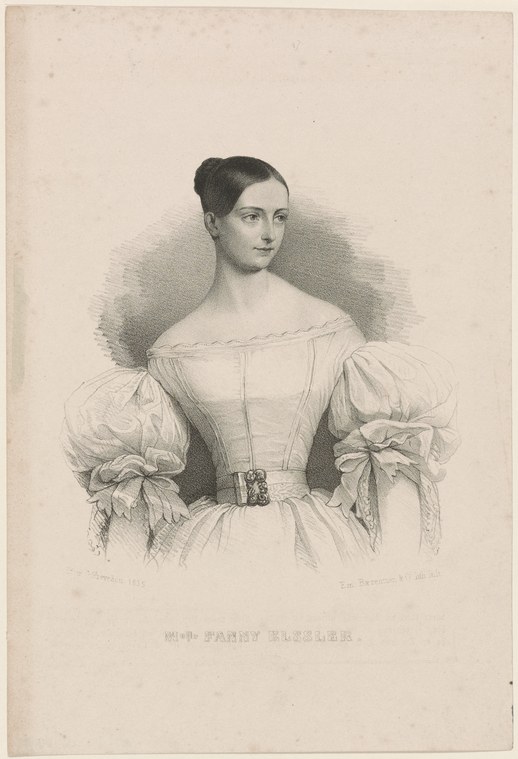
Melle. Fanny Elssler
Unknown artist
- Collection:
- Prints depicting dance
- Source:
- New York Public Library
- Rights:
- Public domain — free to use, share and adapt.
- Recorded as:
- Public Domain
Fanny Elssler was one of the two or three most famous dancers of the Romantic era, and this print is a primary document of how her image was promoted and remembered by the public. For historians of Romantic ballet, Romantic dress, and the emergence of the modern theatre star, this portrait is direct evidence of costume, grooming, and the visual language used to present a major dancer to an admiring public.
What you are looking at
A three-quarter-length portrait of a young woman shown from the waist up, rendered in fine engraving or lithograph. She is dressed in an off-shoulder gown with voluminous puffed sleeves gathered at the cuffs, a fitted bodice with a broad belt, and a full skirt with delicate pleating at the hem. Her dark hair is swept back from her face in the style of the 1830s–40s, and her complexion is pale and refined. The background is rendered in soft, atmospheric shading that creates depth behind the figure. The woman's posture is upright and poised, her shoulders back, her gaze directed slightly to the left in the manner of theatrical or promotional portraiture. There is no action, setting, or narrative—this is a formal presentation of the subject in her professional dress.
The dancing
A single standing figure in a classical portrait pose, weight evenly distributed, arms at rest at her sides with hands just visible at the hem of the skirt. The silhouette emphasizes the fashionable silhouette of the period: narrow shoulders pushed back, a pronounced waist, and broad hips created by the full skirt. The posture conveys poise and dignity rather than movement or dance position. There is no indication of a balletic stance—no turned-out legs, no weight on the balls of the feet, no lift through the torso that would suggest training in theatrical dance.
The dance depicted
This is a portrait of the dancer Fanny Elssler, one of the most celebrated performers of the Romantic era. The inscription at the bottom confirms the subject's name. The image itself does not depict her dancing or in a moment from a choreographic work; rather, it presents her as a public figure in her stage costume—the dress a Romantic-era ballerina would have worn in performance. Elssler was renowned for her dramatic roles and naturalistic style, in contrast to the ethereal aesthetic associated with her contemporary Marie Taglioni, and this portrait reflects the elevated social status and celebrity of major theatrical dancers of her time.
How it was made
This is a fine-lined engraving or steel engraving, a reproductive print technique that allowed wide distribution of theatrical celebrity portraiture in the 19th century. The delicate parallel lines (hatching and cross-hatching) create tone and volume, with particular care given to rendering the texture of the fabric and the modeling of the face. The technique produces a black-and-white image suitable for publication in periodicals, theatrical souvenir portfolios, or sold individually to the public. Such prints were the primary means by which theatre-goers could own a permanent image of their favorite performers and were produced in significant quantities for a growing middle-class audience.
About this work
This is a formally posed portrait engraving of Fanny Elssler, the celebrated Romantic-era ballerina, presented in her stage costume of the 1830s–40s. Rather than a depiction of choreography or movement, it is a celebrity portrait—a public image of the dancer as a star. It belongs in a dance gallery as evidence of how dancers were presented to the public during the Romantic period, and how theatrical celebrity was constructed and circulated through reproductive prints. The image documents the costume, the ideal of feminine beauty and grace associated with Romantic ballet, and the status of the professional dancer in 19th-century European culture.
How to look at it
Attend to the costume: the off-shoulder neckline, the puffed sleeves, and the full skirt are all hallmarks of Romantic-era ballet dress, designed to emphasize grace, lightness, and a certain delicate femininity. The posture, though poised, is not a ballet position—the weight is not on the balls of the feet, and there is no active tension in the body that would suggest movement or training in dance technique. Instead, this is a formal, static presentation of the subject in her professional guise. The soft, atmospheric background and the refined execution of the engraving reflect the high status of the subject and the respect the medium paid to major theatrical celebrities.
The artist
The artist is not recorded in the catalogue, which is not unusual for reproductive prints of this period. Such works were often produced by engraving workshops or lithographic printing houses rather than by a single identifiable artist, and prints might circulate without clear attribution. The style and execution suggest a professional theatrical portraiture engraver working in France or England in the 1830s–40s, when demand for images of Romantic-era dancers was at its height.
The period
This portrait dates to the height of Romantic ballet in Europe, when dancers such as Fanny Elssler and Marie Taglioni achieved unprecedented celebrity and commanded major fees. Elssler was particularly celebrated for her dramatic interpretations and her tours of Europe and America. In the 1830s–40s, theatrical portraiture in engraved form was a major industry: prints of famous dancers, singers, and actors were sold to the public, commissioned by theatres, published in journals, and collected by enthusiasts. This was the age before photography; engravings and lithographs were the only means of mass-producing and distributing the image of a performer beyond those who saw them on stage.
Where it lives
This print is held in the New York Public Library's collection of prints depicting dance. It is part of a broader body of 19th-century theatrical portraiture that documents the appearance and celebrity of major performers.
Questions about this work
Was Fanny Elssler a ballerina?
Yes. Fanny Elssler (1810–1884) was one of the two greatest dancers of the Romantic era, along with Marie Taglioni. She was celebrated for her dramatic roles, her technical brilliance, and her naturalistic style. Unlike Taglioni, who embodied the ethereal, weightless ideal of the Romantic ballerina, Elssler was known for her passion, her earthy vigor, and her willingness to dance Spanish and other character dances that Taglioni avoided.
What does this portrait show about Romantic ballet costume?
The dress here is typical of Romantic-era stage wear: an off-shoulder bodice that emphasizes the shoulders and arms, a tightly corseted waist, and a full skirt that fell to the ankle or slightly below. The silhouette created an ideal of graceful, contained femininity. The soft, pale-toned fabric and the refined execution of the garment reflect the status and expense of a major theatre's costumes.
Why is this a print and not a painting?
Prints were the primary medium for circulating images of performers in the 19th century. They were cheaper to produce than paintings, could be reproduced in multiple copies, and could be sold individually to the public or published in theatrical periodicals and souvenir portfolios. A painting of a famous dancer would be a unique, expensive object; a print could reach hundreds or thousands of people.
Why does this portrait not show her dancing?
This is a celebrity portrait, not a narrative or action scene. Its purpose was to present the subject to the public in her professional guise and to circulate her image as a star. Such static, formal poses were the convention for theatrical portraiture. Action scenes or depictions of specific choreography appear in other types of prints and paintings, but celebrity portraiture typically emphasized elegance, poise, and direct presentation to the viewer.
More dance artwork





