49 works in this view — arrow keys or swipe to move between them.
Dance in Art
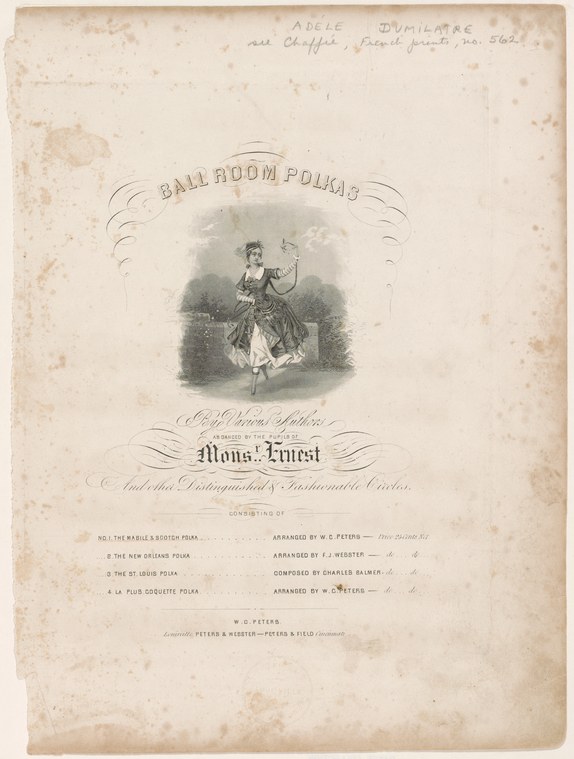
Ballroom polkas by various authors as danced by the pupils of Monsr. Ernest and other distinguished & fashionable circles
Unknown artist
- Collection:
- Prints depicting dance
- Source:
- New York Public Library
- Rights:
- Public domain — free to use, share and adapt.
- Recorded as:
- Public Domain
This work documents not just a dance style but an entire commercial and social ecosystem—the publication, teaching, and aspirational performance of ballroom dance in the 19th-century United States. The polka's rapid rise in popularity and the speed with which publishers produced instructional and performance materials reveal how quickly new dances penetrated American social life. The engraving itself demonstrates how dance was marketed and consumed as a visual commodity in the period.
What you are looking at
A decorative title page for a collection of polka dances, centered on an engraved vignette of a female dancer in mid-performance. She wears a full-skirted dress typical of mid-19th-century fashion, with her skirt caught in dynamic motion, and holds what appears to be a fan or decorative accessory. The figure is rendered in fine stippled engraving against a plain background, her pose suggesting the lively turning action characteristic of the polka. The title cartouche above reads "BALLROOM POLKAS" in ornamental lettering, with additional text below identifying the dances as "composed &c. &c. by Monsr. Ernest / And other Distinguished & Fashionable Circles." The page lists four polkas by name: the Seville Polka, the New Orleans Polka, the St. Louis Polka, and the Pure Coquette Polka, with their arrangers credited. The publication details at the base identify W.D. Pattee as the publisher and Peters & Bischer as printers in both Philadelphia and New York.
The dancing
A single female figure is shown in three-quarter view, mid-turn with considerable rotational momentum evident in her posture and the swirl of her skirt. Her upper body remains relatively upright while her lower body executes the characteristic rapid turning action of the polka. Her arms are positioned to balance the turn—one appears raised, the other lower—and she holds what may be a fan or dance accessory. The skirt, rendered with fine detail, billows outward in a way that captures the speed and liveliness of the movement. Her pose suggests she is captured at the moment of maximum rotation, a moment of peak energy rather than a static position.
The dance depicted
This is a teaching and performance collection of polka dances, a social ballroom form that was at the height of its fashionable popularity in the mid-19th century. The polka was a couple dance typically performed in 2/4 time with rapid turning and traveling steps. The image shows a solo female dancer rather than a couple, which suggests this may represent either a solo performance variant, a moment extracted from a partner dance, or a stylized representation of the polka style for promotional purposes. The attribution to "Monsr. Ernest" and "other Distinguished & Fashionable Circles" indicates these are arrangements or compositions created by and for the ballroom dancing world of the period, likely intended for piano performance at social gatherings.
How it was made
This is an engraved title page, likely hand-engraved or created through steel engraving given the fine detail and stippled shading visible throughout. The technique allows for precise rendering of the dancer's form and costume and would have enabled economical reproduction through printing, making multiple copies available for distribution. The ornamental typography and decorative cartouche are characteristic of mid-19th-century commercial music publishing. The quality of the engraving and the professional presentation suggest this was a commercial publication aimed at middle and upper-class households, where such dance instruction materials were commonly purchased.
About this work
This is a title page and advertisement for a published collection of polka compositions arranged for piano, centered on a finely engraved vignette of a female dancer performing the dance. The polka was among the most fashionable social dances of the 1840s–1860s, and collections like this served both as instruction for amateur musicians and dancers and as aspirational material for those seeking to participate in fashionable society. The image captures the polka's essential character: rapid rotation, energetic momentum, and the swirling motion of a woman's full skirt. The attribution to "Monsr. Ernest" and fashionable circles grounds the work in the real teaching and performance world of mid-19th-century ballroom dancing.
How to look at it
Notice how the engraver has captured the turning motion of the polka through the sculptor's principle of capturing a moment of peak energy: the dancer's skirt is lifted and spread by centrifugal force, her body is caught mid-rotation, and her arms are positioned to balance the movement. The technique of engraving allows fine detail in the rendering of fabric, musculature, and the nuances of the pose. The figure is shown from a three-quarter angle, which displays both her turning action and her costume to best effect—a choice that reveals how these images were meant to teach the look and feeling of the dance, not merely its steps.
The artist
The artist is not recorded. The publisher W.D. Pattee and the printer Peters & Bischer are identified. This appears to be a commercial music publishing venture typical of mid-19th-century Philadelphia and New York, where such materials were produced in quantity for a growing middle-class market.
The period
The polka emerged in Bohemia in the early 1830s and reached Paris by the mid-1830s, becoming a craze that spread across Europe and to America by the 1840s. By the time this collection was published, the polka was firmly established in the American ballroom repertoire and was a staple of dance instruction. The period saw an explosion of published dance instruction materials, music arrangements, and illustrated guides aimed at genteel households. Simultaneously, the printing trades—engraving, lithography, and letterpress—were being industrialized and refined, making illustrated publications increasingly affordable and accessible.
Where it lives
This is a commercial music publication by W.D. Pattee (publisher) and Peters & Bischer (printers), with offices in both Philadelphia and New York. The New York Public Library holds it as part of their prints collection documenting dance imagery. Such materials were typical products of the mid-19th-century music publishing trade.
Dance in this work
Questions about this work
Who was Monsr. Ernest?
The catalogue record does not identify him beyond the credit on the title page. He appears to have been a ballroom dancing master or composer working in fashionable American circles in the mid-19th century. The attribution to him and "other Distinguished & Fashionable Circles" suggests he was among a community of professional dance teachers and composers.
Why is the dancer shown alone when the polka was a couple dance?
This was common in promotional and instructional imagery of the period. Showing a solo female figure allowed the engraver to display the dance's characteristic motion and the fashionable costume in clear detail, and it made the image more suitable for a title page. Such images often represented the essence or style of a dance rather than a literal scene of social dancing.
What does the fan or object in her hand represent?
It may be a decorative fan, which was a standard accessory in fashionable female dress of the mid-19th century. Alternatively, it might be a stylized representation of a dance prop. Without additional documentation, the exact purpose cannot be determined with certainty.
More dance artwork





