49 works in this view — arrow keys or swipe to move between them.
Dance in Art
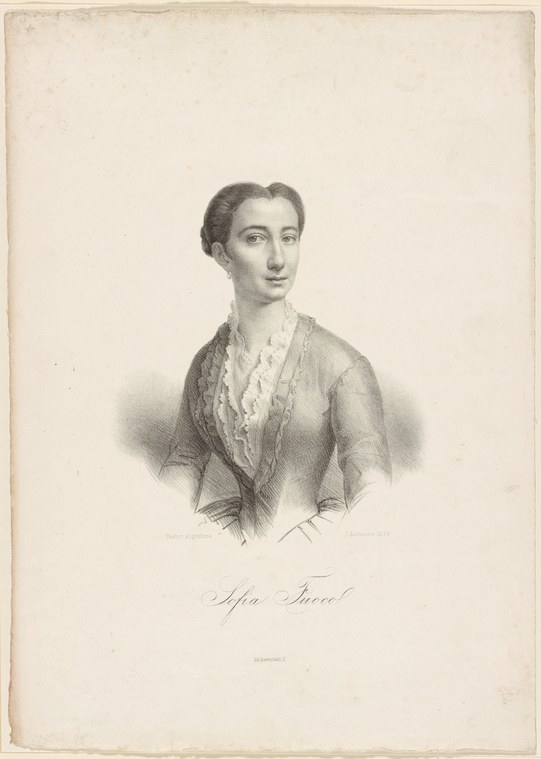
Sofia Fuoco. Teatro Argentina. l'Autunno 1852
Unknown artist
- Collection:
- Prints depicting dance
- Source:
- New York Public Library
- Rights:
- Public domain — free to use, share and adapt.
- Recorded as:
- Public Domain
Fuoco was a major international star of Romantic ballet, known for her speed, elevation, and dramatic intensity—qualities difficult to assess from a portrait alone. This print documents how her fame was circulated and packaged; the focus on her face and fashionable dress tells us that by 1852, the ballerina's star power transcended the stage and she had become a commodity for public consumption.
What you are looking at
A young woman in an elegant day dress is shown in three-quarter view against a plain background, her pose and bearing suggesting a moment of stillness or repose rather than active movement. She wears a fitted dress with short sleeves and a white lace fichu at the neckline, typical of mid-19th-century fashion. Her dark hair is pulled back smoothly, and her expression is calm and composed. The work is executed as a finely detailed lithographic portrait, with careful tonal gradation creating volume in the face and subtle shading in the fabric of her dress. The artist has captured a delicate, refined quality appropriate to a celebrated performer of the period.
The dancing
A single standing female figure, shown at roughly waist-to-head length. Her weight is evenly distributed and her posture is upright but relaxed. Her arms hang naturally at her sides, with one hand resting lightly on her lap or dress. The head is held with a gentle tilt, the chin slightly lowered, and the gaze directed toward the viewer with a direct but soft expression. There is no active dancing pose or theatrical gesture; this is a portrait of repose, not performance.
The dance depicted
Sofia Fuoco was a celebrated Italian prima ballerina of the Romantic era, renowned for her technical brilliance and dramatic presence. The inscription on this print identifies her and associates the image with Teatro Argentina in autumn 1852, when she was likely performing or appearing in Rome. However, the portrait itself shows her in street dress rather than in a ballet costume, so it documents her as a public figure and personality rather than depicting a specific role or movement. The work is a celebrity portrait—a testimonial to her fame—rather than a record of choreography or technique.
How it was made
This is a lithographic print, a process that allowed for relatively rapid production of multiple copies and wide distribution to the public. The technique shows considerable skill in rendering subtle tonal variations across the face and in capturing the texture of mid-19th-century fabric. Lithography was the dominant medium for theatrical and celebrity portraiture during this period, making such prints affordable for dance admirers and theatregoers. The quality of execution here suggests this was a professionally issued print, likely sold through theatrical venues or print shops.
About this work
This is a portrait print of the Romantic-era prima ballerina Sofia Fuoco, created around the time of her performances in Rome in 1852. Rather than depicting her dancing, it presents her as a fashionable public figure in contemporary dress, a type of celebrity portraiture that was widespread in 19th-century theatre culture. The work belongs to the visual archive of Romantic ballet not as a record of dance technique or narrative, but as evidence of how prima donnas of the period were promoted, consumed, and remembered by the public.
How to look at it
Read this as a document of theatrical fame rather than a choreographic record. The artist has chosen to present Fuoco as a cultivated, fashionable woman—the portrait equivalent of a publicity photograph. Her composed expression and elegant dress signal her status as a star accessible only through such images and rare theatrical appearances. The lithographic technique's emphasis on fine detail in the face reflects the 19th-century viewer's hunger for intimate access to performers they would otherwise see only from a distance across the footlights.
The artist
The artist is not recorded in the catalogue, though the print is professionally executed in a standardized mid-19th-century lithographic style. Attribution may be retrievable from other copies or from archival records at the source institution (NYPL). This type of theatrical portrait was a commercial genre, often produced by publishing houses or print studios in major cities, and individual artists' names were sometimes omitted.
The period
The 1850s were the height of Romantic ballet in Europe. Ballerinas like Fuoco were international celebrities, touring between major opera houses and capital cities. The cult of the prima donna was at its peak; fans collected prints and cartes de visite of their favourite dancers much as they do trading cards or social media content today. Theatre prints and celebrity portraiture formed a substantial publishing industry. At the same time, photography was emerging and would soon transform theatrical portraiture, making lithographic prints like this one a document of a transitional moment in visual culture.
Where it lives
This print is held in the New York Public Library's collection of prints depicting dance. It is an example of the commercial theatrical portraiture that was distributed to the public during the Romantic era, likely sold at the theatre or through print vendors.
Questions about this work
Who was Sofia Fuoco?
Sofia Fuoco (1830–1916) was an Italian prima ballerina of the Romantic era, famous for her technical virtuosity, speed, and dramatic presence. She danced across Europe and was one of the last prima donnas of the old Romantic tradition. She performed major roles in works by choreographers including Jules Perrot and was known for both classical and dramatic ballets.
Why is this a portrait and not a stage image?
Most surviving images of Romantic-era dancers are portraits rather than theatrical scenes, because photographing live performance was technically impossible until late in the century. Prints like this one served as the main way fans could possess an image of their favourite dancer. The portrait format also allowed the ballerina to be presented as a fashionable public figure, not just a stage character.
What does Teatro Argentina have to do with this image?
The Teatro Argentina in Rome was a major opera house, and the inscription indicates this print was issued in autumn 1852, when Fuoco was performing or appearing there. The theatre's name adds authentication and context, helping buyers know when and where the subject had been seen.
More dance artwork





