49 works in this view — arrow keys or swipe to move between them.
Dance in Art
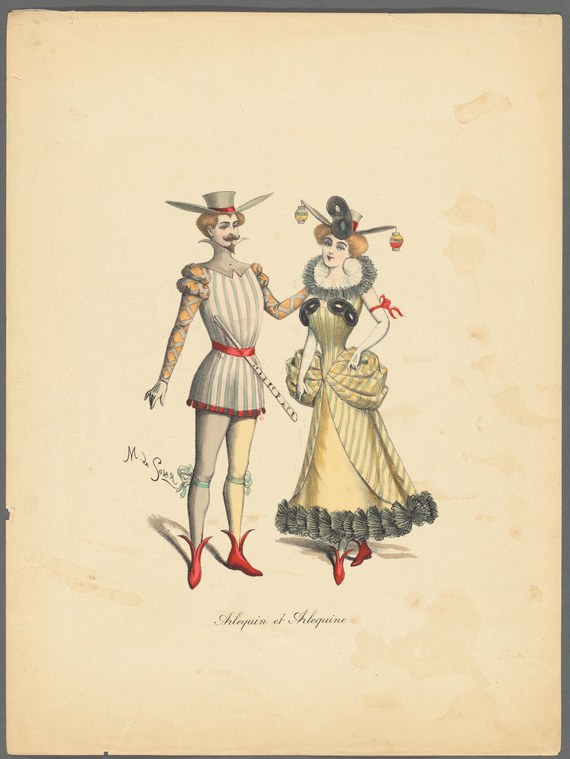
Arlequin et Arlequine
Unknown artist
- Collection:
- Prints depicting dance
- Source:
- New York Public Library
- Rights:
- Public domain — free to use, share and adapt.
- Recorded as:
- Public Domain
Commedia dell'arte shaped European theatrical movement and influenced the development of ballet technique, particularly in the handling of character and comic roles. This print provides visual evidence of how performers of the 19th century understood and presented the iconic commedia characters, showing the persistence of a performance tradition stretching back centuries. The work demonstrates the relationship between costume, character, and physical gesture—how clothing and accessories cued both performer and audience to expect a particular vocabulary of movement.
What you are looking at
Two figures in commedia dell'arte costume occupy the center of the composition against a plain cream background. On the left stands Arlequin (Harlequin) in a short tunic with vertical striping in red and cream, wearing a wide-brimmed hat with a feather, and red shoes with turned-up points. His legs are bare and he stands with one hand on his hip in a gesture of theatrical confidence. To his right is Arlequine (a female Harlequin), dressed in a long gown with cream and gold striping, a high ruffled collar, and an elaborate black feathered headdress. She wears red shoes matching his and holds a small object (possibly jewelry or a trinket) at arm's length on a thin cord, as though displaying it or tempting him with it. Both figures adopt exaggerated poses characteristic of theatrical performance—weight shifted, bodies angled toward each other, limbs extended with deliberate artifice. The artist has rendered the fabric textures with careful attention to the striping and the play of light across the costumes, using hand-coloring over what appears to be an engraved or lithographed base.
The dancing
Both dancers stand in contrapposto positions with weight shifted to one leg, creating a sense of theatrical movement even in stillness. Arlequin's torso twists slightly as he gestures with his free hand while his hip juts forward; Arlequine mirrors this dynamism from the opposite side. Their bodies form a gentle diagonal across the composition, neither in a ballroom hold nor in unison, but in a playful oppositional stance that suggests flirtation or confrontation. The extended arm of Arlequine, holding the dangling object, draws the eye and creates a focal point of interaction between them—a moment of temptation or coquetry rather than a formal dance position.
The dance depicted
This is a costume study of commedia dell'arte characters rather than a document of a specific dance technique. Arlequin and Arlequine were stock characters of the commedia tradition who appeared in pantomime and theatrical comedy across Europe from the 16th century onward, and commedia performances incorporated elaborate physical comedy, acrobatic movement, and stylized gesture. The print captures the characters in costume but does not depict a recognizable ballroom or theatrical dance form. The exaggerated poses and theatrical framing suggest the performative physical vocabulary of commedia—the art of physical comedy and character comedy rather than formal dance steps. This is a record of theatrical character and costume rather than technique.
How it was made
The work is a hand-colored print, likely a lithograph or engraving from the 19th century based on the fine linear detail and the quality of the hand-coloring. The signature visible in the lower left (appearing to read 'M.D.' or similar) indicates a known artist of the period, though the full name is not recorded. The technique of colored lithography allowed for wide distribution and made theatrical costume studies available to a mass audience—these were popular souvenirs of theatrical performances and references for actors, costume makers, and theater enthusiasts. The careful rendering of fabric patterns and the subtle use of shadow suggest a work intended for study and appreciation rather than mere ephemeral advertisement.
About this work
This is a 19th-century hand-colored theatrical print documenting the costume and character of commedia dell'arte's Arlequin and Arlequine. The work sits at the intersection of theater history, costume study, and performance documentation—it records not a dance in the ballroom sense, but the physical and sartorial language of a comedic performance tradition that influenced European theater for centuries. The image preserves both the visual spectacle of commedia costume and the exaggerated, gestural physicality that defined the tradition's approach to movement and character. For dance historians, it offers evidence of how theatrical character comedy employed the body and how performers were trained to present themselves on stage.
How to look at it
Attend to the construction of the poses: neither figure is in motion, yet both are arranged to suggest movement and playfulness through the angle of the torso, the placement of the limbs, and the direction of gaze. The artist has frozen a moment of theatrical interaction—the temptation and the response—capturing the essential dynamic of commedia performance: the interplay of will, desire, and comic deflation between characters. Notice how the costumes themselves are as much the subject as the bodies—the precise rendering of striping and texture tells you that this is a costume study, a record of what an audience would actually see on stage.
The artist
The artist is not recorded in the catalogue, though the signature suggests a professional theater illustrator or lithographer working in the 19th century. Artists specializing in theatrical costume prints and character studies were common in this period, serving the theater industry, the publishing trade, and the educated public's appetite for theatrical imagery. The work's technical competence and the care taken with costume detail suggest an artist familiar with stage practice.
The period
Commedia dell'arte had declined as a living performance tradition by the 18th century but persisted in popular memory and continued to influence theatrical practice, particularly in pantomime and comic opera. The 19th century saw a revival of interest in commedia as a historical and cultural phenomenon, with theaters occasionally reviving commedia characters and scenarios. Simultaneously, lithography had made theatrical prints widely affordable and collectable, and the documentation of theatrical costume and character became a standard artistic practice. Romantic-era ballet was also incorporating commedia elements—Harlequin figures appeared in ballets, and the exaggerated characterization of commedia influenced how dancers approached comic and character roles.
Where it lives
The work comes from the New York Public Library's collection of prints depicting dance, where it is catalogued as a theatrical costume study. It is part of a broader documentary tradition of theater prints that served as both performance records and costume references for the theater industry.
Questions about this work
Is this a ballet?
No. This is a commedia dell'arte character study. Commedia was a form of improvisational comedy and pantomime that influenced theater and later ballet, but this image documents a comedic performance tradition rather than a dance form with codified steps and technique.
Who are Arlequin and Arlequine?
Arlequin (Harlequin) is one of the most famous stock characters of commedia dell'arte, a servant character known for acrobatic movement, comic business, and witty repartee. Arlequine is the female equivalent. Both characters appear throughout European theater from the 16th century onward, and their costumes—particularly the distinctive diamond-patterned tunic—became iconic symbols of theatrical comedy.
What does the object she is holding mean?
The dangling object appears to be jewelry or a trinket—a prop used to create a moment of temptation or flirtation between the characters. In commedia, such objects often became the focus of comic business: one character tempts another, withholds or offers the object, and the interaction becomes the core of the scene.
Why is this in a dance collection?
Commedia dell'arte influenced the development of ballet and theatrical dance, particularly in character and comic roles. The physical vocabulary and exaggerated gesture of commedia performers shaped how dancers were trained to move, and commedia characters appeared frequently in ballets. This print documents a performance tradition that is ancestral to modern dance and theater.
More dance artwork





