49 works in this view — arrow keys or swipe to move between them.
Dance in Art
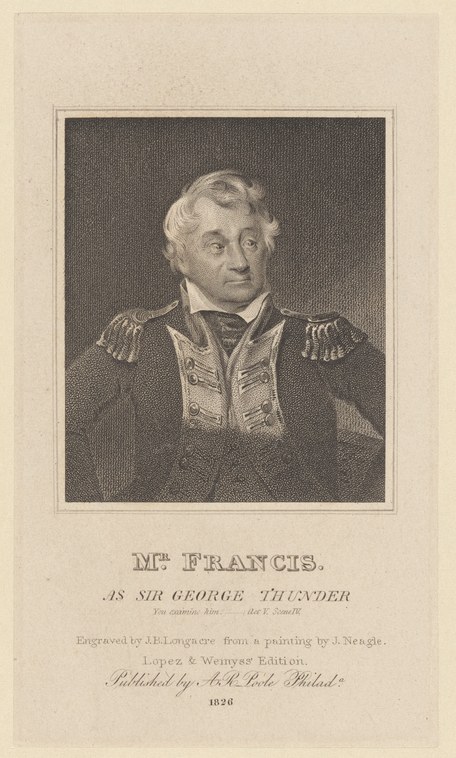
Mr. Francis as Sir George Thunder
Unknown artist
- Collection:
- Prints depicting dance
- Source:
- New York Public Library
- Rights:
- Public domain — free to use, share and adapt.
- Recorded as:
- Public Domain
Although this work does not depict dance, it is significant for its documentation of theatrical costume and male character portraiture from the early 19th century, a period when theatrical spectacle and character acting were undergoing rapid change. For historians of performance and dress, it provides concrete visual evidence of how stage characters were costumed and presented to the public through the medium of print.
What you are looking at
A three-quarter-length portrait of a man in early 19th-century military dress, shown against a dark background. He wears a dark coat with ornate gold epaulettes on both shoulders, a high collar, and a decorated chest plate or gorget with intricate embroidery or metalwork. His white hair is styled in the fashion of the period, swept back from his forehead. The man's expression is stern and composed, his gaze directed slightly away from the viewer. The engraving is rendered in fine cross-hatching that creates subtle modeling of his face and the texture of his uniform. A cartouche below identifies him as "Mr. Francis as Sir George Thunder."
The dancing
A single standing figure, depicted from approximately the waist up in a formal, stationary pose. The shoulders are squared, the neck extended, the head held with military bearing. No dance posture is evident—this is a portrait of repose, not movement. The arms are not visible, and there is no suggestion of the weight shifts, extension, or spatial awareness characteristic of dance imagery.
The dance depicted
This work does not depict dance. The title "Mr. Francis as Sir George Thunder" indicates a theatrical character—likely from an 18th- or early 19th-century comedy or play—portrayed by an actor named Francis in costume. While the figure is theatrical in nature (a character portrait), there is no dance action, choreography, or movement vocabulary present. The engraving documents an actor's appearance in role, not a dancer or dance event.
How it was made
This is a line engraving, a print medium created by incising fine lines into a metal plate (usually copper), which is then inked and printed. The technique is evident from the fine parallel hatching and cross-hatching used throughout to model form and create tonal gradation—particularly visible in the rendering of the face and the texture of the uniform. Line engraving was the primary medium for theatrical portraiture of this era, allowing for wide circulation and affordable reproduction of actor likenesses. The inscription and publication information ("Engraved by [artist], From a painting by J. Neagle. Lupton & Whitmore Edition. Published by A. C. Durell Whitford 1826") indicates this is a reproductive print based on a portrait painting, circulating to theater-going and collecting audiences.
About this work
This is a theatrical character portrait in the form of a line engraving, depicting an actor named Francis in the costume and makeup of Sir George Thunder, a character from early 19th-century theater. It is a historical record of theatrical dress and performance convention from the Regency or early Georgian period. While the subject is a stage actor and the figure wears theatrical costume, the work itself documents identity and character rather than movement or dance. It belongs in a holding of theater imagery, portraiture, and print culture rather than specifically in dance documentation.
How to look at it
Examine the costume details: the ornate epaulettes, decorative chest plate, and high collar are hallmarks of early 19th-century theatrical military dress, exaggerated for stage effect and visibility. Notice how the engraver has used fine cross-hatching to suggest the texture and weight of the fabric and metalwork. The formal, composed pose is characteristic of theatrical portraiture of the era—the actor presents himself in character, in a moment of stillness rather than action. The stern expression and military bearing are part of the character's identity as Sir George Thunder.
The artist
The catalogue record identifies the painter as J. Neagle and lists the engraver as (not recorded). The inscription states the print was published by A. C. Durell Whitford in 1826 as part of the Lupton & Whitmore edition. This suggests a professional theatrical portrait atelier producing likenesses of notable actors of the period for commercial distribution.
The period
This engraving dates to 1826, during the Regency and early Georgian period when theater was a major entertainment medium in Britain and America. Theatrical portraiture was a significant commercial genre, with engraved prints of famous actors circulating widely among theater patrons and print collectors. The military costume and formal bearing suggest a dramatic character, possibly from a comedy of manners or satire. The quality and finish of the engraving indicates a work intended for educated, affluent audiences.
Where it lives
This work is held in the New York Public Library's collection of prints depicting dance (possibly catalogued under performance, theater, or print culture rather than dance specifically). It appears to have been circulated as a commercial print in the Lupton & Whitmore edition of 1826.
Questions about this work
Is this an image of dance or a dancer?
No. This is a theatrical character portrait of an actor named Francis in costume as Sir George Thunder, a stage character. While the subject is theatrical, the image shows no dance movement, choreography, or dance convention. It documents the appearance of a stage actor in role, not a dancer or dance event.
What is Sir George Thunder?
Sir George Thunder is a theatrical character, likely from an 18th- or early 19th-century British play or comedy, portrayed here by an actor named Francis. The military costume suggests a comic or dramatic character type. Without access to the original play, the precise context is difficult to determine.
Who made this print?
The painter is identified as J. Neagle. The engraver's name is not recorded in the available catalogue information. The print was published by A. C. Durell Whitford in 1826 as part of the Lupton & Whitmore edition.
Why is this in a dance collection?
This print may have been catalogued in a theater or performance collection rather than specifically as dance, or it may have been included in a broader holding of theatrical and performance imagery. It does not depict dance and should be understood as a theatrical portrait and record of early 19th-century stage costume.
More dance artwork





