49 works in this view — arrow keys or swipe to move between them.
Dance in Art
Vaslav
Unknown artist
- Collection:
- Prints depicting dance
- Source:
- New York Public Library
- Rights:
- Public domain — free to use, share and adapt.
- Recorded as:
- Public Domain
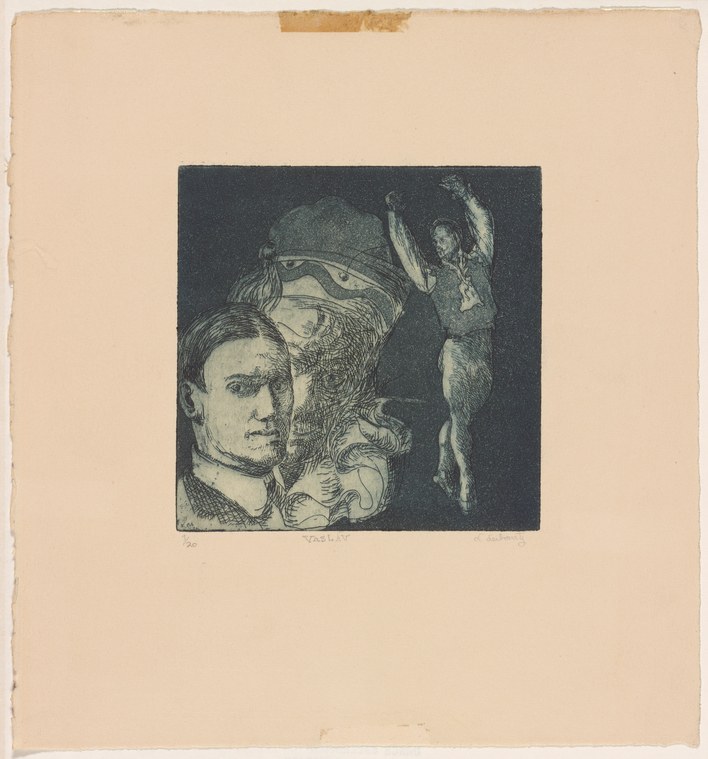
This print is significant as a document of how Vaslav Nijinsky was commemorated in visual culture—not as a performer frozen in a iconic ballet role, but as a complex psychological subject worthy of introspective portraiture. For historians of dance iconography, it reveals that even a legendary dancer's image could be mobilised for purposes other than recording his art.
What you are looking at
This is a portrait-format etching composed in dark tones, depicting multiple figures in a densely layered composition. At left, a young man with sharp features gazes directly outward, his head tilted slightly. Behind and to the right of him stands an older, bearded man wearing what appears to be a turban or wrapped headdress, rendered in heavier shadow. At top right, a nude or semi-draped figure—possibly male, possibly allegorical—appears in mid-movement or gesture, with one arm raised. The entire composition is compressed into a shallow picture plane with no clear setting; the background is undifferentiated shadow. The work has the quality of a psychological or symbolic portrait rather than a narrative scene, with the clustered figures suggesting multiple aspects or ages of a single identity, or perhaps a memento mori theme.
The dancing
Three figures occupy the composition without clear spatial relationship. The frontal young man at left is static and observational; the bearded elder behind him is passive, almost a mask or shadow of experience. The figure at top right shows active movement—raised arm and torso turned—but this figure is isolated and ethereal, suggesting it may represent something intangible rather than a participant in social dance. No couple is formed; no hold or frame exists. The bodies do not appear to be engaged in any recognisable social or theatrical dance vocabulary.
The dance depicted
This does not depict a recognisable dance. The raised arm and turned torso of the figure at top right could suggest momentary movement, but without partner positioning, floor pattern, or costume markers of a specific dance style, the gesture appears symbolic or allegorical rather than choreographic. The composition reads as a portrait study or psychological exploration rather than a representation of dance practice or performance.
How it was made
This is an intaglio print—most likely an etching given the tonal quality and the delicate line work visible in the faces and the turban. The technique allows deep blacks and fine detail, which the artist has used to create psychological density and a sense of haunting presence. The signature or initials visible at lower right suggest this is a finished work for circulation. Etchings of this scale and finish were typically printed in small editions and circulated among collectors and artists.
About this work
This is a portrait-format etching depicting three figures—a young man, an older bearded man, and a nude or semi-draped youth—arranged in a compressed, emotionally charged composition. The title 'Vaslav' suggests a connection to Vaslav Nijinsky, the legendary Russian ballet dancer, but the image does not depict theatrical dance or recognisable dance movement. Instead, it reads as a psychological or memorial portrait, possibly exploring multiple facets or life stages of a single identity. The work is held in the NYPL collection of prints depicting dance, but its presence there may reflect the identity of the subject rather than the content of the image.
How to look at it
The composition is not a record of dance but a meditation on identity and temporality. The viewer should attend to the relationship between the three figures—how the young, present face of the man at left relates to the shadowed elder behind him, and to the ethereal, possibly youthful or allegorical figure above. The raised arm of the upper figure is the only gesture toward movement in the whole composition; consider whether it represents aspiration, memory, or something departed. The enveloping shadow and lack of setting suggest an interior or psychological space rather than a stage or ballroom.
The artist
The artist is not recorded in the catalogue. The etching technique and expressive handling suggest a European modernist printmaker of the early 20th century, possibly someone within Nijinsky's social or artistic circle, but attribution cannot be established from the image alone.
The period
Nijinsky was active 1907–1917 and died in 1950. This etching is likely a memorial or biographical study created after his death or during his later years of mental illness. The psychological intensity of the portrayal and the departure from documentary dance imagery align with early 20th-century modernist portraiture, which often sought to capture inner states rather than external appearance. Nijinsky's cultural status as a revolutionary artist made him a subject of intense artistic interest beyond dance circles.
Where it lives
The work is held in the New York Public Library's collection of prints depicting dance, catalogued simply as 'Vaslav' with no date, artist, medium, or descriptive information recorded. It appears in a collection focused on dance imagery, but the criteria for its inclusion are unclear.
Questions about this work
Is this a portrait of the dancer Vaslav Nijinsky?
The title suggests a connection to Nijinsky, and the NYPL collection context supports this identification. However, the image does not depict him dancing or in theatrical costume. It appears instead to be a psychological or memorial portrait exploring multiple aspects or life stages of his identity. Without an artist attribution or documentation, the specific circumstances of the work's creation and the artist's intent remain unknown.
Why is this in a collection of dance imagery if it does not show dance?
The work is likely included because of the identity of its subject—Nijinsky—rather than because it depicts recognisable dance movement or performance. This reflects a broader curatorial choice to collect images of dancers themselves, not only images of dancing. The print may also have been intended as a memorial to Nijinsky or as part of his biography in visual form.
What is the raised arm at the top of the composition?
The figure at top right appears semi-draped or nude, and the raised arm could represent youth, aspiration, or a figure from classical or allegorical tradition. It does not correspond to any recognisable dance gesture or position. The figure may represent a memory, a spiritual presence, or an aspect of the subject's inner life rather than a literal dancer or dance partner.
More dance artwork





